Unit 9 · Topic 9.7
Polar Coordinates and Polar Derivatives
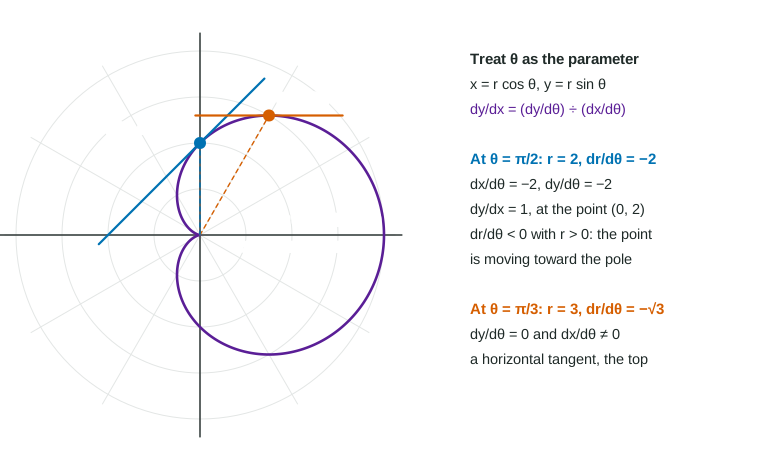
Treat r = f(θ) as the parametric curve x = rcos θ , y = rsin θ .
Practice 1: Implementing Mathematical ProcessesPractice 2: Connecting RepresentationsPractice 3: Justification
Part 1 · Hook
Why this matters
A
polar curve is drawn by a beam that turns:
goes up and the point slides along the curve. So it is a
parametric curve, with
as the parameter, and its
slope comes from the rule you already know. The new question polar adds is whether the point is moving toward the pole or away from it, and that lives in
.
Part 2 · Before you start
What this builds on
Part 3 · Prerequisite check
Quick check before you start
1. For a parametric curve , , the slope is
- , where
Show the answer
Divide the rate of change of by that of (Topic 9.1).
- Correct: , where :
- :
- :
- :
2. Which point is the polar point ?
- in and
Show the answer
and .
- Correct: :
- :
- :
- in and :
3. What is ?
Show the answer
Product rule: derivative of the first times the second, plus the first times the derivative of the second.
- Correct: :
- :
- :
- :
Part 5 · Step by step
How it works, step by step
- Write the curve as , with →it is a parametric curve with parameter
- Differentiate each with the product rule→ and
- Divide, where →the slope
- Read the signs of and together→the same sign: moving away from the pole; opposite signs: moving toward it
Part 6 · Key ideas
Key ideas
- Slope: . Horizontal tangent: with ; vertical tangent: with .
- is not the slope. It is the rate of change of the signed distance from the pole.
- Distance from the pole is . It increases when and have the same sign and decreases when they have opposite signs.
- and say whether the point moves right or left, up or down. Distance from the -axis is .
Part 7 · Misconception
A common mistake
The wrong idea: The slope of a polar curve is .
What actually happens: tells how fast the distance from the pole changes. The slope needs and : .
Part 8 · Check yourself
Check yourself
Exam-style questions. Anything you miss goes into your review queue.
1. Find the slope of the tangent line to at .
No calculator. Type the exact value (a fraction, π, e or a root is fine).
Show the answer
and . Then and , so .
- Answer: ≈ 1.732
Table
A polar curve given by a table
Values of and its derivative for a differentiable function | | |
|---|
| | |
|---|
| | |
|---|
| | |
|---|
| | |
|---|
2. At , is the point on the curve moving toward the pole or away from it, as increases?
- Away from the pole: is large
- Toward the pole: and
- Away from the pole:
- Neither: makes
Show the answer
The distance from the pole is here, and : the distance is decreasing, so the point moves toward the pole.
- Away from the pole: is large: The size of says where the point is; the sign of , with the sign of , says how the distance changes.
- Correct: Toward the pole: and : Right: a positive distance that is decreasing.
- Away from the pole: : tracks the horizontal position. The distance from the pole is , read from and .
- Neither: makes : is read from the table; it is not multiplied by .
3. At , is the point on the curve moving toward the pole or away from it, as increases?
- Away: and , so grows
- Toward: , so the value of is decreasing
- Toward: puts the point on the opposite ray
- Neither: the point is at the pole
Show the answer
The distance from the pole is . With and , is becoming more negative, so is increasing: the point moves away from the pole. The rule: increases when and have the same sign.
- Correct: Away: and , so grows: Right: and have the same sign, so the distance increases.
- Toward: , so the value of is decreasing: A negative means toward the pole when . Here , and becoming more negative moves it away.
- Toward: puts the point on the opposite ray: A negative puts the point on the opposite ray; it says nothing about how the distance is changing.
- Neither: the point is at the pole: The point is at the pole when ; here , one unit away.
4. Find the slope of the curve at .
No calculator. Type the exact value (a fraction, π, e or a root is fine).
Show the answer
and , so .
- Answer: ≈ 0.500
5. At which points does a polar curve have a horizontal tangent line?
- Where and
- Where
- Where and
- Where
Show the answer
is 0 when the numerator is 0 and the denominator is not.
- Correct: Where and : Right: the slope is 0 there.
- Where : is where the distance from the pole stops changing, such as the tip of a petal; the tangent there is perpendicular to the ray, not horizontal in general.
- Where and : That makes the slope's denominator 0: a vertical tangent.
- Where : is the pole. A curve through the pole has tangent along the ray there, horizontal only if that ray is horizontal.
6. For a polar curve , and . What does mean?
- At , the slope of the curve is
- The distance from the pole shrinks at 3 units per radian
- At , the point is moving downward at 3 units per radian
- At , the point is 3 units from the pole
Show the answer
is the rate of change of with respect to . With , a negative rate means the distance from the pole is decreasing, at 3 units per radian.
- At , the slope of the curve is : The slope is , which needs both and .
- Correct: The distance from the pole shrinks at 3 units per radian: Right: is the distance, and means it is shrinking.
- At , the point is moving downward at 3 units per radian: Moving down is the sign of , not of .
- At , the point is 3 units from the pole: The distance is ; is its rate of change.
Part 9 · Summary
Summary
Treat
as the parametric curve
,
. The product rule gives
and
; their quotient is the slope. Separately, the signs of
and
say whether the point moves toward the pole (opposite signs) or away from it (the same sign).
Part 10 · Up next
What comes next
Part 11 · Connections
Connections