Rectangular coordinates say "go units right and units up". Polar coordinates say "turn to an angle, then go a distance". The 2025 exam's polar question had the lowest average of any question that year, and the readers' advice was simple: review the precalculus first. This page is that review.
Naming a point with
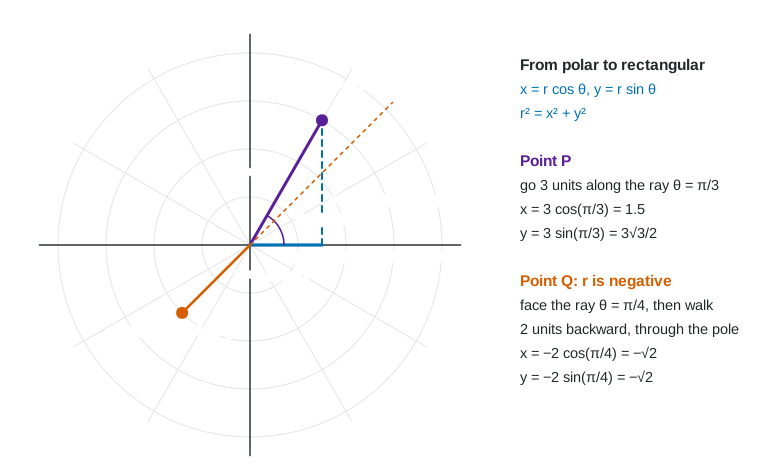
Start at the pole (the origin). The angle is measured from the positive -axis, counterclockwise, in radians. Turn to the ray at angle , then go units along it. That point is .
Two facts make polar different from rectangular:
- can be negative. Then you go units backward, through the pole, onto the opposite ray. The figure shows , which sits in the third quadrant.
- A point has many names. , and are the same point. Adding to changes nothing; adding and flipping the sign of changes nothing.
Converting between polar and rectangular
The segment from the pole to is the hypotenuse of a right triangle with legs and :
Worked example 1. Convert to rectangular, then convert to polar.
For : . The point is straight down, on the ray . So , or equally .
Do not trust alone: and have the same tangent. Always check the quadrant.
The same formulas convert equations. To rewrite , multiply by : , so , which is : a circle of radius 3 through the pole.
Plotting a polar curve from a table
A polar curve gives one distance for each angle. To sketch one, make a table, then sweep around like a lighthouse beam, marking each distance on its ray.
Worked example 2. Sketch for .
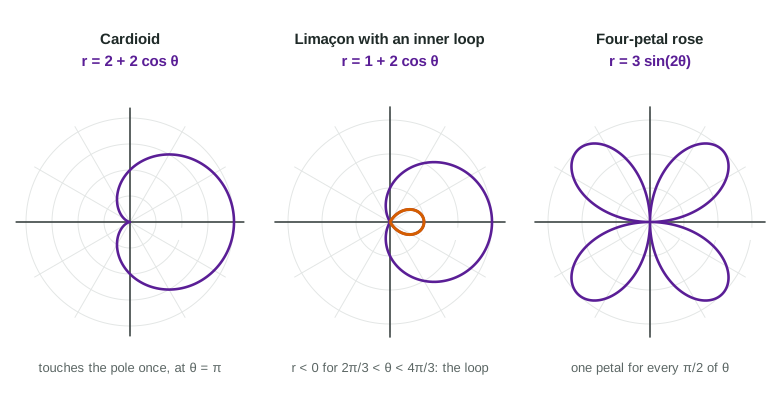
From to the distance shrinks from 3 to 0: a big arc into the pole. From to , is negative, so the rays point left but the points land on the right: a small inner loop. From to , grows back to 3 below the axis.
Two readings matter most for calculus: where (the curve passes through the pole) and where changes sign (the curve switches to the opposite ray).
Shapes to recognize
| Equation | Shape | What to read off |
|---|---|---|
| circle centered at the pole | radius | |
| line through the pole | slope | |
| , | circle through the pole | diameter , on the -axis or -axis |
| cardioid | touches the pole once | |
| , | limaçon with an inner loop | loop where |
| , | rose | petals if is odd, if is even; length |
A rose has four petals (the figure): one for each stretch of of length between zeros of . On a graphing calculator, use polar mode and radians, and set the -window to to see the whole curve.
Why calculus cares
Writing and turns a polar curve into a parametric curve with parameter . Everything from Topics 9.1 to 9.3 then applies: slopes in 9.7, and areas built from thin sectors in 9.8 and 9.9.