Motion in the plane brings together everything in Unit 9 so far: the position vector, its derivatives, its integrals and the length of a path. Every free-response question on a particle in the plane asks some mix of the same five things. This page lists them, shows the tool for each, and points out where points are usually lost.
From position to velocity, speed and distance
Start from the position vector and follow the arrows:
| Quantity | Formula | Kind of answer |
|---|---|---|
| Velocity | a vector | |
| Acceleration | a vector | |
| Speed | a number, at least 0 | |
| Displacement on | a vector | |
| Position at | a point or vector | |
| Distance traveled on | a number, at least 0 |
The table mirrors straight-line motion from Units 4 and 8, where speed was and distance . In the plane, the absolute value becomes the magnitude of a vector.
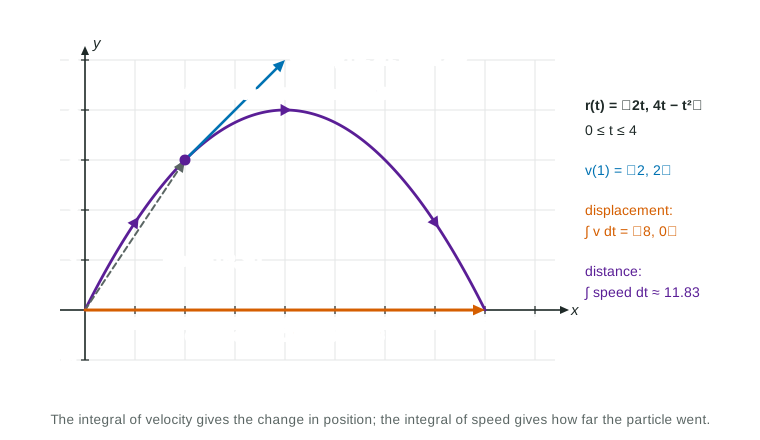
The figure shows for . At the particle is at with , so its speed is . Over the whole trip the displacement is , length 8, but the particle flies along the arch, a distance of
A calculator question, start to finish
Worked example 1. A particle moves with and for , and .
Speed at :
Position at :
Distance traveled:
Each answer shows the setup first, then the calculator value to three decimal places, with stored values and no early rounding.
A question may also give a speed and ask for the time: "when is the speed 3?" Then write the equation
Reading direction and behavior
Many points come from reading signs, and each question has its own derivative:
- "Is the particle moving left or right?" Read . "Up or down?" Read .
- "Is the -coordinate decreasing?" Read , not . A path can fall as increases () while itself is decreasing, so that rises in time.
- "Is the particle at rest?" Both components of the velocity are 0.
- "Where is the particle farthest left?" A candidates test on : compare at the endpoints and where changes sign.
Worked example 2. A particle has and for . For which is the particle moving left and down?
Left: , so .
Down:
Both: .
Two particles
With two particles, label everything with its particle (, ). Their paths cross where the curves share a point; they collide only if they are at that point at the same time. Set the -coordinates equal, solve for , and check that the -coordinates agree at that same .
Where points are lost
| Slip | Fix |
|---|---|
| Speed as or as one component | |
| Position without the initial value, or with it subtracted | |
| A missing , or limits that do not match the start | Write the full integral with its differential and the -interval |
| " is decreasing" read from | Read the sign of |
| Velocity given when acceleration is asked, or components swapped | Check which derivative, and keep the order |
| Fewer than three decimal places | Store values; round only the final answer |