In 9.4 you went from position to velocity by differentiating each component. This topic runs the other way: from a velocity vector, and a starting point, back to the position. It is the planar version of what you did for straight-line motion in 8.2, done twice, once for and once for .
Each component gets its own constant, so the constant is a vector, . Definite integrals work the same way and give a vector of numbers:
One velocity, many paths
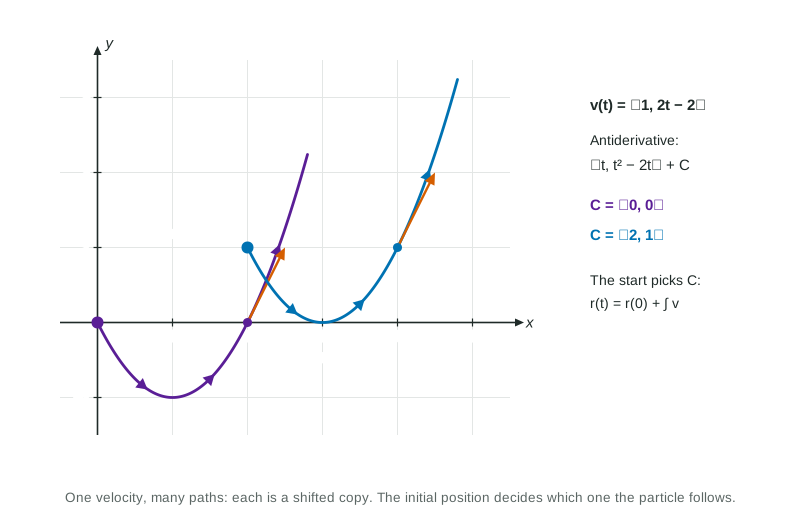
Figure 1. The same velocity from two starting points: two shifted paths. LevlPrep original diagram.
Knowing the velocity tells you how the particle moves, not where it is. The figure shows two paths with the same velocity . Both are antiderivatives, ; they differ by the constant vector, so one is the other shifted. An initial condition picks the path:
In components: and . The integral is the change in position over the interval; the start is added to it.
Worked example 1. A particle has velocity and starts at . Find and .
Antiderivatives: .
At : , so . Notice , so is , not .
and .
From acceleration: two constants
Given the acceleration vector, integrate twice. The initial velocity fixes the first constant vector and the initial position the second.
Worked example 2. , , . Find .
Velocity: .
Position: .
.
Velocity from a table
When and are known only at some times, approximate each integral with a sum, using the table's own widths, and then add the starting coordinate.
Worked example 3. A cart starts at , in feet. Its velocity components, in feet per second, are and at seconds. Approximate the cart's position at with a trapezoidal sum.
, so feet.
, so feet.
The cart is near .
What each integral means
Expression
Meaning
Change in -coordinate from to
Change in position, as a vector
The -coordinate at
Average vertical velocity on
In context, give each with its units: the integral of a velocity in meters per minute is in meters. And keep the in every integral you write: the scoring guidelines read an integral without its differential as incomplete.