Unit 9 · Topic 9.5

Integrating Vector-Valued Functions

To integrate a vector-valued function, integrate each component; an indefinite integral carries a constant vector C .

Practice 1: Implementing Mathematical ProcessesPractice 3: Justification

Part 1 · Hook

Why this matters

A ship's navigator without GPS knows where the ship started and logs its velocity east and north every hour. From those two facts alone she can say where the ship is now: start plus the accumulated change in each direction. That is dead reckoning, and it is exactly how you integrate a velocity vector.

Part 2 · Before you start

What this builds on

Part 3 · Prerequisite check

Quick check before you start

1. If dydt=6t\frac{dy}{dt} = 6t and y(0)=5y(0) = 5, then y(t)=y(t) =

  1. 3t2+53t^2 + 5
  2. 3t23t^2
  3. 6t+56t + 5
  4. 3t2−53t^2 - 5
Show the answer

Antidifferentiate, 3t2+C3t^2 + C, then y(0)=C=5y(0) = C = 5.

  • Correct: 3t2+53t^2 + 5:
  • 3t23t^2:
  • 6t+56t + 5:
  • 3t2−53t^2 - 5:

2. A particle on a line has velocity v(t)v(t) and position s(0)=2s(0) = 2. Its position at t=3t = 3 is

  1. 2+∫03v(t)dt2 + \int_0^3 v(t)\,dt
  2. ∫03v(t)dt\int_0^3 v(t)\,dt
  3. ∫03v(t)dt−2\int_0^3 v(t)\,dt - 2
  4. 2+v(3)2 + v(3)
Show the answer

Position at a time is the starting position plus the accumulated change.

  • Correct: 2+∫03v(t)dt2 + \int_0^3 v(t)\,dt:
  • ∫03v(t)dt\int_0^3 v(t)\,dt:
  • ∫03v(t)dt−2\int_0^3 v(t)\,dt - 2:
  • 2+v(3)2 + v(3):

3. If r(t)=⟨t3,4t⟩\mathbf{r}(t) = \left\langle t^3, 4t \right\rangle, then r′(t)=\mathbf{r}'(t) =

  1. ⟨3t2,4⟩\left\langle 3t^2, 4 \right\rangle
  2. ⟨3t2,4t⟩\left\langle 3t^2, 4t \right\rangle
  3. ⟨t44,2t2⟩\left\langle \frac{t^4}{4}, 2t^2 \right\rangle
  4. ⟨6t,0⟩\left\langle 6t, 0 \right\rangle
Show the answer

Differentiate each component.

  • Correct: ⟨3t2,4⟩\left\langle 3t^2, 4 \right\rangle:
  • ⟨3t2,4t⟩\left\langle 3t^2, 4t \right\rangle:
  • ⟨t44,2t2⟩\left\langle \frac{t^4}{4}, 2t^2 \right\rangle:
  • ⟨6t,0⟩\left\langle 6t, 0 \right\rangle:

Part 4 · See it

See it first

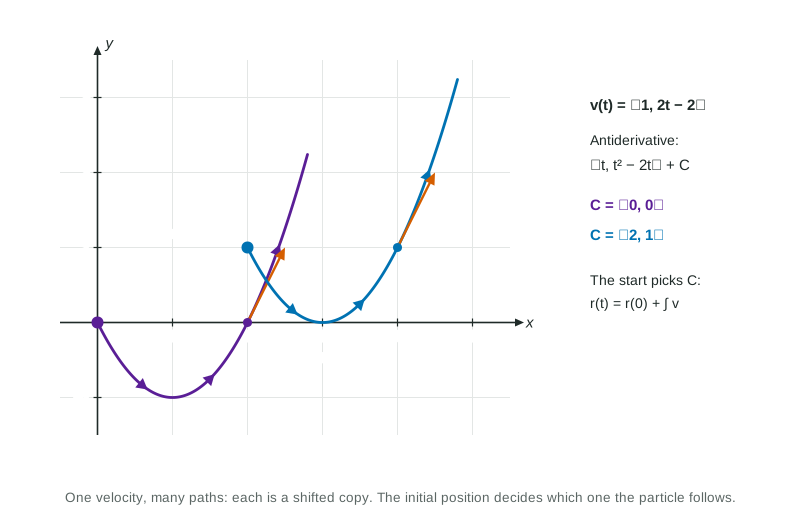
Two paths with the same velocity v(t) = 1, 2t - 2 for t from 0 to 2.8. The emerald path starts at (0, 0) and the blue path starts at (2, 1); the blue path is the emerald one shifted 2 right and 1 up. At t = 2 both carry the same vermillion velocity vector. The antiderivative of v is t, t squared minus 2t, plus a constant vector C: C = 0, 0 for the emerald path and C = 2, 1 for the blue one. The initial position picks C: r(t) = r(0) plus the integral of v.
The velocity v(t)=⟨1,2t−2⟩\mathbf{v}(t) = \left\langle 1, 2t - 2 \right\rangle has the antiderivatives ⟨t,t2−2t⟩+C\left\langle t, t^2 - 2t \right\rangle + \mathbf{C}: one path for each constant vector. The starting point, here (0,0)(0, 0) or (2,1)(2, 1), decides which path the particle follows. LevlPrep original diagram.

Part 5 · Step by step

How it works, step by step

  1. The velocity vector is ⟨x′(t),y′(t)⟩\left\langle x'(t), y'(t) \right\rangleantidifferentiate each component, adding a constant vector C=⟨C1,C2⟩\mathbf{C} = \left\langle C_1, C_2 \right\rangle
  2. An initial position r(0)\mathbf{r}(0) is knownit fixes C\mathbf{C} and picks out the one path the particle follows
  3. The integral of a rate over an interval is the net changer(b)\mathbf{r}(b)=r(a)= \mathbf{r}(a)+∫abv(t)dt+ \int_a^b \mathbf{v}(t)\,dt, one component at a time
  4. The velocity is known only from a tableapproximate each component's integral with a Riemann or trapezoidal sum, then add the start

Part 6 · Key ideas

Key ideas

  • Integrate a vector one component at a time: ∫⟨f(t),g(t)⟩dt\int \left\langle f(t), g(t) \right\rangle\,dt=⟨F(t),G(t)⟩= \left\langle F(t), G(t) \right\rangle+C+ \mathbf{C}.
  • Position from velocity always adds the start: x(b)x(b)=x(a)= x(a)+∫abx′(t)dt+ \int_a^b x'(t)\,dt and y(b)y(b)=y(a)= y(a)+∫aby′(t)dt+ \int_a^b y'(t)\,dt.
  • From acceleration, integrate twice: v(0)\mathbf{v}(0) fixes the first constant and r(0)\mathbf{r}(0) the second.
  • ∫aby′(t)dt\int_a^b y'(t)\,dt is the change in yy from t=at = a to t=bt = b, not y(b)y(b) and not a distance.

Part 7 · Misconception

A common mistake

The wrong idea: r(0)=⟨2,5⟩\mathbf{r}(0) = \left\langle 2, 5 \right\rangle and ∫03v(t)dt\int_0^3 \mathbf{v}(t)\,dt=⟨4,−1⟩= \left\langle 4, -1 \right\rangle, so r(3)\mathbf{r}(3)=⟨4,−1⟩−⟨2,5⟩= \left\langle 4, -1 \right\rangle - \left\langle 2, 5 \right\rangle=⟨2,−6⟩= \left\langle 2, -6 \right\rangle.

What actually happens: The integral is the change in position, and a change is added to where you started: r(3)\mathbf{r}(3)=⟨2,5⟩+⟨4,−1⟩= \left\langle 2, 5 \right\rangle + \left\langle 4, -1 \right\rangle=⟨6,4⟩= \left\langle 6, 4 \right\rangle. Subtracting the start, or leaving it out, is the most common lost point on this topic.

Part 8 · Check yourself

Check yourself

Exam-style questions. Anything you miss goes into your review queue.

Table

A boat's velocity components and its starting point

A remote-controlled boat moves on a lake. Its velocity components are differentiable functions of time tt, in minutes, and at t=0t = 0 the boat is at the point (3,−1)(3, -1). Distances are in meters.
Velocity components of the boat at selected times
tt (minutes)x′(t)x'(t) (meters per minute)y′(t)y'(t) (meters per minute)
004411
2266−2-2
553300
88−1-155

1. Use a trapezoidal sum with the three subintervals in the table to approximate x(8)x(8), the boat's xx-coordinate at t=8t = 8. Include units.

No calculator. Type the exact value (a fraction, π, e or a root is fine), then its unit.

Show the answer

∫08x′(t)dt\int_0^8 x'(t)\,dt≈4+62(2)\approx \frac{4 + 6}{2}(2)+6+32(3)+ \frac{6 + 3}{2}(3)+3+(−1)2(3)+ \frac{3 + (-1)}{2}(3)=10= 10+13.5+ 13.5+3+ 3=26.5= 26.5. Then x(8)x(8)=x(0)= x(0)+∫08x′(t)dt+ \int_0^8 x'(t)\,dt≈3\approx 3+26.5+ 26.5=29.5= 29.5 meters.

  • Answer: 29.5 meters

2. Use a left Riemann sum with the three subintervals in the table to approximate y(8)y(8), the boat's yy-coordinate at t=8t = 8.

No calculator. Type the exact value (a fraction, π, e or a root is fine).

Show the answer

Left sum: 1(2)+(−2)(3)+0(3)1(2) + (-2)(3) + 0(3)=−4= -4. So y(8)y(8)=y(0)= y(0)+∫08y′(t)dt+ \int_0^8 y'(t)\,dt≈−1\approx -1+(−4)+ (-4)=−5= -5 meters.

  • Answer: -5

3. What does ∫25y′(t)dt\int_2^5 y'(t)\,dt represent?

  1. The boat's yy-coordinate at t=5t = 5, in meters
  2. The change in the boat's yy-coordinate, in meters, from t=2t = 2 to t=5t = 5
  3. The boat's average vertical velocity, in meters per minute, from t=2t = 2 to t=5t = 5
  4. The distance, in meters, that the boat travels from t=2t = 2 to t=5t = 5
Show the answer

The integral of a rate over an interval is the net change of the quantity: ∫25y′(t)dt\int_2^5 y'(t)\,dt=y(5)−y(2)= y(5) - y(2), in meters.

  • The boat's yy-coordinate at t=5t = 5, in meters: To get y(5)y(5) you would add a known value, such as y(2)y(2), to the change.
  • Correct: The change in the boat's yy-coordinate, in meters, from t=2t = 2 to t=5t = 5: Right: y(5)−y(2)y(5) - y(2).
  • The boat's average vertical velocity, in meters per minute, from t=2t = 2 to t=5t = 5: An average would divide by 5−2=35 - 2 = 3 minutes.
  • The distance, in meters, that the boat travels from t=2t = 2 to t=5t = 5: Distance along the path uses the speed (x′)2+(y′)2\sqrt{(x')^2 + (y')^2}, not y′y' alone.

4. Using one trapezoid on [0,2][0, 2] for each component, which point best approximates the boat's position at t=2t = 2?

  1. (10,−1)(10, -1)
  2. (7,0)(7, 0)
  3. (13,−2)(13, -2)
  4. (11,1)(11, 1)
Show the answer

x(2)x(2)≈3+4+62(2)\approx 3 + \frac{4 + 6}{2}(2)=13= 13 and y(2)y(2)≈−1+1+(−2)2(2)\approx -1 + \frac{1 + (-2)}{2}(2)=−2= -2.

  • (10,−1)(10, -1): These are the changes in xx and yy; add the starting point (3,−1)(3, -1).
  • (7,0)(7, 0): This subtracts the starting point from the changes; the start is added.
  • Correct: (13,−2)(13, -2): Right: start plus the trapezoid approximation of each change.
  • (11,1)(11, 1): This uses the left-end rates only, 4(2)4(2) and 1(2)1(2); a trapezoid averages both ends.

5. A particle has velocity v(t)=⟨6t2,cos⁡t⟩\mathbf{v}(t) = \left\langle 6t^2, \cos t \right\rangle and r(0)=⟨1,2⟩\mathbf{r}(0) = \left\langle 1, 2 \right\rangle. Find x(t)x(t).

Type an expression for x(t)=x(t) =.

Show the answer

x(t)x(t)=x(0)= x(0)+∫0t6s2ds+ \int_0^t 6s^2\,ds=1= 1+2t3+ 2t^3. (Likewise y(t)=2+sin⁡ty(t) = 2 + \sin t.)

  • Answer: x(t)=x(t) = 2t3+12t^{3} + 1

6. Find ∫⟨e2t,1t⟩dt\int \left\langle e^{2t}, \frac{1}{t} \right\rangle\,dt.

  1. ⟨2e2t,−1t2⟩+C\left\langle 2e^{2t}, -\frac{1}{t^2} \right\rangle + \mathbf{C}
  2. ⟨12e2t,ln⁡|t|⟩+C\left\langle \frac{1}{2}e^{2t}, \ln|t| \right\rangle + \mathbf{C}
  3. ⟨e2t,ln⁡|t|⟩+C\left\langle e^{2t}, \ln|t| \right\rangle + \mathbf{C}
  4. ⟨12e2t,−1t2⟩+C\left\langle \frac{1}{2}e^{2t}, -\frac{1}{t^2} \right\rangle + \mathbf{C}
Show the answer

Antidifferentiate each component: ∫e2tdt=12e2t\int e^{2t}\,dt = \frac{1}{2}e^{2t} and ∫1tdt=ln⁡|t|\int \frac{1}{t}\,dt = \ln|t|. The constant is a vector C=⟨C1,C2⟩\mathbf{C} = \left\langle C_1, C_2 \right\rangle, one constant per component.

  • ⟨2e2t,−1t2⟩+C\left\langle 2e^{2t}, -\frac{1}{t^2} \right\rangle + \mathbf{C}: These are derivatives of the components; the integral reverses differentiation.
  • Correct: ⟨12e2t,ln⁡|t|⟩+C\left\langle \frac{1}{2}e^{2t}, \ln|t| \right\rangle + \mathbf{C}: Right: one antiderivative per component, plus a constant vector.
  • ⟨e2t,ln⁡|t|⟩+C\left\langle e^{2t}, \ln|t| \right\rangle + \mathbf{C}: Differentiating e2te^{2t} gives 2e2t2e^{2t}, so the antiderivative needs the factor 12\frac{1}{2}.
  • ⟨12e2t,−1t2⟩+C\left\langle \frac{1}{2}e^{2t}, -\frac{1}{t^2} \right\rangle + \mathbf{C}: −1t2-\frac{1}{t^2} is the derivative of 1t\frac{1}{t}; its antiderivative is ln⁡|t|\ln|t|.

7. A particle starts at r(0)=⟨1,1⟩\mathbf{r}(0) = \left\langle 1, 1 \right\rangle, and ∫04v(t)dt\int_0^4 \mathbf{v}(t)\,dt=⟨5,−2⟩= \left\langle 5, -2 \right\rangle. Where is the particle at t=4t = 4?

  1. ⟨5,−2⟩\left\langle 5, -2 \right\rangle
  2. ⟨6,−1⟩\left\langle 6, -1 \right\rangle
  3. ⟨4,−3⟩\left\langle 4, -3 \right\rangle
  4. ⟨1,1⟩\left\langle 1, 1 \right\rangle
Show the answer

The integral of velocity is the change in position: r(4)\mathbf{r}(4)=r(0)= \mathbf{r}(0)+∫04v(t)dt+ \int_0^4 \mathbf{v}(t)\,dt=⟨1+5,1−2⟩= \left\langle 1 + 5, 1 - 2 \right\rangle=⟨6,−1⟩= \left\langle 6, -1 \right\rangle.

  • ⟨5,−2⟩\left\langle 5, -2 \right\rangle: That is the change in position from t=0t = 0 to t=4t = 4; add it to the start.
  • Correct: ⟨6,−1⟩\left\langle 6, -1 \right\rangle: Right: start plus change.
  • ⟨4,−3⟩\left\langle 4, -3 \right\rangle: The start is added to the change, not subtracted from it.
  • ⟨1,1⟩\left\langle 1, 1 \right\rangle: That is where the particle started; the integral says it moved.

Part 9 · Summary

Summary

To integrate a vector-valued function, integrate each component; an indefinite integral carries a constant vector C\mathbf{C}. An initial condition fixes it: the position at time bb is the starting position plus the integral of the velocity, r(b)\mathbf{r}(b)=r(a)= \mathbf{r}(a)+∫abv(t)dt+ \int_a^b \mathbf{v}(t)\,dt. From a table, approximate each component's integral with a sum, then add the start.

Part 10 · Up next

What comes next

Part 11 · Connections

Connections