Unit 9 Topic 9.4

Vector-Valued Functions and Their Derivatives

every AB topic, then series

3 min readfreeNot practiced

Parametric equations give a moving point's xx and yy separately. A vector-valued function packages them as one object, the position vector

r(t)=⟨x(t),y(t)⟩,\mathbf{r}(t) = \left\langle x(t), y(t) \right\rangle,

the arrow from the origin to the particle at time tt. Nothing new is needed to differentiate it: every rule you know works on each component. What is new is the meaning of the result, a vector that tells you both how fast and which way.

Velocity and acceleration vectors

Differentiate each component:

v(t)=r′(t)=⟨x′(t),y′(t)⟩,a(t)=v′(t)=r″(t)=⟨x″(t),y″(t)⟩.\mathbf{v}(t) = \mathbf{r}'(t) = \left\langle x'(t), y'(t) \right\rangle, \qquad \mathbf{a}(t) = \mathbf{v}'(t) = \mathbf{r}''(t) = \left\langle x''(t), y''(t) \right\rangle.

v(t)\mathbf{v}(t) is the velocity vector and a(t)\mathbf{a}(t) the acceleration vector. The rules from straight-line motion still hold, one direction at a time: x′(t)x'(t) is the horizontal velocity, y′(t)y'(t) the vertical velocity, and so on.

Worked example 1. A particle has position r(t)\mathbf{r}(t)=⟨t2−4t,sin⁡(πt)⟩= \left\langle t^2 - 4t, \sin(\pi t) \right\rangle. Find its velocity and acceleration vectors at t=1t = 1.

Velocity: v(t)\mathbf{v}(t)=⟨2t−4,πcos⁡(πt)⟩= \left\langle 2t - 4, \pi\cos(\pi t) \right\rangle (chain rule on sin⁡(πt)\sin(\pi t)), so v(1)\mathbf{v}(1)=⟨−2,πcos⁡π⟩= \left\langle -2, \pi\cos\pi \right\rangle=⟨−2,−π⟩= \left\langle -2, -\pi \right\rangle.

Acceleration: a(t)=⟨2,−π2sin⁡(πt)⟩\mathbf{a}(t) = \left\langle 2, -\pi^2\sin(\pi t) \right\rangle, so a(1)=⟨2,0⟩\mathbf{a}(1) = \left\langle 2, 0 \right\rangle.

Reading: at t=1t = 1 the particle moves left (first component negative) and down (second component negative), while its acceleration points right.

What the velocity vector shows

Draw v(t)\mathbf{v}(t) starting at the particle's position. Two facts make it useful:

  • Direction. Its slope is y′(t)x′(t)=dydx\frac{y'(t)}{x'(t)} = \frac{dy}{dx}, the slope of the tangent line from 9.1, and its signs say which way the particle moves. So the velocity vector is tangent to the path and points in the direction of motion.
  • Length. Its magnitude is the speed: ‖v(t)‖\left\| \mathbf{v}(t) \right\|=(x′(t))2+(y′(t))2= \sqrt{(x'(t))^2 + (y'(t))^2}. In worked example 1 the speed at t=1t = 1 is 4+π2≈3.724\sqrt{4 + \pi^2} \approx 3.724.
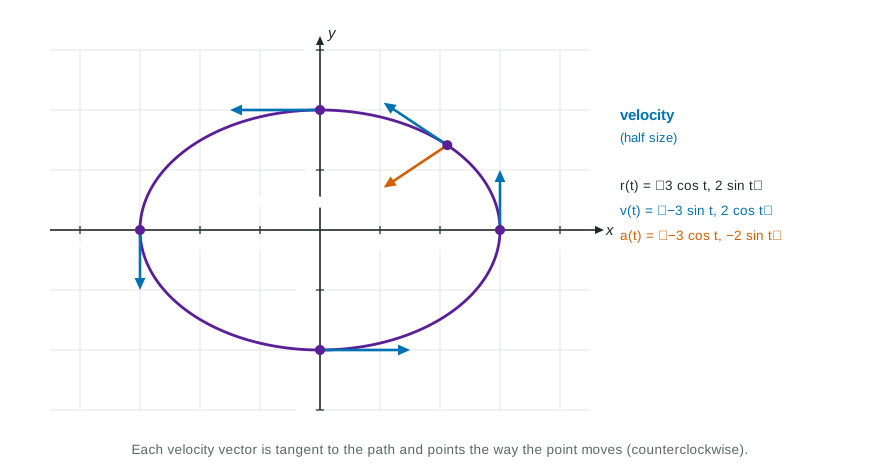
The ellipse r(t) = 3 cos t, 2 sin t, traced counterclockwise. Blue velocity vectors, drawn at half size, start at the points where t = 0, pi/4, pi/2, pi and 3 pi/2; each is tangent to the ellipse and points counterclockwise: straight up at t = 0, straight left at t = pi/2. At t = pi/4 a vermillion acceleration vector, also half size, points from the particle toward the center. The formulas are r(t) = 3 cos t, 2 sin t; v(t) = -3 sin t, 2 cos t; a(t) = -3 cos t, -2 sin t.
Figure 1. Velocity vectors are tangent to the path; this acceleration vector points into the bend. LevlPrep original diagram.

The figure shows r(t)=⟨3cos⁡t,2sin⁡t⟩\mathbf{r}(t) = \left\langle 3\cos t, 2\sin t \right\rangle. At t=0t = 0 the particle is at (3,0)(3, 0) and v(0)=⟨0,2⟩\mathbf{v}(0) = \left\langle 0, 2 \right\rangle points straight up, along the vertical tangent. At t=π2t = \frac{\pi}{2} it is at (0,2)(0, 2) and v=⟨−3,0⟩\mathbf{v} = \left\langle -3, 0 \right\rangle points straight left. Here a(t)=−r(t)\mathbf{a}(t) = -\mathbf{r}(t), so the acceleration always points from the particle back toward the center: it bends the path.

Special cases follow from the components:

Velocity at t0t_0Meaning
⟨0,b⟩\left\langle 0, b \right\rangle, b≠0b \ne 0Moving straight up or down: vertical tangent
⟨a,0⟩\left\langle a, 0 \right\rangle, a≠0a \ne 0Moving straight across: horizontal tangent
⟨0,0⟩\left\langle 0, 0 \right\rangleAt rest for an instant; the path may have a sharp point there

Velocity from a table

When positions are known only at some times, estimate each component of the velocity with a difference quotient, as in 2.3.

Worked example 2. A boat's position, in kilometers, is ⟨1,2⟩\left\langle 1, 2 \right\rangle at t=1t = 1 hour and ⟨9,−4⟩\left\langle 9, -4 \right\rangle at t=3t = 3 hours. Estimate its velocity vector and speed at t=2t = 2.

Each component over [1,3][1, 3]: 9−12=4\frac{9 - 1}{2} = 4 and −4−22=−3\frac{-4 - 2}{2} = -3. So v(2)≈⟨4,−3⟩\mathbf{v}(2) \approx \left\langle 4, -3 \right\rangle kilometers per hour.

Speed ≈42+(−3)2=5\approx \sqrt{4^2 + (-3)^2} = 5 kilometers per hour.

Common slips

SlipFix
Giving r(t0)\mathbf{r}(t_0) when the velocity is askedDifferentiate first: velocity is r′(t0)\mathbf{r}'(t_0)
Giving the velocity when the acceleration is askedAcceleration is the second derivative
Swapping the componentsKeep the order ⟨x,y⟩\left\langle x, y \right\rangle in every vector
Losing a chain rule factorddtsin⁡(kt)\frac{d}{dt}\sin(kt)=kcos⁡(kt)= k\cos(kt), ddtekt=kekt\frac{d}{dt}e^{kt} = ke^{kt}
Speed as one component, or as |dydx|\left|\frac{dy}{dx}\right|Speed is (x′(t))2+(y′(t))2\sqrt{(x'(t))^2 + (y'(t))^2}

Spot a mistake on this page?