Unit 9 Topic 9.8

Area Inside a Polar Curve

every AB topic, then series

4 min readfreeNot practiced

In rectangular coordinates, area is built from thin vertical rectangles: ∫abf(x)dx\int_a^b f(x)\,dx. A polar region fans out from the pole, so it is built from thin wedges instead. This is the topic where the most points were lost on the 2025 exam, and the losses had three causes: rr not squared, the 12\frac{1}{2} dropped, and wrong limits.

Where 12∫r2dθ\frac{1}{2}\int r^2\,d\theta comes from

A slice of a circle of radius rr with angle Δθ\Delta\theta is the fraction Δθ2π\frac{\Delta\theta}{2\pi} of the whole disk, so its area is

Δθ2π⋅πr2=12r2Δθ.\frac{\Delta\theta}{2\pi} \cdot \pi r^2 = \frac{1}{2}r^2\,\Delta\theta.

Now take the region swept by the radius to r=f(θ)r = f(\theta) as θ\theta goes from α\alpha to β\beta. Cut it into thin wedges. In each one, rr barely changes, so the wedge is nearly a slice of a circle. Add the slices and you have a Riemann sum; let Δθ→0\Delta\theta \to 0:

A=12∫αβr2dθ=12∫αβ(f(θ))2dθ.A = \frac{1}{2}\int_{\alpha}^{\beta} r^2\,d\theta = \frac{1}{2}\int_{\alpha}^{\beta} \left(f(\theta)\right)^2\,d\theta.

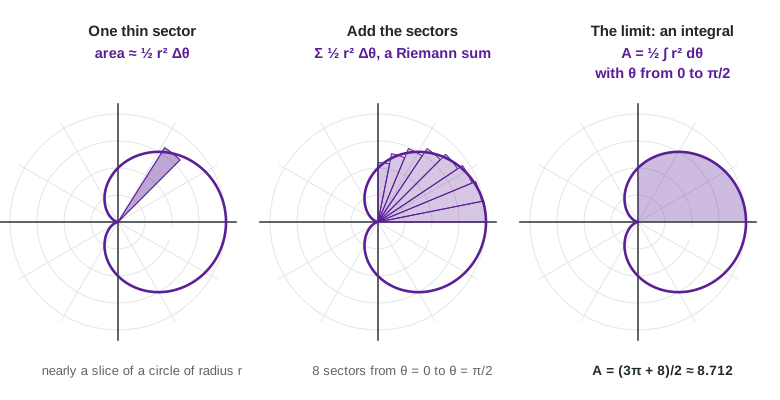
Three copies of the cardioid r = 2 + 2 cos θ. Left: one thin wedge of angle Δθ near θ = π/4 is shaded; it is nearly a slice of a circle of radius r, with area about one half r squared Δθ. Middle: eight such wedges fill the region swept from θ = 0 to θ = π/2; adding them is a Riemann sum. Right: the exact region swept from θ = 0 to θ = π/2 is shaded; its area is one half the integral of r squared from 0 to π/2, which is (3π + 8)/2, about 8.712.
Figure 1. From one wedge, to a sum of wedges, to the integral. LevlPrep original diagram.

The figure shows the three steps on the cardioid r=2+2cos⁡θr = 2 + 2\cos\theta. Because the integrand is a square, it is never negative, so a polar area integral is never negative either.

A whole closed curve

Worked example 1. Find the area enclosed by the cardioid r=2+2cos⁡θr = 2 + 2\cos\theta.

Limits: the curve is traced once as θ\theta goes from 0 to 2π2\pi.

Setup: AA=12∫02π(2+2cos⁡θ)2dθ= \frac{1}{2}\int_0^{2\pi} (2 + 2\cos\theta)^2\,d\theta.

Expand: (2+2cos⁡θ)2(2 + 2\cos\theta)^2=4= 4+8cos⁡θ+ 8\cos\theta+4cos2⁡θ+ 4\cos^2\theta=4= 4+8cos⁡θ+ 8\cos\theta+2+ 2+2cos⁡(2θ)+ 2\cos(2\theta)=6= 6+8cos⁡θ+ 8\cos\theta+2cos⁡(2θ)+ 2\cos(2\theta).

Integrate: ∫02π(6+8cos⁡θ+2cos⁡(2θ))dθ\int_0^{2\pi} \left(6 + 8\cos\theta + 2\cos(2\theta)\right)d\theta=12π= 12\pi+0+ 0+0+ 0=12π= 12\pi.

Area: A=12⋅12π=6πA = \frac{1}{2} \cdot 12\pi = 6\pi.

The identities cos2⁡u\cos^2 u=1+cos⁡(2u)2= \frac{1 + \cos(2u)}{2} and sin2⁡u\sin^2 u=1−cos⁡(2u)2= \frac{1 - \cos(2u)}{2} do most of the work on no-calculator polar areas. Over a full period, ∫cos⁡(ku)\int \cos(ku) and ∫sin⁡(ku)\int \sin(ku) are 0.

Choosing the limits

The limits must sweep the region exactly once. Three habits help:

  • A petal or a loop starts and ends at the pole, so its limits are consecutive zeros of rr. For r=3sin⁡(2θ)r = 3\sin(2\theta), r=0r = 0 at θ=0\theta = 0 and π2\frac{\pi}{2}, so one petal is 12∫0π/29sin2⁡(2θ)dθ\frac{1}{2}\int_0^{\pi/2} 9\sin^2(2\theta)\,d\theta=9π8= \frac{9\pi}{8}.
  • A region bounded by rays uses those rays' angles: the region swept from θ=0\theta = 0 to θ=π2\theta = \frac{\pi}{2} by the cardioid is 12∫0π/2(2+2cos⁡θ)2dθ\frac{1}{2}\int_0^{\pi/2} (2 + 2\cos\theta)^2\,d\theta=3π+82= \frac{3\pi + 8}{2}.
  • Watch for retracing. The circle r=4sin⁡θr = 4\sin\theta is traced once for 0≤θ≤π0 \le \theta \le \pi. On [π,2π][\pi, 2\pi], r<0r < 0 and the same circle is drawn again, so 12∫02π\frac{1}{2}\int_0^{2\pi} gives twice the area.

Worked example 2. Find the area of the inner loop of r=1+2cos⁡θr = 1 + 2\cos\theta.

The loop is where r<0r < 0: 1+2cos⁡θ=01 + 2\cos\theta = 0 at θ=2π3\theta = \frac{2\pi}{3} and 4π3\frac{4\pi}{3}.

AA=12∫2π/34π/3(1+2cos⁡θ)2dθ= \frac{1}{2}\int_{2\pi/3}^{4\pi/3} (1 + 2\cos\theta)^2\,d\theta=12∫2π/34π/3(3+4cos⁡θ+2cos⁡(2θ))dθ= \frac{1}{2}\int_{2\pi/3}^{4\pi/3} \left(3 + 4\cos\theta + 2\cos(2\theta)\right)d\theta.

=12[3θ+4sin⁡θ+sin⁡(2θ)]2π/34π/3= \frac{1}{2}\Big[3\theta + 4\sin\theta + \sin(2\theta)\Big]_{2\pi/3}^{4\pi/3}=12(2π−43+3)= \frac{1}{2}\left(2\pi - 4\sqrt{3} + \sqrt{3}\right)=π−332= \pi - \frac{3\sqrt{3}}{2}.

Squaring makes the negative rr-values harmless: the area comes out positive.

Calculator questions and tables

On a calculator question, write the setup first, exactly as you will enter it, for example 12∫0π(1+θsin⁡θ)2dθ\frac{1}{2}\int_0^{\pi} \left(1 + \theta\sin\theta\right)^2\,d\theta≈6.904\approx 6.904, in radian mode. A bald number earns nothing. If rr is given only by a table, approximate the integral with a Riemann or trapezoidal sum of the values 12r2\frac{1}{2}r^2, not rr.

SlipFix
12∫rdθ\frac{1}{2}\int r\,d\thetasquare rr: 12∫r2dθ\frac{1}{2}\int r^2\,d\theta
∫r2dθ\int r^2\,d\thetakeep the 12\frac{1}{2}
00 to 2π2\pi for every curvefind where r=0r = 0 and check for retracing
a bald calculator valuewrite the integral, then three decimals

Spot a mistake on this page?