Unit 9 · Topic 9.8

Area Inside a Polar Curve

The area of the region bounded by r = f(θ) and the rays θ = α and θ = β is 1/2 ∫ from α to β of r² dθ , the limit of sums of thin wedges 1/2 r² Δθ .

Practice 1: Implementing Mathematical ProcessesPractice 2: Connecting Representations

Part 1 · Hook

Why this matters

Cut a pizza into very thin slices and every slice is nearly a triangle with its point at the center. Polar regions are cut the same way: thin wedges fanning out from the pole. The 2025 exam's polar question had the lowest average of the year, and the lost points were mostly here: the square on rr, the 12\frac{1}{2}, and the limits.

Part 2 · Before you start

What this builds on

Part 3 · Prerequisite check

Quick check before you start

1. What is the area of a sector of a circle of radius 3 with central angle π2\frac{\pi}{2}?

  1. 9π4\frac{9\pi}{4}
  2. 3π2\frac{3\pi}{2}
  3. 9π2\frac{9\pi}{2}
  4. 9π9\pi
Show the answer

The sector is 14\frac{1}{4} of the disk: 14⋅9π=9π4\frac{1}{4} \cdot 9\pi = \frac{9\pi}{4}, which is 12r2θ=12⋅9⋅π2\frac{1}{2}r^2\theta = \frac{1}{2} \cdot 9 \cdot \frac{\pi}{2}.

  • Correct: 9π4\frac{9\pi}{4}:
  • 3π2\frac{3\pi}{2}:
  • 9π2\frac{9\pi}{2}:
  • 9π9\pi:

2. A definite integral ∫abf(x)dx\int_a^b f(x)\,dx is the limit of

  1. Riemann sums ∑f(xi)Δx\sum f(x_i)\,\Delta x
  2. slopes of secant lines
  3. the values f(a)f(a) and f(b)f(b)
  4. averages of f(a)f(a) and f(b)f(b)
Show the answer

Thin pieces of size f(xi)Δxf(x_i)\,\Delta x, added up, as the pieces get thinner.

  • Correct: Riemann sums ∑f(xi)Δx\sum f(x_i)\,\Delta x:
  • slopes of secant lines:
  • the values f(a)f(a) and f(b)f(b):
  • averages of f(a)f(a) and f(b)f(b):

3. At which θ\theta in [0,π][0, \pi] is r=3sin⁡(2θ)r = 3\sin(2\theta) equal to 0?

  1. 00, π2\frac{\pi}{2} and π\pi
  2. π4\frac{\pi}{4} and 3π4\frac{3\pi}{4}
  3. 00 and π\pi
  4. π2\frac{\pi}{2}
Show the answer

sin⁡(2θ)=0\sin(2\theta) = 0 when 2θ2\theta is a multiple of π\pi.

  • Correct: 00, π2\frac{\pi}{2} and π\pi:
  • π4\frac{\pi}{4} and 3π4\frac{3\pi}{4}:
  • 00 and π\pi:
  • π2\frac{\pi}{2}:

Part 4 · See it

See it first

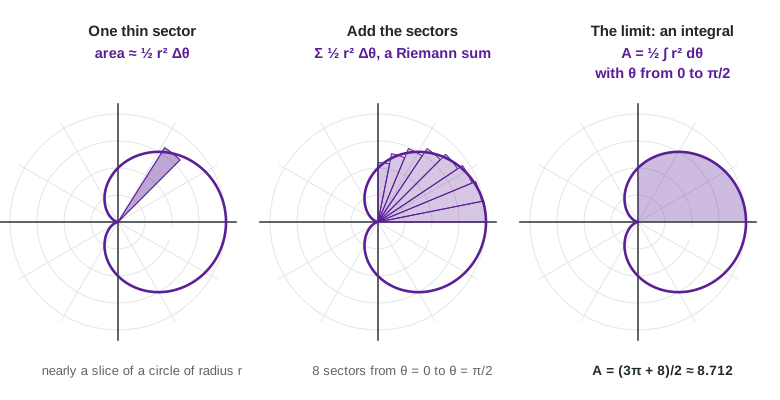
Three copies of the cardioid r = 2 + 2 cos θ. Left: one thin wedge of angle Δθ near θ = π/4 is shaded; it is nearly a slice of a circle of radius r, with area about one half r squared Δθ. Middle: eight such wedges fill the region swept from θ = 0 to θ = π/2; adding them is a Riemann sum. Right: the exact region swept from θ = 0 to θ = π/2 is shaded; its area is one half the integral of r squared from 0 to π/2, which is (3π + 8)/2, about 8.712.
One wedge has area about 12r2Δθ\frac{1}{2}r^2\,\Delta\theta; adding wedges is a Riemann sum; its limit is 12∫r2dθ\frac{1}{2}\int r^2\,d\theta. LevlPrep original diagram.

Part 5 · Step by step

How it works, step by step

  1. Cut the region into thin wedges of angle Δθ\Delta\theta from the poleeach wedge is nearly a slice of a circle of radius rr
  2. A slice of a circle has area 12r2Δθ\frac{1}{2}r^2\,\Delta\thetathe region's area is about ∑12r2Δθ\sum \frac{1}{2}r^2\,\Delta\theta, a Riemann sum
  3. Let Δθ→0\Delta\theta \to 0AA=12∫αβr2dθ= \frac{1}{2}\int_{\alpha}^{\beta} r^2\,d\theta
  4. Find α\alpha and β\beta from where r=0r = 0 or from the rays that bound the regionthe region is swept exactly once

Part 6 · Key ideas

Key ideas

  • AA=12∫αβr2dθ= \frac{1}{2}\int_{\alpha}^{\beta} r^2\,d\theta: the region bounded by r=f(θ)r = f(\theta) and the rays θ=α\theta = \alpha, θ=β\theta = \beta. Write the 12\frac{1}{2} and the square in every setup.
  • Limits: a loop or petal runs between consecutive zeros of rr. Check that the region is traced once; a circle such as r=4sin⁡θr = 4\sin\theta is traced once on [0,π][0, \pi], twice on [0,2π][0, 2\pi].
  • No calculator: expand r2r^2 and use sin2⁡u\sin^2 u=1−cos⁡(2u)2= \frac{1 - \cos(2u)}{2} and cos2⁡u\cos^2 u=1+cos⁡(2u)2= \frac{1 + \cos(2u)}{2}. Calculator: write the integral, then the value to three decimals.

Part 7 · Misconception

A common mistake

The wrong idea: The area inside r=4sin⁡θr = 4\sin\theta is 12∫02π16sin2⁡θdθ\frac{1}{2}\int_0^{2\pi} 16\sin^2\theta\,d\theta=8π= 8\pi.

What actually happens: That counts the circle twice: for π<θ<2π\pi < \theta < 2\pi, r<0r < 0 and the same circle is retraced. Over [0,π][0, \pi] the area is 4π4\pi, which matches a circle of radius 2.

Part 8 · Check yourself

Check yourself

Exam-style questions. Anything you miss goes into your review queue.

Graph

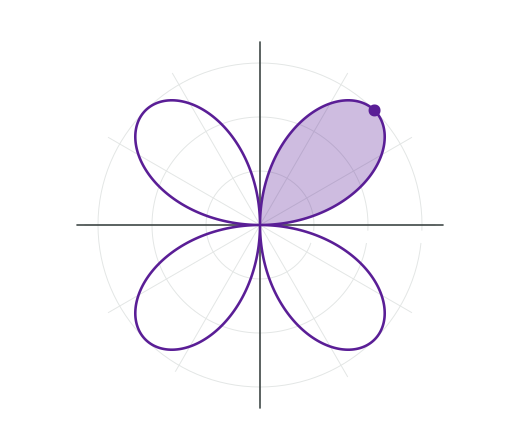
One petal of the rose r=3sin⁡(2θ)r = 3\sin(2\theta)

A polar grid with circles of radius 1, 2 and 3. The four-petal rose r = 3 sin(2θ) is drawn in emerald. The petal in the first quadrant, swept as θ runs from 0 to π/2, is shaded; it starts and ends at the pole, where r = 0, and reaches its tip, r = 3, at θ = π/4.
LevlPrep original diagram.

1. Which integral gives the area of the shaded petal?

  1. ∫0π/29sin2⁡(2θ)dθ\int_0^{\pi/2} 9\sin^2(2\theta)\,d\theta
  2. 12∫0π/29sin2⁡(2θ)dθ\frac{1}{2}\int_0^{\pi/2} 9\sin^2(2\theta)\,d\theta
  3. 12∫0π/23sin2⁡(2θ)dθ\frac{1}{2}\int_0^{\pi/2} 3\sin^2(2\theta)\,d\theta
  4. 12∫0π9sin2⁡(2θ)dθ\frac{1}{2}\int_0^{\pi} 9\sin^2(2\theta)\,d\theta
Show the answer

AA=12∫αβr2dθ= \frac{1}{2}\int_{\alpha}^{\beta} r^2\,d\theta with r2=9sin2⁡(2θ)r^2 = 9\sin^2(2\theta); the petal is traced once as θ\theta runs from 0 to π2\frac{\pi}{2}.

  • ∫0π/29sin2⁡(2θ)dθ\int_0^{\pi/2} 9\sin^2(2\theta)\,d\theta: The 12\frac{1}{2} is missing: each thin sector has area 12r2Δθ\frac{1}{2}r^2\,\Delta\theta, like a slice of a circle.
  • Correct: 12∫0π/29sin2⁡(2θ)dθ\frac{1}{2}\int_0^{\pi/2} 9\sin^2(2\theta)\,d\theta: Right: one half, rr squared, and the θ\theta-limits where the petal starts and ends at the pole.
  • 12∫0π/23sin2⁡(2θ)dθ\frac{1}{2}\int_0^{\pi/2} 3\sin^2(2\theta)\,d\theta: Square all of rr: (3sin⁡(2θ))2(3\sin(2\theta))^2=9sin2⁡(2θ)= 9\sin^2(2\theta), so the 3 is squared too.
  • 12∫0π9sin2⁡(2θ)dθ\frac{1}{2}\int_0^{\pi} 9\sin^2(2\theta)\,d\theta: From 0 to π\pi the curve traces two petals; the shaded petal ends at θ=π2\theta = \frac{\pi}{2}, where rr returns to 0.

2. Find the area of the shaded petal.

No calculator. Type the exact value (a fraction, π, e or a root is fine).

Show the answer

12∫0π/29sin2⁡(2θ)dθ\frac{1}{2}\int_0^{\pi/2} 9\sin^2(2\theta)\,d\theta=92∫0π/21−cos⁡(4θ)2dθ= \frac{9}{2}\int_0^{\pi/2} \frac{1 - \cos(4\theta)}{2}\,d\theta=94[θ−sin⁡(4θ)4]0π/2= \frac{9}{4}\left[\theta - \frac{\sin(4\theta)}{4}\right]_0^{\pi/2}=94⋅π2= \frac{9}{4} \cdot \frac{\pi}{2}=9π8= \frac{9\pi}{8}.

  • Answer: 9π8\frac{9\,\pi}{8} ≈ 3.534

3. Why are the limits of integration for the shaded petal θ=0\theta = 0 and θ=π2\theta = \frac{\pi}{2}?

  1. The petal lies in the first quadrant, which is 0≤θ≤π20 \le \theta \le \frac{\pi}{2}
  2. rr is largest at θ=π2\theta = \frac{\pi}{2}
  3. r=0r = 0 at both, so the petal starts and ends at the pole
  4. sin⁡(2θ)\sin(2\theta) has period π\pi, half of 2π2\pi
Show the answer

Solve 3sin⁡(2θ)=03\sin(2\theta) = 0: θ=0,π2,π,…\theta = 0, \frac{\pi}{2}, \pi, \ldots Between 00 and π2\frac{\pi}{2}, r>0r > 0 and the curve leaves the pole and returns to it once: one petal.

  • The petal lies in the first quadrant, which is 0≤θ≤π20 \le \theta \le \frac{\pi}{2}: True here, but it is a coincidence of this rose. Limits come from where r=0r = 0 or curves meet, found from the equation.
  • rr is largest at θ=π2\theta = \frac{\pi}{2}: r=3sin⁡π=0r = 3\sin\pi = 0 at θ=π2\theta = \frac{\pi}{2}; the tip, r=3r = 3, is at θ=π4\theta = \frac{\pi}{4}.
  • Correct: r=0r = 0 at both, so the petal starts and ends at the pole: Right: between two consecutive zeros of rr, the curve traces one petal.
  • sin⁡(2θ)\sin(2\theta) has period π\pi, half of 2π2\pi: The period of sin⁡(2θ)\sin(2\theta) is π\pi, which would give limits 0 and π\pi: two petals.

4. Find the area of the region enclosed by the circle r=4sin⁡θr = 4\sin\theta.

No calculator. Type the exact value (a fraction, π, e or a root is fine).

Show the answer

The circle is traced once for 0≤θ≤π0 \le \theta \le \pi: 12∫0π16sin2⁡θdθ\frac{1}{2}\int_0^{\pi} 16\sin^2\theta\,d\theta=8⋅π2= 8 \cdot \frac{\pi}{2}=4π= 4\pi, the area of a circle of radius 2.

  • Answer: 4π4\,\pi ≈ 12.566

5. Which expression gives the area inside the small inner loop of r=1+2cos⁡θr = 1 + 2\cos\theta?

  1. 12∫02π/3(1+2cos⁡θ)2dθ\frac{1}{2}\int_{0}^{2\pi/3} (1 + 2\cos\theta)^2\,d\theta
  2. 12∫−2π/32π/3(1+2cos⁡θ)2dθ\frac{1}{2}\int_{-2\pi/3}^{2\pi/3} (1 + 2\cos\theta)^2\,d\theta
  3. 12∫2π/34π/3(1+2cos⁡θ)2dθ\frac{1}{2}\int_{2\pi/3}^{4\pi/3} (1 + 2\cos\theta)^2\,d\theta
  4. 12∫02π(1+2cos⁡θ)2dθ\frac{1}{2}\int_{0}^{2\pi} (1 + 2\cos\theta)^2\,d\theta
Show the answer

1+2cos⁡θ=01 + 2\cos\theta = 0 at θ=2π3\theta = \frac{2\pi}{3} and 4π3\frac{4\pi}{3}. Between them r<0r < 0, and the curve traces the inner loop once; squaring rr makes the integrand positive. The area is π−332\pi - \frac{3\sqrt{3}}{2}.

  • 12∫02π/3(1+2cos⁡θ)2dθ\frac{1}{2}\int_{0}^{2\pi/3} (1 + 2\cos\theta)^2\,d\theta: From 0 to 2π3\frac{2\pi}{3} the curve traces the upper half of the big outer loop.
  • 12∫−2π/32π/3(1+2cos⁡θ)2dθ\frac{1}{2}\int_{-2\pi/3}^{2\pi/3} (1 + 2\cos\theta)^2\,d\theta: That is the whole outer loop, where r>0r > 0.
  • Correct: 12∫2π/34π/3(1+2cos⁡θ)2dθ\frac{1}{2}\int_{2\pi/3}^{4\pi/3} (1 + 2\cos\theta)^2\,d\theta: Right: r<0r < 0 between the two zeros 2π3\frac{2\pi}{3} and 4π3\frac{4\pi}{3}, and that stretch traces the inner loop.
  • 12∫02π(1+2cos⁡θ)2dθ\frac{1}{2}\int_{0}^{2\pi} (1 + 2\cos\theta)^2\,d\theta: A full turn counts the inner loop inside the outer one a second time.

6. Why does a polar area integral have 12r2\frac{1}{2}r^2 in it?

  1. A thin wedge is nearly a circle slice, of area 12r2Δθ\frac{1}{2}r^2\,\Delta\theta
  2. It is the area of a thin rectangle of height rr and width Δθ\Delta\theta
  3. It is the average of rr and r2r^2 over the interval
  4. The curve is traced twice, so the area is halved
Show the answer

A slice of a circle of radius rr with angle Δθ\Delta\theta is the fraction Δθ2π\frac{\Delta\theta}{2\pi} of the disk, so its area is Δθ2ππr2=12r2Δθ\frac{\Delta\theta}{2\pi}\pi r^2 = \frac{1}{2}r^2\,\Delta\theta. Adding slices and taking the limit gives 12∫αβr2dθ\frac{1}{2}\int_{\alpha}^{\beta} r^2\,d\theta.

  • Correct: A thin wedge is nearly a circle slice, of area 12r2Δθ\frac{1}{2}r^2\,\Delta\theta: Right: the polar area integral is the limit of these sectors' areas added up.
  • It is the area of a thin rectangle of height rr and width Δθ\Delta\theta: Polar regions are cut into wedges, not rectangles; a wedge's area grows with r2r^2.
  • It is the average of rr and r2r^2 over the interval: 12r2\frac{1}{2}r^2 is not an average; it is the slice area Δθ2π⋅πr2\frac{\Delta\theta}{2\pi} \cdot \pi r^2 per unit of Δθ\Delta\theta.
  • The curve is traced twice, so the area is halved: Some curves are traced twice over [0,2π][0, 2\pi], which is a reason to change the limits, not the source of the 12\frac{1}{2}.

Part 9 · Summary

Summary

The area of the region bounded by r=f(θ)r = f(\theta) and the rays θ=α\theta = \alpha and θ=β\theta = \beta is 12∫αβr2dθ\frac{1}{2}\int_{\alpha}^{\beta} r^2\,d\theta, the limit of sums of thin wedges 12r2Δθ\frac{1}{2}r^2\,\Delta\theta. Square rr, keep the 12\frac{1}{2}, and choose limits that sweep the region exactly once.
Part 10 · Up next

What comes next

Part 11 · Connections

Connections