Unit 9 · Topic 9.9

Area Between Two Polar Curves

For the region outside r = r(θ) and inside r = R(θ) , find the limits where the curves meet (and check the pole), decide which curve is outer, and compute 1/2 ∫ from α to β of (R² − r²)dθ .

Practice 1: Implementing Mathematical ProcessesPractice 2: Connecting Representations

Part 1 · Hook

Why this matters

A washer is a big disk with a smaller disk cut out. Areas between polar curves work the same way: a big wedge with a smaller wedge removed, thousands of times over. The hard part is not the integral but the setup: where the curves meet, and which one is outside.

Part 2 · Before you start

What this builds on

Part 3 · Prerequisite check

Quick check before you start

1. The area of the region bounded by r=f(θ)r = f(\theta) for α≤θ≤β\alpha \le \theta \le \beta is

  1. 12∫αβ(f(θ))2dθ\frac{1}{2}\int_{\alpha}^{\beta} \left(f(\theta)\right)^2 d\theta
  2. ∫αβf(θ)dθ\int_{\alpha}^{\beta} f(\theta)\,d\theta
  3. 12∫αβf(θ)dθ\frac{1}{2}\int_{\alpha}^{\beta} f(\theta)\,d\theta
  4. ∫αβ(f(θ))2dθ\int_{\alpha}^{\beta} \left(f(\theta)\right)^2 d\theta
Show the answer

Thin wedges of area 12r2Δθ\frac{1}{2}r^2\,\Delta\theta, added up (Topic 9.8).

  • Correct: 12∫αβ(f(θ))2dθ\frac{1}{2}\int_{\alpha}^{\beta} \left(f(\theta)\right)^2 d\theta:
  • ∫αβf(θ)dθ\int_{\alpha}^{\beta} f(\theta)\,d\theta:
  • 12∫αβf(θ)dθ\frac{1}{2}\int_{\alpha}^{\beta} f(\theta)\,d\theta:
  • ∫αβ(f(θ))2dθ\int_{\alpha}^{\beta} \left(f(\theta)\right)^2 d\theta:

2. The area between y=f(x)y = f(x) on top and y=g(x)y = g(x) below, for a≤x≤ba \le x \le b, is

  1. ∫ab(f(x)−g(x))dx\int_a^b \left(f(x) - g(x)\right)dx
  2. ∫ab(g(x)−f(x))dx\int_a^b \left(g(x) - f(x)\right)dx
  3. ∫abf(x)dx⋅∫abg(x)dx\int_a^b f(x)\,dx \cdot \int_a^b g(x)\,dx
  4. ∫ab(f(x)−g(x))2dx\int_a^b \left(f(x) - g(x)\right)^2 dx
Show the answer

Top minus bottom, integrated (Topic 8.4).

  • Correct: ∫ab(f(x)−g(x))dx\int_a^b \left(f(x) - g(x)\right)dx:
  • ∫ab(g(x)−f(x))dx\int_a^b \left(g(x) - f(x)\right)dx:
  • ∫abf(x)dx⋅∫abg(x)dx\int_a^b f(x)\,dx \cdot \int_a^b g(x)\,dx:
  • ∫ab(f(x)−g(x))2dx\int_a^b \left(f(x) - g(x)\right)^2 dx:

Part 4 · See it

See it first

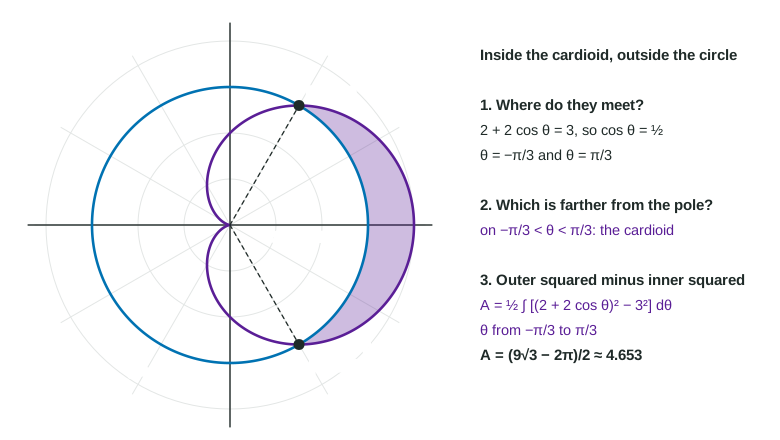
The cardioid r = 2 + 2 cos θ in emerald and the circle r = 3 in blue on a polar grid. They meet at (3, π/3) and (3, −π/3), marked with dashed rays from the pole. The region inside the cardioid and outside the circle, a crescent on the right, is shaded. A side panel gives the steps: set 2 + 2 cos θ = 3 to get θ = ±π/3; on that interval the cardioid is the outer curve; the area is one half the integral from −π/3 to π/3 of (2 + 2 cos θ) squared minus 3 squared, which is (9√3 − 2π)/2, about 4.653.
Inside r=2+2cos⁡θr = 2 + 2\cos\theta and outside r=3r = 3: meet at θ=±π3\theta = \pm\frac{\pi}{3}, outer squared minus inner squared. LevlPrep original diagram.

Part 5 · Step by step

How it works, step by step

  1. Set the two equations equal, and check where each reaches the polethe crossing angles, which become the limits
  2. Pick a θ\theta between the limits and compare the two rr-valuesyou know which curve is outer, RR, and which is inner, rr
  3. Each thin piece is a wedge of radius RR minus a wedge of radius rrits area is 12(R2−r2)Δθ\frac{1}{2}\left(R^2 - r^2\right)\Delta\theta
  4. Add the pieces and take the limitAA=12∫αβ(R2−r2)dθ= \frac{1}{2}\int_{\alpha}^{\beta} \left(R^2 - r^2\right)d\theta

Part 6 · Key ideas

Key ideas

  • AA=12∫αβ(R(θ)2−r(θ)2)dθ= \frac{1}{2}\int_{\alpha}^{\beta} \left(R(\theta)^2 - r(\theta)^2\right)d\theta, outer squared minus inner squared. Never 12∫(R−r)2dθ\frac{1}{2}\int (R - r)^2\,d\theta.
  • Limits come from where the curves meet: solve f(θ)=g(θ)f(\theta) = g(\theta), then check the pole separately, since each curve may reach it at a different angle.
  • Area arithmetic often beats a new integral: the region inside both curves is one curve's area minus the region inside it and outside the other.

Part 7 · Misconception

A common mistake

The wrong idea: The area between r=3r = 3 and r=2r = 2 for 0≤θ≤π20 \le \theta \le \frac{\pi}{2} is 12∫0π/2(3−2)2dθ\frac{1}{2}\int_0^{\pi/2} (3 - 2)^2\,d\theta=π4= \frac{\pi}{4}.

What actually happens: Subtract the wedge areas, not the radii: 12∫0π/2(32−22)dθ\frac{1}{2}\int_0^{\pi/2} \left(3^2 - 2^2\right)d\theta=5π4= \frac{5\pi}{4}, a quarter of the ring between the circles.

Part 8 · Check yourself

Check yourself

Exam-style questions. Anything you miss goes into your review queue.

Graph

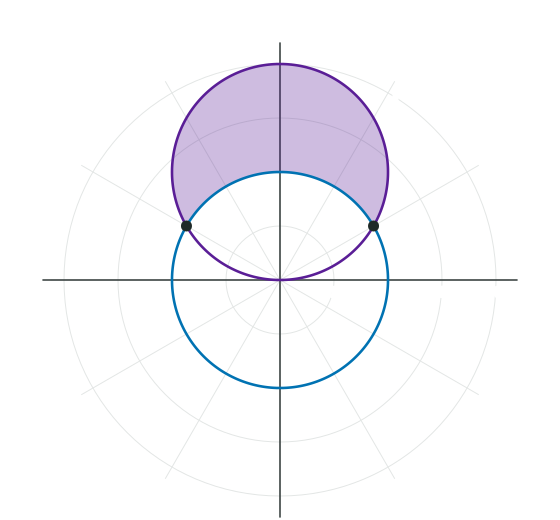
The circles r=4sin⁡θr = 4\sin\theta and r=2r = 2

On a polar grid with circles of radius 1 to 4: the circle r = 4 sin θ in emerald, of diameter 4, resting on the pole and reaching up to (0, 4), and the circle r = 2 in blue, centered at the pole. They cross at two marked points, at θ = π/6 and θ = 5π/6. The region inside r = 4 sin θ and outside r = 2, a crescent above the blue circle, is shaded.
LevlPrep original diagram.

1. At which angles do the two circles cross?

  1. θ=π3\theta = \frac{\pi}{3} and θ=2π3\theta = \frac{2\pi}{3}
  2. θ=π6\theta = \frac{\pi}{6} and θ=5π6\theta = \frac{5\pi}{6}
  3. θ=0\theta = 0 and θ=π\theta = \pi
  4. θ=π2\theta = \frac{\pi}{2} and θ=3π2\theta = \frac{3\pi}{2}
Show the answer

Set the two equations equal: 4sin⁡θ=24\sin\theta = 2, so sin⁡θ=12\sin\theta = \frac{1}{2} and θ=π6\theta = \frac{\pi}{6} or 5π6\frac{5\pi}{6}.

  • θ=π3\theta = \frac{\pi}{3} and θ=2π3\theta = \frac{2\pi}{3}: Those solve sin⁡θ=32\sin\theta = \frac{\sqrt{3}}{2}. Setting 4sin⁡θ=24\sin\theta = 2 gives sin⁡θ=12\sin\theta = \frac{1}{2}.
  • Correct: θ=π6\theta = \frac{\pi}{6} and θ=5π6\theta = \frac{5\pi}{6}: Right: 4sin⁡θ=24\sin\theta = 2 gives sin⁡θ=12\sin\theta = \frac{1}{2}.
  • θ=0\theta = 0 and θ=π\theta = \pi: There r=4sin⁡θ=0r = 4\sin\theta = 0: the pole, which is not on the circle r=2r = 2.
  • θ=π2\theta = \frac{\pi}{2} and θ=3π2\theta = \frac{3\pi}{2}: At θ=π2\theta = \frac{\pi}{2}, r=4r = 4 on one circle and 2 on the other; they do not meet there.

2. Which integral gives the area of the shaded region, inside r=4sin⁡θr = 4\sin\theta and outside r=2r = 2?

  1. 12∫π/65π/6(16sin2⁡θ−4)dθ\frac{1}{2}\int_{\pi/6}^{5\pi/6} \left(16\sin^2\theta - 4\right)d\theta
  2. 12∫π/65π/6(4sin⁡θ−2)2dθ\frac{1}{2}\int_{\pi/6}^{5\pi/6} \left(4\sin\theta - 2\right)^2 d\theta
  3. 12∫π/65π/6(4−16sin2⁡θ)dθ\frac{1}{2}\int_{\pi/6}^{5\pi/6} \left(4 - 16\sin^2\theta\right)d\theta
  4. 12∫0π(16sin2⁡θ−4)dθ\frac{1}{2}\int_{0}^{\pi} \left(16\sin^2\theta - 4\right)d\theta
Show the answer

AA=12∫αβ(R2−r2)dθ= \frac{1}{2}\int_{\alpha}^{\beta} \left(R^2 - r^2\right)d\theta with R=4sin⁡θR = 4\sin\theta (outer) and r=2r = 2 (inner), from π6\frac{\pi}{6} to 5π6\frac{5\pi}{6}.

  • Correct: 12∫π/65π/6(16sin2⁡θ−4)dθ\frac{1}{2}\int_{\pi/6}^{5\pi/6} \left(16\sin^2\theta - 4\right)d\theta: Right: outer radius squared minus inner radius squared, between the crossing angles.
  • 12∫π/65π/6(4sin⁡θ−2)2dθ\frac{1}{2}\int_{\pi/6}^{5\pi/6} \left(4\sin\theta - 2\right)^2 d\theta: Square each radius separately: the region is a big wedge minus a small wedge, 12(R2−r2)\frac{1}{2}(R^2 - r^2), not 12(R−r)2\frac{1}{2}(R - r)^2.
  • 12∫π/65π/6(4−16sin2⁡θ)dθ\frac{1}{2}\int_{\pi/6}^{5\pi/6} \left(4 - 16\sin^2\theta\right)d\theta: This subtracts the wrong way: on this interval 4sin⁡θ4\sin\theta is the outer curve. The result would be negative.
  • 12∫0π(16sin2⁡θ−4)dθ\frac{1}{2}\int_{0}^{\pi} \left(16\sin^2\theta - 4\right)d\theta: For θ\theta near 0 and π\pi, 4sin⁡θ<24\sin\theta < 2; the region is only between the crossings, π6\frac{\pi}{6} to 5π6\frac{5\pi}{6}.

3. Find the area of the shaded region.

No calculator. Type the exact value (a fraction, π, e or a root is fine).

Show the answer

16sin2⁡θ−416\sin^2\theta - 4=8−8cos⁡(2θ)−4= 8 - 8\cos(2\theta) - 4=4−8cos⁡(2θ)= 4 - 8\cos(2\theta). Then 12[4θ−4sin⁡(2θ)]π/65π/6\frac{1}{2}\Big[4\theta - 4\sin(2\theta)\Big]_{\pi/6}^{5\pi/6}=12(8π3−4(−32−32))= \frac{1}{2}\left(\frac{8\pi}{3} - 4\left(-\frac{\sqrt{3}}{2} - \frac{\sqrt{3}}{2}\right)\right)=4π3= \frac{4\pi}{3}+23+ 2\sqrt{3}.

  • Answer: 4π3+23\frac{4\,\pi}{3} + 2\,\sqrt{3} ≈ 7.653

4. Find the area of the region between the circles r=2r = 2 and r=3r = 3 for 0≤θ≤π20 \le \theta \le \frac{\pi}{2}.

No calculator. Type the exact value (a fraction, π, e or a root is fine).

Show the answer

12∫0π/2(32−22)dθ\frac{1}{2}\int_0^{\pi/2} \left(3^2 - 2^2\right)d\theta=12⋅5⋅π2= \frac{1}{2} \cdot 5 \cdot \frac{\pi}{2}=5π4= \frac{5\pi}{4}.

  • Answer: 5π4\frac{5\,\pi}{4} ≈ 3.927

5. Why is the area between an outer curve r=R(θ)r = R(\theta) and an inner curve r=r(θ)r = r(\theta) equal to 12∫(R2−r2)dθ\frac{1}{2}\int \left(R^2 - r^2\right)d\theta and not 12∫(R−r)2dθ\frac{1}{2}\int (R - r)^2\,d\theta?

  1. Squaring a difference could give a negative number
  2. (R−r)2(R - r)^2 is the same expression, multiplied out
  3. Each thin piece is a big wedge minus a small wedge: 12R2Δθ−12r2Δθ\frac{1}{2}R^2\,\Delta\theta - \frac{1}{2}r^2\,\Delta\theta
  4. 12∫(R−r)2dθ\frac{1}{2}\int (R - r)^2\,d\theta counts the inner region twice
Show the answer

In rectangular area you subtract heights, f−gf - g, because rectangles have area height times width. Polar wedges have area 12r2Δθ\frac{1}{2}r^2\,\Delta\theta, so you subtract the two wedge areas: 12(R2−r2)Δθ\frac{1}{2}\left(R^2 - r^2\right)\Delta\theta.

  • Squaring a difference could give a negative number: A square is never negative; the trouble is that (R−r)2(R - r)^2 is not the area of the piece.
  • (R−r)2(R - r)^2 is the same expression, multiplied out: (R−r)2=R2−2Rr+r2(R - r)^2 = R^2 - 2Rr + r^2, which is not R2−r2R^2 - r^2.
  • Correct: Each thin piece is a big wedge minus a small wedge: 12R2Δθ−12r2Δθ\frac{1}{2}R^2\,\Delta\theta - \frac{1}{2}r^2\,\Delta\theta: Right: subtract areas, which are already squared.
  • 12∫(R−r)2dθ\frac{1}{2}\int (R - r)^2\,d\theta counts the inner region twice: It does not count any region correctly: a band between two arcs is not a wedge of radius R−rR - r.

6. The curves r=sin⁡θr = \sin\theta and r=cos⁡θr = \cos\theta both pass through the pole, but solving sin⁡θ=cos⁡θ\sin\theta = \cos\theta gives only θ=π4\theta = \frac{\pi}{4}. Why?

  1. The pole is not a point of either curve
  2. Equal rr at equal θ\theta is the one way two curves can meet
  3. θ=5π4\theta = \frac{5\pi}{4} also solves it, at the pole
  4. They reach the pole at different angles: θ=0\theta = 0 and θ=π2\theta = \frac{\pi}{2}
Show the answer

Setting rr-values equal finds crossings reached at the same θ\theta. A point has many polar names, and the pole is r=0r = 0 at every angle, so always check where each curve reaches the pole.

  • The pole is not a point of either curve: r=sin⁡θr = \sin\theta is 0 at θ=0\theta = 0 and r=cos⁡θr = \cos\theta is 0 at θ=π2\theta = \frac{\pi}{2}: both pass through the pole.
  • Equal rr at equal θ\theta is the one way two curves can meet: That is what the equation finds, but two curves can also meet at a point named by different polar coordinates, like the pole.
  • θ=5π4\theta = \frac{5\pi}{4} also solves it, at the pole: At 5π4\frac{5\pi}{4} both rr-values are −22-\frac{\sqrt{2}}{2}: the same point as at π4\frac{\pi}{4}, not the pole.
  • Correct: They reach the pole at different angles: θ=0\theta = 0 and θ=π2\theta = \frac{\pi}{2}: Right: a crossing at the pole need not happen at the same θ\theta, so check r=0r = 0 on each curve.

Part 9 · Summary

Summary

For the region outside r=r(θ)r = r(\theta) and inside r=R(θ)r = R(\theta), find the limits where the curves meet (and check the pole), decide which curve is outer, and compute 12∫αβ(R2−r2)dθ\frac{1}{2}\int_{\alpha}^{\beta} \left(R^2 - r^2\right)d\theta. Square each radius before subtracting.
Part 10 · Up next

What comes next

Part 11 · Connections

Connections