Skills

Sequences, Sigma Notation and Factorials

An infinite sequence lists a term a_n for each n .

Practice 1: Implementing Mathematical Processes

Part 1 · Hook

Why this matters

A savings account balance listed month by month, a ball's bounce heights, the digits of π\pi to more and more places: each is a list of numbers, one for each counting number nn. Unit 10 is about adding infinitely many numbers like these, and before adding them you need to name them, find where they head, and handle the factorials that show up everywhere.

Part 2 · Before you start

What this builds on

Part 3 · Prerequisite check

Quick check before you start

1. limx→∞2x+1x−3\lim_{x \to \infty} \frac{2x + 1}{x - 3}==

  1. 22
  2. 00
  3. −13-\frac{1}{3}
  4. ∞\infty
Show the answer

Same degree on top and bottom: the ratio of the leading coefficients, 21\frac{2}{1}.

  • Correct: 22:
  • 00:
  • −13-\frac{1}{3}:
  • ∞\infty:

2. ∑i=132i=\sum_{i=1}^{3} 2i =

  1. 1212
  2. 66
  3. 22
  4. 1818
Show the answer

2+4+6=122 + 4 + 6 = 12.

  • Correct: 1212:
  • 66:
  • 22:
  • 1818:

Part 4 · See it

See it first

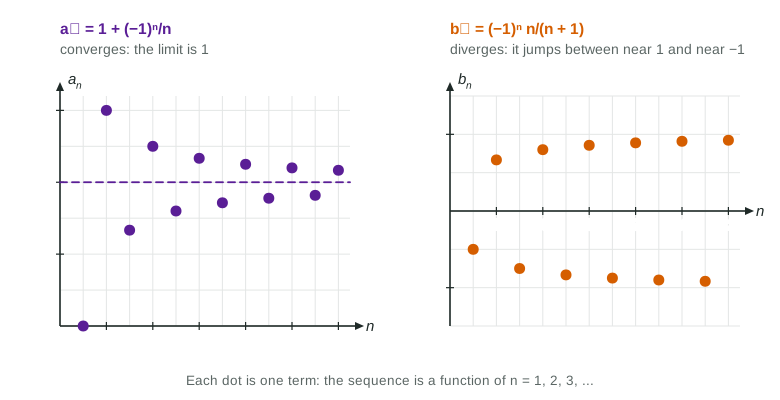
Two plots of terms against n for n = 1 to 12, one dot per term. Left: a sub n = 1 + (−1) to the n over n; the dots alternate above and below the dashed line at height 1 and close in on it, so the sequence converges to 1. Right: b sub n = (−1) to the n times n over (n + 1); the dots jump between values near 1 and near −1 and never settle, so the sequence diverges.
Left: an=1+(−1)nna_n = 1 + \frac{(-1)^n}{n} closes in on 1. Right: bn=(−1)nnn+1b_n = \frac{(-1)^n n}{n + 1} jumps between values near 1 and near −1-1. LevlPrep original diagram.

Part 5 · Step by step

How it works, step by step

  1. List one number for each n=1,2,3,…n = 1, 2, 3, \ldotsan infinite sequence a1,a2,a3,…a_1, a_2, a_3, \ldots, a function of nn
  2. Let nn grow without boundthe terms settle to one number (the sequence converges) or they do not (it diverges)
  3. Treat ana_n as f(n)f(n) for a function f(x)f(x)limn→∞an\lim_{n \to \infty} a_n comes from limx→∞f(x)\lim_{x \to \infty} f(x) when that limit exists
  4. Expand the larger factorial in a ratiothe common factorial cancels, leaving a few factors

Part 6 · Key ideas

Key ideas

  • A sequence is a function whose inputs are n=1,2,3,…n = 1, 2, 3, \ldots Its limit is found with the tools for limx→∞f(x)\lim_{x \to \infty} f(x): leading terms, L'Hospital's rule, the squeeze theorem.
  • n!=n(n−1)(n−2)⋯2⋅1n! = n(n - 1)(n - 2) \cdots 2 \cdot 1, with 0!=10! = 1. Simplify ratios by writing the larger factorial down to the smaller: (n+1)!=(n+1)n!(n + 1)! = (n + 1)\,n!.
  • Sigma notation ∑k=1mak\sum_{k=1}^{m} a_k adds the terms from k=1k = 1 to k=mk = m. Check the starting index: it decides the first term.

Part 7 · Misconception

A common mistake

The wrong idea: (2n+2)!(2n)!\frac{(2n + 2)!}{(2n)!}=2n+2= 2n + 2, since the factorials cancel.

What actually happens: Two factors sit between them: (2n+2)!(2n + 2)!=(2n+2)(2n+1)(2n)!= (2n + 2)(2n + 1)(2n)!, so the ratio is (2n+2)(2n+1)(2n + 2)(2n + 1).

Part 8 · Check yourself

Check yourself

Exam-style questions. Anything you miss goes into your review queue.

Table

The first terms of a sequence

The first four terms of a sequence ana_n, starting at n=1n = 1
nn11223344
ana_n12\frac{1}{2}23\frac{2}{3}34\frac{3}{4}45\frac{4}{5}

1. Write a formula for ana_n that fits the table.

Type an expression for an=a_n =.

Show the answer

Each numerator is nn and each denominator is one more: an=nn+1a_n = \frac{n}{n + 1}. Check: a3=34a_3 = \frac{3}{4}.

  • Answer: an=a_n = nn+1\frac{n}{n + 1}

2. Find limn→∞an\lim_{n \to \infty} a_n.

No calculator. Type the exact value (a fraction, π, e or a root is fine).

Show the answer

nn+1\frac{n}{n + 1}=11+1/n→11+0= \frac{1}{1 + 1/n} \to \frac{1}{1 + 0}=1= 1. The terms climb toward 1 but never reach it.

  • Answer: 11

3. Find a10a_{10}.

No calculator. Type the exact value (a fraction, π, e or a root is fine).

Show the answer

a10a_{10}=1010+1= \frac{10}{10 + 1}=1011= \frac{10}{11}.

  • Answer: 1011\frac{10}{11} ≈ 0.909

4. Does the sequence an=(−1)nna_n = \frac{(-1)^n}{n} converge?

  1. Yes, to 0: |an|=1n→0|a_n| = \frac{1}{n} \to 0
  2. No: its terms alternate in sign
  3. Yes, to 1: the terms close in on 1
  4. No: (−1)n(-1)^n has no limit
Show the answer

−1n≤(−1)nn≤1n-\frac{1}{n} \le \frac{(-1)^n}{n} \le \frac{1}{n} and both bounds approach 0, so by the squeeze theorem an→0a_n \to 0.

  • Correct: Yes, to 0: |an|=1n→0|a_n| = \frac{1}{n} \to 0: Right: the signs alternate, but the sizes shrink to 0, so the terms close in on 0.
  • No: its terms alternate in sign: Alternating signs do not stop convergence; the terms here approach 0 from both sides.
  • Yes, to 1: the terms close in on 1: The terms are −1,12,−13,14,…-1, \frac{1}{2}, -\frac{1}{3}, \frac{1}{4}, \ldots, which close in on 0.
  • No: (−1)n(-1)^n has no limit: (−1)n(-1)^n alone has no limit, but dividing by nn squeezes the terms to 0.

5. Simplify (2n+2)!(2n)!\frac{(2n + 2)!}{(2n)!}.

Type an expression for (2n+2)!(2n)!=\frac{(2n + 2)!}{(2n)!} =.

Show the answer

(2n+2)!(2n + 2)!=(2n+2)(2n+1)(2n)!= (2n + 2)(2n + 1)(2n)!: two factors sit between (2n)!(2n)! and (2n+2)!(2n + 2)!.

  • Answer: (2n+2)!(2n)!=\frac{(2n + 2)!}{(2n)!} = (2n+2)(2n+1)(2n + 2) (2n + 1)

6. Find ∑k=14k2\sum_{k=1}^{4} k^2.

No calculator. Type the exact value (a fraction, π, e or a root is fine).

Show the answer

1+4+9+16=301 + 4 + 9 + 16 = 30.

  • Answer: 3030

Part 9 · Summary

Summary

An infinite sequence lists a term ana_n for each nn. It converges if its terms approach one number and diverges otherwise; find the limit as for functions at infinity. Simplify factorial ratios by expanding the larger factorial, and read sigma notation from its starting index.

Part 10 · Up next

What comes next

Part 11 · Connections

Connections