Convergent and Divergent Series
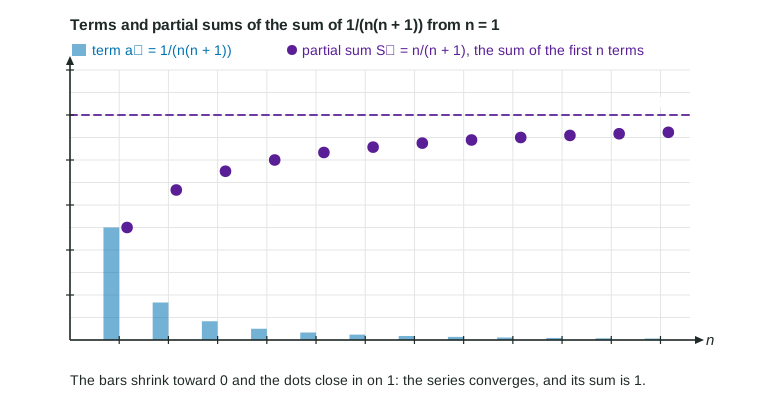
A series ∑ a_n converges to S when its partial sums S_n = a_1 + ⋯ + a_n approach S ; otherwise it diverges.
Part 1 · Hook
Why this matters
Part 2 · Before you start
What this builds on
Part 3 · Prerequisite check
Quick check before you start
1. Does the sequence converge?
- Yes, to 1
- Yes, to 0
- No: its terms keep growing
- No: it alternates
Show the answer
- Correct: Yes, to 1:
- Yes, to 0:
- No: its terms keep growing:
- No: it alternates:
2. means
- , which is 1
- nothing: the region is infinite
Show the answer
An improper integral is a limit of definite integrals; here .
- Correct: , which is 1:
- :
- :
- nothing: the region is infinite:
Part 4 · See it
See it first
Part 5 · Step by step
How it works, step by step
- Add the first terms of the partial sum
- Do this for every a new sequence,
- If , a finite numberthe series converges and its sum is
- If the partial sums grow without bound or never settlethe series diverges and has no sum
Part 6 · Key ideas
Key ideas
- An infinite series converges to exactly when its partial sums approach . Two sequences are in play: the terms and the partial sums . Keep them apart.
- From partial sums back to terms: and for .
- Say \"the series converges\" or \"the series diverges\". The terms of a convergent series approach 0, not the sum.
- Constants factor out of a convergent series; adding or removing finitely many terms changes the sum but never whether the series converges.
Part 7 · Misconception
A common mistake
The wrong idea: The terms of approach 0, so the series converges.
What actually happens: Its partial sums are , which grow without bound: the series diverges. Terms that shrink to 0 are not enough.
Part 8 · Check yourself
Check yourself
Exam-style questions. Anything you miss goes into your review queue.
Graph
Partial sums of a series
1. What is the sum of the series ?
No calculator. Type the exact value (a fraction, π, e or a root is fine).
Show the answer
The sum of a series is the limit of its partial sums:
- Answer:
2. Find , the third term of the series.
No calculator. Type the exact value (a fraction, π, e or a root is fine).
Show the answer
- Answer: ≈ 0.300
3. Which statement about this series is correct?
- The terms converge to 3, so the series converges
- The series diverges, since keeps growing as grows
- The series converges to 3, and its terms approach 0
- The series converges to 3, and its terms approach 3
Show the answer
A series converges when its partial sums have a limit; here , so the series converges, to 3. Say it about the series: \"the series converges\", not \"the terms converge to 3\".
- The terms converge to 3, so the series converges: The terms approach 0, not 3. It is the partial sums that approach 3.
- The series diverges, since keeps growing as grows: Partial sums can rise forever and still approach a limit; here they level off at 3.
- Correct: The series converges to 3, and its terms approach 0: Right: the partial sums approach 3, and
. - The series converges to 3, and its terms approach 3: If every term were near 3, the partial sums would grow by about 3 each step and never level off.
Table
A series whose partial sums jump
4. Does the series converge?
- Yes, to 0, since the even partial sums are 0
- Yes, to 1, since the first term is 1
- Yes, since each term is 1 or and so stays bounded
- No: the partial sums jump between 1 and 0
Show the answer
is 1 for odd and 0 for even . The sequence of partial sums has no limit, so the series diverges.
- Yes, to 0, since the even partial sums are 0: The odd partial sums are 1; the whole sequence of partial sums has no limit.
- Yes, to 1, since the first term is 1: The sum of a series is the limit of all its partial sums, not its first term.
- Yes, since each term is 1 or and so stays bounded: Bounded partial sums are not enough; they must approach a single number.
- Correct: No: the partial sums jump between 1 and 0: Right: a series converges when its partial sums approach one number, and these do not.
5. The partial sums of are . What does this show?
- The series converges, since its terms approach 0
- The series converges to , its first term
- The series diverges, though its terms approach 0
- The series converges to 0
Show the answer
- The series converges, since its terms approach 0: Terms approaching 0 do not make a series converge: these partial sums grow forever.
- The series converges to , its first term: is . The sum would be , which does not exist.
- Correct: The series diverges, though its terms approach 0: Right: grows without bound, while .
- The series converges to 0: The terms approach 0; the partial sums grow without bound.
6. For a series , what is the partial sum ?
- The th term,
- The sum of the first terms,
- The sum of the terms after the th one
- The limit of as
Show the answer
- The th term, : is one term; adds the first of them.
- Correct: The sum of the first terms, : Right: the series converges when these partial sums have a limit.
- The sum of the terms after the th one: That is what is left over, , when the series converges.
- The limit of as : That limit describes the terms, not the sum of the first .
Part 9 · Summary
Summary
Part 10 · Up next
What comes next
Part 11 · Connections