Unit 9 Topic 9.9

Area Between Two Polar Curves

every AB topic, then series

3 min readfreeNot practiced

Topic 9.8 found the area swept by one polar curve. Now there are two curves, and the region lies between them: inside one and outside the other. The idea is the same as the washer in a volume problem: a big piece with a small piece removed.

Outer squared minus inner squared

Cut the region into thin wedges from the pole. Each piece is a wedge of the outer curve R(θ)R(\theta) with a wedge of the inner curve r(θ)r(\theta) removed, so its area is

12R2Δθ−12r2Δθ=12(R2−r2)Δθ.\frac{1}{2}R^2\,\Delta\theta - \frac{1}{2}r^2\,\Delta\theta = \frac{1}{2}\left(R^2 - r^2\right)\Delta\theta.

Adding and taking the limit:

A=12∫αβ(R(θ)2−r(θ)2)dθ.A = \frac{1}{2}\int_{\alpha}^{\beta} \left(R(\theta)^2 - r(\theta)^2\right)d\theta.

Square each radius, then subtract. Writing 12∫(R−r)2dθ\frac{1}{2}\int (R - r)^2\,d\theta is the most common setup error in this topic: (R−r)2(R - r)^2 is not the area of anything here. For R=3R = 3 and r=2r = 2 on a quarter turn, the correct area is 12⋅(9−4)⋅π2=5π4\frac{1}{2} \cdot (9 - 4) \cdot \frac{\pi}{2} = \frac{5\pi}{4}, while the wrong one gives π4\frac{\pi}{4}.

The three-step setup

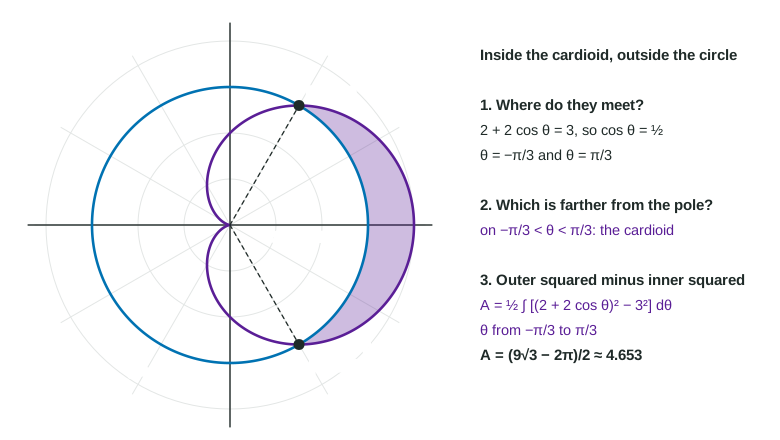
The cardioid r = 2 + 2 cos θ in emerald and the circle r = 3 in blue on a polar grid. They meet at (3, π/3) and (3, −π/3), marked with dashed rays from the pole. The region inside the cardioid and outside the circle, a crescent on the right, is shaded. A side panel gives the steps: set 2 + 2 cos θ = 3 to get θ = ±π/3; on that interval the cardioid is the outer curve; the area is one half the integral from −π/3 to π/3 of (2 + 2 cos θ) squared minus 3 squared, which is (9√3 − 2π)/2, about 4.653.
Figure 1. The region inside the cardioid r=2+2cos⁡θr = 2 + 2\cos\theta and outside the circle r=3r = 3. LevlPrep original diagram.
  1. Where do the curves meet? Set the rr-values equal and solve for θ\theta. Then check the pole on its own: each curve reaches r=0r = 0 at its own angle, and the equation will not find that crossing.
  2. Which curve is outer? Pick a test angle between the crossings and compare the two rr-values. The larger is RR.
  3. Integrate 12(R2−r2)\frac{1}{2}\left(R^2 - r^2\right) between the crossing angles.

Worked example. Find the area inside r=2+2cos⁡θr = 2 + 2\cos\theta and outside r=3r = 3 (the figure).

Step 1: 2+2cos⁡θ=32 + 2\cos\theta = 3, so cos⁡θ=12\cos\theta = \frac{1}{2} and θ=−π3\theta = -\frac{\pi}{3} or π3\frac{\pi}{3}.

Step 2: at θ=0\theta = 0, the cardioid has r=4r = 4 and the circle r=3r = 3, so the cardioid is outer.

Step 3: (2+2cos⁡θ)2−9(2 + 2\cos\theta)^2 - 9=4= 4+8cos⁡θ+ 8\cos\theta+4cos2⁡θ−9+ 4\cos^2\theta - 9=−3= -3+8cos⁡θ+ 8\cos\theta+2cos⁡(2θ)+ 2\cos(2\theta).

AA=12∫−π/3π/3(−3+8cos⁡θ+2cos⁡(2θ))dθ= \frac{1}{2}\int_{-\pi/3}^{\pi/3} \left(-3 + 8\cos\theta + 2\cos(2\theta)\right)d\theta=12[−3θ+8sin⁡θ+sin⁡(2θ)]−π/3π/3= \frac{1}{2}\Big[-3\theta + 8\sin\theta + \sin(2\theta)\Big]_{-\pi/3}^{\pi/3}.

=12(−2π+83+3)= \frac{1}{2}\left(-2\pi + 8\sqrt{3} + \sqrt{3}\right)=93−2π2= \frac{9\sqrt{3} - 2\pi}{2}≈4.653\approx 4.653.

Symmetry saves work: this region is symmetric about the xx-axis, so AA=2⋅12∫0π/3(R2−r2)dθ= 2 \cdot \frac{1}{2}\int_0^{\pi/3} \left(R^2 - r^2\right)d\theta gives the same answer with an easier lower limit.

Regions inside both curves

A region inside both curves is bounded by one curve for some angles and by the other for the rest, so it needs two integrals, or area arithmetic. Take r=4sin⁡θr = 4\sin\theta and r=2r = 2, which meet at θ=π6\theta = \frac{\pi}{6} and 5π6\frac{5\pi}{6}. The crescent inside r=4sin⁡θr = 4\sin\theta and outside r=2r = 2 has area 12∫π/65π/6(16sin2⁡θ−4)dθ\frac{1}{2}\int_{\pi/6}^{5\pi/6} \left(16\sin^2\theta - 4\right)d\theta=4π3= \frac{4\pi}{3}+23+ 2\sqrt{3}. The whole disk inside r=4sin⁡θr = 4\sin\theta has area 4π4\pi, so the part inside both is

4π−(4π3+23)=8π3−23.4\pi - \left(\frac{4\pi}{3} + 2\sqrt{3}\right) = \frac{8\pi}{3} - 2\sqrt{3}.

RegionSetup
inside RR, outside rr12∫(R2−r2)dθ\frac{1}{2}\int \left(R^2 - r^2\right)d\theta between the crossings
inside bothsplit at the crossing and use each curve where it is the boundary, or subtract from a known area
between two loops of one curveouter loop's area minus inner loop's area

On the exam

Readers look for the 12\frac{1}{2}, both squares and the right limits in the setup. On a calculator question, write the integral with its limits, then the value to three decimals. If the crossing angle needs a calculator, store it and use the stored value as a limit rather than a rounded one.
Spot a mistake on this page?