Unit 9 · Topic 9.4

Vector-Valued Functions and Their Derivatives

A vector-valued function r(t) = ⟨x(t), y(t)⟩ gives the position of a particle as a vector.

Practice 1: Implementing Mathematical ProcessesPractice 2: Connecting Representations

Part 1 · Hook

Why this matters

A GPS tracker records a runner's position as a pair of numbers that change every second. Packaged as one object, r(t)=⟨x(t),y(t)⟩\mathbf{r}(t) = \left\langle x(t), y(t) \right\rangle, the position becomes a vector-valued function, and its derivative is a vector too: an arrow that points the way the runner is heading, with a length equal to how fast she is going.

Part 2 · Before you start

What this builds on

Part 3 · Prerequisite check

Quick check before you start

1. A particle on a line has position s(t)=t3−6ts(t) = t^3 - 6t. Its acceleration at t=2t = 2 is

  1. 1212
  2. 66
  3. −4-4
  4. 00
Show the answer

v(t)=3t2−6v(t) = 3t^2 - 6 and a(t)=6ta(t) = 6t, so a(2)=12a(2) = 12.

  • Correct: 1212:
  • 66:
  • −4-4:
  • 00:

2. The magnitude of the vector ⟨−6,8⟩\left\langle -6, 8 \right\rangle is

  1. 1010
  2. 22
  3. 1414
  4. 100100
Show the answer

(−6)2+82\sqrt{(-6)^2 + 8^2}=100= \sqrt{100}=10= 10.

  • Correct: 1010:
  • 22:
  • 1414:
  • 100100:

3. For x=t2x = t^2, y=t3y = t^3, the slope dydx\frac{dy}{dx} at t=2t = 2 is

  1. 33
  2. 13\frac{1}{3}
  3. 1212
  4. 22
Show the answer

3t22t=3t2\frac{3t^2}{2t} = \frac{3t}{2}, which is 3 at t=2t = 2.

  • Correct: 33:
  • 13\frac{1}{3}:
  • 1212:
  • 22:

Part 4 · See it

See it first

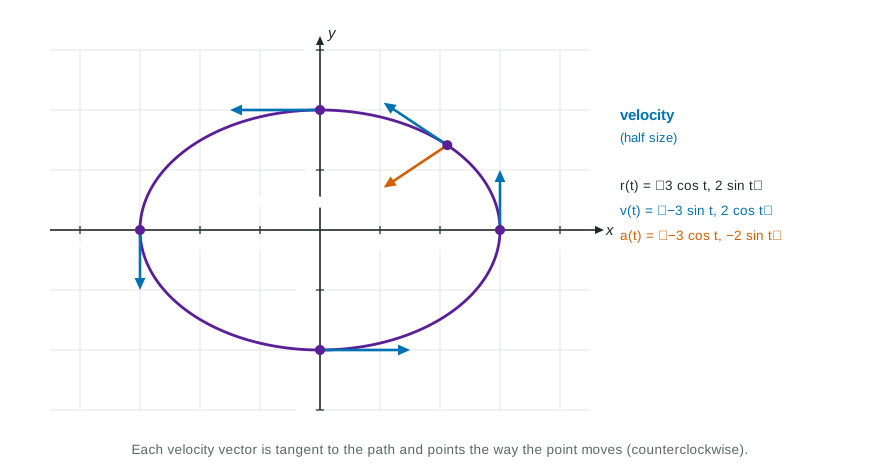
The ellipse r(t) = 3 cos t, 2 sin t, traced counterclockwise. Blue velocity vectors, drawn at half size, start at the points where t = 0, pi/4, pi/2, pi and 3 pi/2; each is tangent to the ellipse and points counterclockwise: straight up at t = 0, straight left at t = pi/2. At t = pi/4 a vermillion acceleration vector, also half size, points from the particle toward the center. The formulas are r(t) = 3 cos t, 2 sin t; v(t) = -3 sin t, 2 cos t; a(t) = -3 cos t, -2 sin t.
For r(t)=⟨3cos⁡t,2sin⁡t⟩\mathbf{r}(t) = \left\langle 3\cos t, 2\sin t \right\rangle, each velocity vector r′(t)\mathbf{r}'(t) is tangent to the ellipse and points the way the particle moves (counterclockwise). The acceleration vector at t=π4t = \frac{\pi}{4} points into the bend, toward the center. LevlPrep original diagram.

Part 5 · Step by step

How it works, step by step

  1. Write the position as one vector r(t)=⟨x(t),y(t)⟩\mathbf{r}(t) = \left\langle x(t), y(t) \right\ranglea vector-valued function, describing the same path as the parametric equations
  2. Differentiate each componentthe velocity vector v(t)\mathbf{v}(t)=r′(t)= \mathbf{r}'(t)=⟨x′(t),y′(t)⟩= \left\langle x'(t), y'(t) \right\rangle
  3. Its slope is y′(t)x′(t)\frac{y'(t)}{x'(t)} and its signs give the direction of motionthe velocity vector is tangent to the path and points the way the particle goes
  4. Differentiate againthe acceleration vector a(t)\mathbf{a}(t)=v′(t)= \mathbf{v}'(t)=⟨x″(t),y″(t)⟩= \left\langle x''(t), y''(t) \right\rangle

Part 6 · Key ideas

Key ideas

  • A vector-valued function r(t)=⟨x(t),y(t)⟩\mathbf{r}(t) = \left\langle x(t), y(t) \right\rangle is parametric equations in one package; every rule works one component at a time.
  • Velocity v(t)=r′(t)\mathbf{v}(t) = \mathbf{r}'(t) and acceleration a(t)=r″(t)\mathbf{a}(t) = \mathbf{r}''(t): differentiate each component, keeping the chain rule's inside factors.
  • The speed is the magnitude of the velocity, (x′(t))2+(y′(t))2\sqrt{(x'(t))^2 + (y'(t))^2}, never a component alone.
  • From a table, estimate each component of the velocity with a difference quotient over the interval around the time.

Part 7 · Misconception

A common mistake

The wrong idea: For r(t)=⟨t2,3t⟩\mathbf{r}(t) = \left\langle t^2, 3t \right\rangle, the velocity at t=2t = 2 is r(2)=⟨4,6⟩\mathbf{r}(2) = \left\langle 4, 6 \right\rangle.

What actually happens: ⟨4,6⟩\left\langle 4, 6 \right\rangle is where the particle is. The velocity is the derivative, r′(t)=⟨2t,3⟩\mathbf{r}'(t) = \left\langle 2t, 3 \right\rangle, so v(2)=⟨4,3⟩\mathbf{v}(2) = \left\langle 4, 3 \right\rangle: 4 units per second to the right and 3 up, a speed of 5.

Part 8 · Check yourself

Check yourself

Exam-style questions. Anything you miss goes into your review queue.

Table

A position vector given by a formula

A particle moves with position vector r(t)\mathbf{r}(t)=⟨t3−3t2,4t−t2⟩= \left\langle t^3 - 3t^2, 4t - t^2 \right\rangle for 0≤t≤40 \le t \le 4.
The position vector and its components
QuantityFormula
x(t)x(t)t3−3t2t^3 - 3t^2
y(t)y(t)4t−t24t - t^2

1. Find the velocity vector at t=1t = 1.

  1. ⟨−2,3⟩\left\langle -2, 3 \right\rangle
  2. ⟨−3,2⟩\left\langle -3, 2 \right\rangle
  3. ⟨0,−2⟩\left\langle 0, -2 \right\rangle
  4. ⟨3,2⟩\left\langle 3, 2 \right\rangle
Show the answer

v(t)\mathbf{v}(t)=r′(t)= \mathbf{r}'(t)=⟨3t2−6t,4−2t⟩= \left\langle 3t^2 - 6t, 4 - 2t \right\rangle, so v(1)\mathbf{v}(1)=⟨3−6,4−2⟩= \left\langle 3 - 6, 4 - 2 \right\rangle=⟨−3,2⟩= \left\langle -3, 2 \right\rangle.

  • ⟨−2,3⟩\left\langle -2, 3 \right\rangle: That is the position r(1)=⟨1−3,4−1⟩\mathbf{r}(1) = \left\langle 1 - 3, 4 - 1 \right\rangle; differentiate each component first.
  • Correct: ⟨−3,2⟩\left\langle -3, 2 \right\rangle: Right: differentiate each component, then put in t=1t = 1.
  • ⟨0,−2⟩\left\langle 0, -2 \right\rangle: That is the acceleration a(1)\mathbf{a}(1), the derivative of the velocity.
  • ⟨3,2⟩\left\langle 3, 2 \right\rangle: 3t2−6t3t^2 - 6t at t=1t = 1 is 3−6=−33 - 6 = -3: keep the sign.

2. Find the acceleration vector at t=1t = 1.

  1. ⟨−3,2⟩\left\langle -3, 2 \right\rangle
  2. ⟨6,−2⟩\left\langle 6, -2 \right\rangle
  3. ⟨0,−2⟩\left\langle 0, -2 \right\rangle
  4. ⟨0,2⟩\left\langle 0, 2 \right\rangle
Show the answer

a(t)\mathbf{a}(t)=v′(t)= \mathbf{v}'(t)=⟨6t−6,−2⟩= \left\langle 6t - 6, -2 \right\rangle, so a(1)=⟨0,−2⟩\mathbf{a}(1) = \left\langle 0, -2 \right\rangle.

  • ⟨−3,2⟩\left\langle -3, 2 \right\rangle: That is the velocity v(1)\mathbf{v}(1); acceleration is one more derivative.
  • ⟨6,−2⟩\left\langle 6, -2 \right\rangle: The derivative of −6t-6t is −6-6: 6t−6=06t - 6 = 0 at t=1t = 1.
  • Correct: ⟨0,−2⟩\left\langle 0, -2 \right\rangle: Right: ⟨6(1)−6,−2⟩\left\langle 6(1) - 6, -2 \right\rangle.
  • ⟨0,2⟩\left\langle 0, 2 \right\rangle: The derivative of 4−2t4 - 2t is −2-2, not 2.

3. At what time is the particle at rest?

  1. t=0t = 0
  2. t=3t = 3
  3. t=0t = 0 and t=2t = 2
  4. t=2t = 2
Show the answer

At rest means the velocity vector is ⟨0,0⟩\left\langle 0, 0 \right\rangle: both 3t2−6t=03t^2 - 6t = 0 (at t=0t = 0 or 22) and 4−2t=04 - 2t = 0 (at t=2t = 2). Both hold at t=2t = 2 alone.

  • t=0t = 0: At t=0t = 0 the horizontal rate is 0, but y′(0)=4y'(0) = 4: the particle moves straight up.
  • t=3t = 3: At t=3t = 3, x(3)=0x(3) = 0, a position, while v(3)=⟨9,−2⟩\mathbf{v}(3) = \left\langle 9, -2 \right\rangle.
  • t=0t = 0 and t=2t = 2: At t=0t = 0 the particle is moving: v(0)=⟨0,4⟩\mathbf{v}(0) = \left\langle 0, 4 \right\rangle.
  • Correct: t=2t = 2: Right: both components of the velocity are 0 there.

4. In which direction does the velocity vector point at t=0t = 0?

  1. Straight up
  2. Straight to the right
  3. Up and to the left
  4. Straight down
Show the answer

v(0)=⟨0,4⟩\mathbf{v}(0) = \left\langle 0, 4 \right\rangle: no horizontal component and a positive vertical one, so it points straight up and the path has a vertical tangent there.

  • Correct: Straight up: Right: ⟨0,4⟩\left\langle 0, 4 \right\rangle.
  • Straight to the right: The horizontal component 3t2−6t3t^2 - 6t is 0 at t=0t = 0; the motion is vertical.
  • Up and to the left: There is no horizontal component at t=0t = 0, so the vector does not lean left.
  • Straight down: y′(0)=4>0y'(0) = 4 > 0, so the vector points up.

5. For r(t)=⟨sin⁡(3t),t4⟩\mathbf{r}(t) = \left\langle \sin(3t), t^4 \right\rangle, find the horizontal component of the acceleration vector, x″(t)x''(t).

Type an expression for x″(t)=x''(t) =.

Show the answer

x′(t)=3cos⁡(3t)x'(t) = 3\cos(3t) and x″(t)=−9sin⁡(3t)x''(t) = -9\sin(3t). (The vertical component is 12t212t^2.)

  • Answer: x″(t)=x''(t) = −9sin⁡(3t)-9\,\sin(3t)

6. A particle has position r(t)=⟨2t,t2⟩\mathbf{r}(t) = \left\langle 2t, t^2 \right\rangle. Find its speed at t=2t = 2.

No calculator. Type the exact value (a fraction, π, e or a root is fine).

Show the answer

v(t)=⟨2,2t⟩\mathbf{v}(t) = \left\langle 2, 2t \right\rangle, so v(2)=⟨2,4⟩\mathbf{v}(2) = \left\langle 2, 4 \right\rangle and the speed is 4+16=20=25\sqrt{4 + 16} = \sqrt{20} = 2\sqrt{5}.

  • Answer: 252\,\sqrt{5} ≈ 4.472

7. A particle moves along a path with position vector r(t)\mathbf{r}(t). Where does the velocity vector r′(t)\mathbf{r}'(t) point, when it is not ⟨0,0⟩\left\langle 0, 0 \right\rangle?

  1. Along the tangent line, in the direction the particle is moving
  2. From the origin to the particle
  3. Toward the inside of the path's bend
  4. Perpendicular to the path, away from the origin
Show the answer

Its components are the horizontal and vertical rates, so its slope is y′x′\frac{y'}{x'}, the slope of the tangent line, and its signs give the direction of motion.

  • Correct: Along the tangent line, in the direction the particle is moving: Right: tangent to the path, pointing the way the particle goes.
  • From the origin to the particle: That describes the position vector r(t)\mathbf{r}(t) itself.
  • Toward the inside of the path's bend: On a curved path that is closer to where the acceleration points; the velocity follows the path.
  • Perpendicular to the path, away from the origin: A vector perpendicular to the path would not move the particle along it.

Part 9 · Summary

Summary

A vector-valued function r(t)=⟨x(t),y(t)⟩\mathbf{r}(t) = \left\langle x(t), y(t) \right\rangle gives the position of a particle as a vector. Its derivative, the velocity vector ⟨x′(t),y′(t)⟩\left\langle x'(t), y'(t) \right\rangle, is tangent to the path and points in the direction of motion, and its magnitude is the speed. The acceleration vector is the second derivative. Every step is done one component at a time.

Part 10 · Up next

What comes next

Part 11 · Connections

Connections