For a particle in the plane, velocity and acceleration are the first and second derivatives of the position vector, and speed is the magnitude of the velocity.
Practice 2: Connecting RepresentationsPractice 3: JustificationPractice 4: Communication and Notation
Part 1 · Hook
Why this matters
A soccer ball curls from the corner flag into the box. Where is it after one second, how fast is it going, how far has it flown, and how far is it from where it started? Each question has its own tool: the position vector, the speed, the integral of speed, and the integral of velocity. Motion in the plane puts all of Unit 9 together, and it is a regular free-response question on the BC exam.
Part 2 · Before you start
What this builds on
Part 3 · Prerequisite check
Quick check before you start
1. On a line, total distance traveled from to is
Show the answer
Distance adds up the size of the velocity, so backtracking counts.
Correct: :
:
:
:
2. If and , then
Show the answer
.
Correct: :
:
:
:
3. The length of , for is
Show the answer
.
Correct: :
:
:
:
Part 4 · See it
See it first
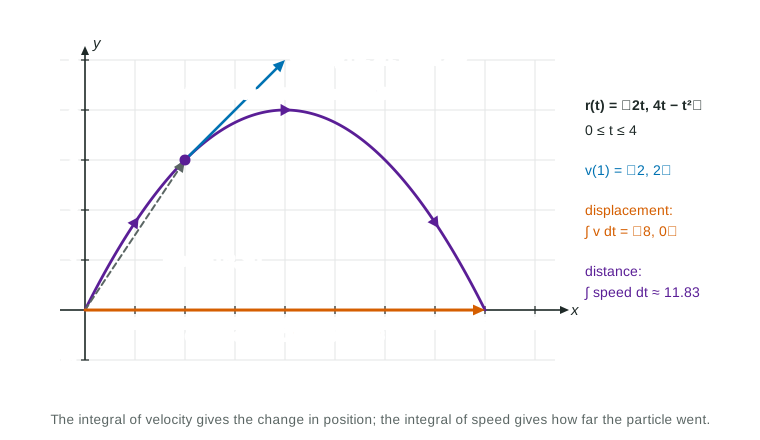
For , : at the particle is at with velocity and speed . The displacementvector is , of length 8, but the distance traveled along the arch is about 11.83. LevlPrep original diagram.
Speed is the magnitude of the velocity, . It is not , which measures steepness, not how fast.
Position: , and the same for . Add the initial value, keep the .
Distance traveled is ; displacement is , a vector.
" is decreasing" reads the sign of ; "moving left" reads . A collision needs the same point at the same time.
Part 7 · Misconception
A common mistake
The wrong idea: At , and , so the speed is .
What actually happens: compares the two rates to give the slope of the path; it does not measure how fast the particle moves. Speed is the length of the velocity vector: .
Part 8 · Check yourself
Check yourself
Exam-style questions. Anything you miss goes into your review queue.
Graph
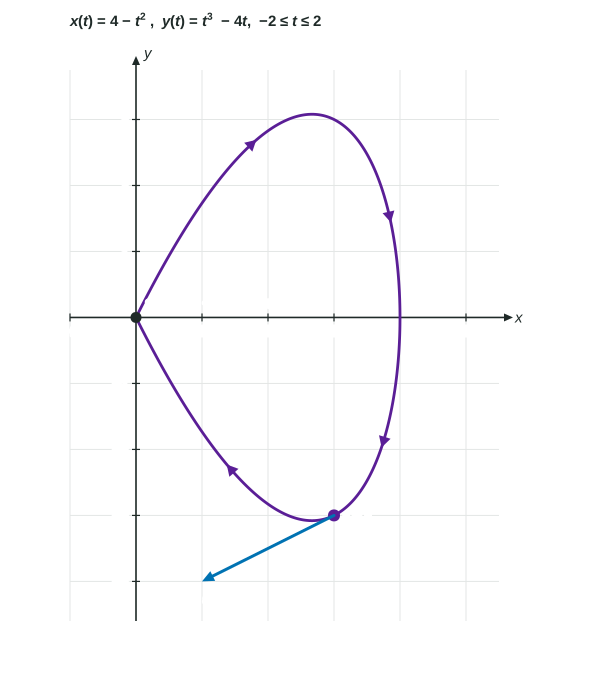
A path with the velocity vector drawn at one point
A particle moves along the path , for . The graph shows the path, the direction of motion, and the velocity vector drawn at the point where .
LevlPrep original diagram.
1. What is the velocity vector of the particle at ?
Show the answer
, so : 2 units left and 1 down per unit of time, as the arrow in the graph shows.
: That is the position , where the vector starts.
Correct: : Right: differentiate each component.
: That is the acceleration at .
: , which is at : the particle moves left.
2. Find the speed of the particle at .
No calculator. Type the exact value (a fraction, π, e or a root is fine).
Show the answer
Speed .
Answer: ≈ 2.236
3. Which statement about the motion from to is correct?
The displacement is , so the distance traveled is 0
The displacement is , the farthest point from the start
The displacement is , the position at
The displacement is , but the distance traveled is positive
Show the answer
: the particle ends where it started. It still went around the loop, so the distance traveled, , is positive.
The displacement is , so the distance traveled is 0: A zero displacement means the start and end coincide; the particle still traveled around the loop.
The displacement is , the farthest point from the start: is the position at ; the displacement compares the end with the start.
The displacement is , the position at : That is a position along the way, not the change from start to end.
Correct: The displacement is , but the distance traveled is positive: Right: net change zero, distance positive.
4. Which expression gives the total distance traveled by the particle from to ?
Show the answer
Distance traveled is the integral of speed: , and .
: This squares the position components; speed squares the velocity components.
Correct: : Right: integrate the speed over the time interval.
: This is the length of the displacement vector, which is 0 here because the path is closed.
: This integrates , the steepness of the path, not the speed.
5. A particle moves with and for . On which interval is the particle's -coordinate decreasing?
and
Nowhere on
Show the answer
is decreasing where , that is : the interval . The sign of does not decide this.
: On , is decreasing () but : increases.
Correct: : Right: read the sign of .
and : This reads , which is negative on both intervals. That says the path falls as increases, not that decreases in time.
Nowhere on : is negative for .
6. A particle moves with . Find the total distance it travels from to .
No calculator. Type the exact value (a fraction, π, e or a root is fine).
Show the answer
, so the speed is . Distance , one trip around a circle of radius 3.
Answer: ≈ 18.850
7. Particle A has position and particle B has position for . Do they collide, and if so, when and where?
Yes, at , at the point
Yes, at , where their paths cross
Yes, at , where both have
No, they do not collide
Show the answer
A collision needs the same point at the same time. gives , and then . Both are at at .
Correct: Yes, at , at the point : Right: both coordinates match at the same time.
Yes, at , where their paths cross: The paths do cross at , but A is there at and B at : different times, no collision.
Yes, at , where both have : At the -coordinates match but the -coordinates are 2 and 3.
No, they do not collide: They do collide: at both and agree.
Part 9 · Summary
Summary
For a particle in the plane, velocity and acceleration are the first and second derivatives of the position vector, and speed is the magnitude of the velocity. The integral of velocity is the displacement vector, so the position at a time is the start plus that integral; the integral of speed is the total distance traveled. Direction questions read the signs of and , and calculator answers carry their setup and three decimal places.