Polar Coordinates and Polar Graphs
Polar coordinates name a point by an angle θ and a signed distance r .
Part 1 · Hook
Why this matters
Part 2 · Before you start
What this builds on
Part 3 · Prerequisite check
Quick check before you start
1. What are and ?
- and
- and
- and
- and
Show the answer
On the unit circle the point at angle is .
- Correct: and :
- and :
- and :
- and :
2. A curve is given by , . What shape is it?
- A circle of radius 2 centered at the origin
- A line through the origin
- A parabola
- A circle of radius 4 centered at the origin
Show the answer
- Correct: A circle of radius 2 centered at the origin:
- A line through the origin:
- A parabola:
- A circle of radius 4 centered at the origin:
Part 4 · See it
See it first
Part 5 · Step by step
How it works, step by step
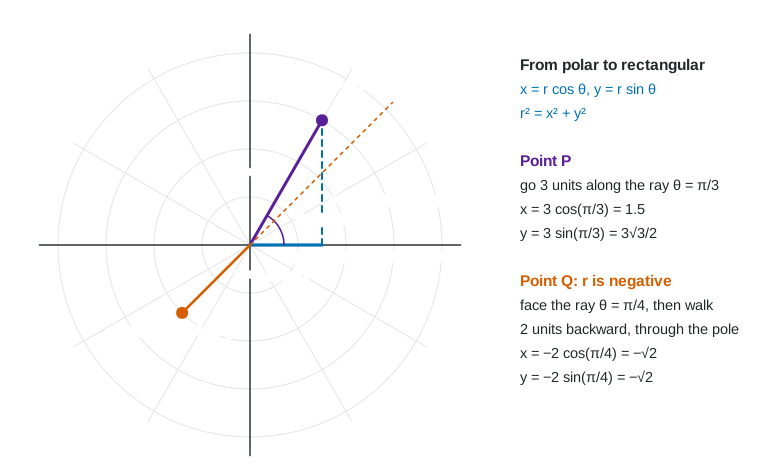
- Turn to the angle and go a distance you reach the point
- Drop the vertical and horizontal legs of that right triangle and
- Let depend on , as as turns, the point traces a polar curve
- Make a table of and , then plot each pointyou see where (the pole) and where (the opposite ray)
Part 6 · Key ideas
Key ideas
- A polar point : turn to the ray at angle , then go units. A negative goes backward, through the pole, onto the opposite ray.
- , , . These connect every polar question to rectangular ones.
- A polar curve is a parametric curve with parameter : , .
- Shapes to know: (circle), (line through the pole), and (circles through the pole), (limaçons, cardioid when ), (roses).
Part 7 · Misconception
A common mistake
The wrong idea: A point with cannot exist: a distance is never negative.
What actually happens: is a signed distance along the ray. is 2 units from the pole on the ray opposite , the same point as .
Part 8 · Check yourself
Check yourself
Exam-style questions. Anything you miss goes into your review queue.
1. Which rectangular point is the polar point ?
Show the answer
- : Sine and cosine are swapped: uses , and .
- Correct: : Right: and .
- : This repeats the polar pair; convert with and .
- : This is the point on the unit circle; multiply each coordinate by .
2. Where is the polar point in rectangular coordinates?
Show the answer
and : the point is on the ray opposite .
- : That is . A negative puts the point on the opposite ray.
- : That is ; the ray is vertical, so the point stays on the -axis.
- : This repeats the polar pair; convert with and .
- Correct: : Right: face straight up, then walk 3 units backward.
Table
Values of
3. Where is the point of the curve at , in rectangular coordinates?
Show the answer
- : That would be on the ray . Here , so the point is on the opposite ray.
- Correct: : Right: on the ray lands one unit to the right of the pole.
- : The ray is horizontal; with the point stays on the -axis.
- : This mixes polar and rectangular. Use
and .
4. At which angle in the table does the curve pass through the pole?
Show the answer
The pole is the point with . In the table at (check:
- Correct: : Right: there, and is the pole whatever the angle.
- : At the point is 3 units from the pole, the farthest point in the table.
- : At , : the point , one unit from the pole.
- : At , : one unit from the pole, on the opposite ray.
5. Find the -coordinate of the point of the curve at .
No calculator. Type the exact value (a fraction, π, e or a root is fine).
Show the answer
- Answer:
6. For , is negative. In which quadrant are the points of the curve for these angles?
- The second quadrant
- The third quadrant
- The fourth quadrant
- On the negative -axis
Show the answer
For the ray points into the second quadrant, but , so the point is on the opposite ray, in the fourth quadrant. This is the lower half of the small inner loop.
- The second quadrant: The rays point into the second quadrant, but puts each point on the opposite ray.
- The third quadrant: Reflecting through the pole turns the second quadrant into the fourth, not the third.
- Correct: The fourth quadrant: Right: these rays point into the second quadrant, and a negative reflects each point through the pole into the fourth.
- On the negative -axis: Only gives a point on an axis, and there gives on the positive -axis.
Part 9 · Summary
Summary
Part 10 · Up next
What comes next
Part 11 · Connections