The length of a parametric curve traced once for a ≤ t ≤ b is ∫ from a to b of √((x′(t))² + (y′(t))²) dt , the integral of the speed of the moving point.
Practice 1: Implementing Mathematical ProcessesPractice 2: Connecting Representations
Part 1 · Hook
Why this matters
A cyclist's app shows a map of the route and the distance ridden. The map is a curve; the distance is its length. If the app logs how fast the bike moves east and how fast it moves north, it can add up the distance without ever knowing an equation for the route. That is arc length for a parametric curve: build each tiny step with the Pythagorean theorem, then integrate.
Part 2 · Before you start
What this builds on
Part 3 · Prerequisite check
Quick check before you start
1. The length of from to is
Show the answer
Each piece is the hypotenuse of a triangle with legs and .
Correct: :
:
:
:
2. For , , the derivatives with respect to are
,
,
,
,
Show the answer
Differentiate each coordinate with respect to .
Correct: , :
, :
, :
, :
Part 4 · See it
See it first
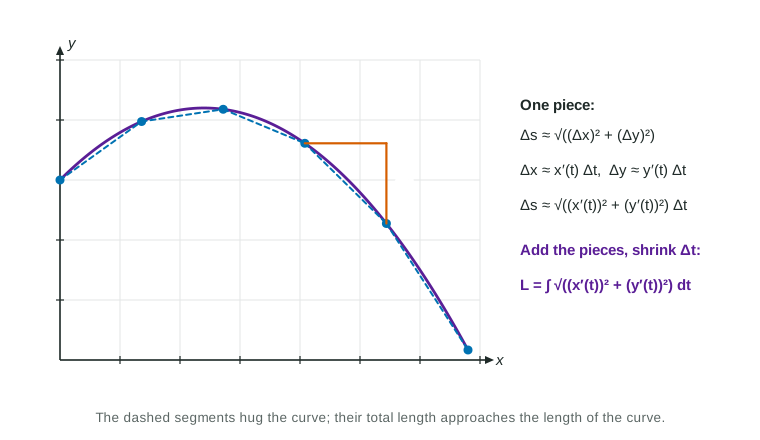
Each short piece of the curve is close to a straight segment, the hypotenuse of a triangle with legs and . Adding the pieces and letting shrink gives the arc length integral. LevlPrep original diagram.
Part 5 · Step by step
How it works, step by step
Over a short time the point moves across and up→the piece of curve is close to a segment of length
Add the pieces from to and let →
The integrand is the speed of the point→the integral is the distance traveled, which is the curve's length when the curve is traced once
Most of these integrals have no simple antiderivative→on the exam they are calculator questions: write the setup, then three decimals
Part 6 · Key ideas
Key ideas
: square each derivative, add, take the root, integrate in .
The limits are values of , not of . Check that from to traces the curve once; a path traced twice gives twice the length.
For , take : the formula becomes the 8.13 formula .
Exact answers come from integrands that simplify, often by or a perfect square under the root.
Part 7 · Misconception
A common mistake
The wrong idea: The length of the segment , for is .
What actually happens: The point moves 5 across and 12 down per unit of at the same time, along the diagonal: its speed is . The length is , which matches the distance from to .
Part 8 · Check yourself
Check yourself
Exam-style questions. Anything you miss goes into your review queue.
Graph
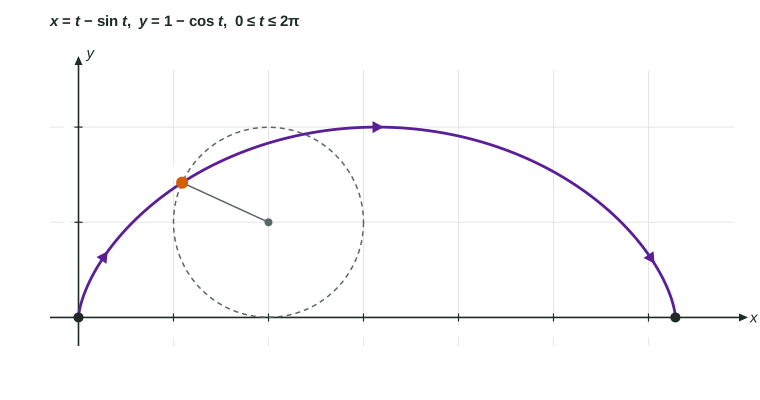
One arch traced by a point on a rolling wheel
A wheel of radius 1 rolls along the -axis. A point on its rim traces the path , . One arch is traced for .
LevlPrep original diagram.
1. Which integral gives the length of one arch?
Show the answer
Length is with and , over the -interval that traces the arch once.
: This squares the coordinates and ; the formula squares their derivatives.
Correct: : Right: the square root of the sum of the squared derivatives.
: Without squares and a square root this is not a length; the legs of the small triangle combine by the Pythagorean theorem.
: goes with , not ; with it needs the factor , which this leaves out.
2. At the top of the arch, . Find , the speed of the rim point there.
No calculator. Type the exact value (a fraction, π, e or a root is fine).
Show the answer
and , so the speed is : at the top, the rim point moves twice as fast as the wheel's center.
Answer: 2
3. Using , find the exact length of one arch.
No calculator. Type the exact value (a fraction, π, e or a root is fine).
Show the answer
On , , so the integrand is . Then .
Answer: 8
4. The wheel keeps rolling, and the rim point traces the path for . How long is the path it traces?
No calculator. Type the exact value (a fraction, π, e or a root is fine).
Show the answer
Each arch has length 8, and from 0 to traces two of them: .
Answer: 16
5. Find the length of the curve , for .
No calculator. Type the exact value (a fraction, π, e or a root is fine).
Show the answer
and , so the integrand is for . With : .
Answer: ≈ 4.667
6. For , , , the integral equals . Which statement is correct?
The circle has circumference , so its radius is 2
The point goes around the unit circle twice, so the integral is twice the circumference
The integral should be ; a value of means an arithmetic slip
The integral measures the area inside the circle,
Show the answer
: the unit circle, of circumference . The speed is , and runs from 0 to : two full turns. The integral is the distance the point travels, , which counts the circle twice.
The circle has circumference , so its radius is 2: , so the radius is 1; the integral counts the circle twice.
Correct: The point goes around the unit circle twice, so the integral is twice the circumference : Right: the formula gives the length of the curve only when it is traced once.
The integral should be ; a value of means an arithmetic slip: The integral is right; it measures the distance traveled, which includes both turns.
The integral measures the area inside the circle, : This integral adds up small lengths, not areas: the area of the unit circle is .
7. The curve , , can be written as , , . Which integral gives its length?
Show the answer
and , so the integrand is . It is the same integral as the 8.13 formula .
: must be squared: .
: This squares and ; the formula squares their derivatives.
Correct: : Right: with and .
: Lengths combine by the Pythagorean theorem: square, add, take the root.
Part 9 · Summary
Summary
The length of a parametric curve traced once for is , the integral of the speed of the moving point. The limits are values of ; a curve traced more than once is counted more than once. With the formula reduces to the formula, and on calculator questions you write the integral and give three decimal places.