Unit 9 · Topic 9.2
Second Derivatives of Parametric Equations
The second derivative of a parametric curve is the derivative of dy/dx with respect to x : differentiate dy/dx with respect to t , then divide by dx/dt .
Practice 1: Implementing Mathematical ProcessesPractice 4: Communication and Notation
Part 1 · Hook
Why this matters
A roller coaster designer cares about more than the
slope of the track: whether the track bends up into a valley or down over a hill decides whether riders are pressed into their seats or lifted out of them. For a track drawn by
parametric equations, that bend is
, and finding it takes one extra division that most students forget.
Part 2 · Before you start
What this builds on
Part 3 · Prerequisite check
Quick check before you start
1. For , , the slope is
Show the answer
.
- Correct: :
- :
- :
- :
2. A graph is concave down on an interval where
- the second derivative is negative
- the first derivative is negative
- the function is negative
- the second derivative is zero
Show the answer
Concave down means the slope is decreasing, so the second derivative is negative.
- Correct: the second derivative is negative:
- the first derivative is negative:
- the function is negative:
- the second derivative is zero:
Part 5 · Step by step
How it works, step by step
- is itself a function of →its rate of change with respect to needs the same slope rule again
- Apply the rule to the function →
- The sign of at a time→gives the concavity of the curve there: positive is concave up, negative concave down
- and has a sign→the second derivative test classifies the point as a relative minimum or maximum
Part 6 · Key ideas
Key ideas
- Step 1: find and simplify it as a function of .
- Step 2: differentiate with respect to . Step 3: divide by . Skipping step 3 is the classic slip.
- is not : second derivatives do not divide that way.
- Concavity, inflection points and the second derivative test work as in Unit 5, with every derivative found from .
Part 7 · Misconception
A common mistake
The wrong idea: For , : , so .
What actually happens: is , a rate per unit of . Divide by to make it a rate per unit of : . Check: , whose second derivative is .
Part 8 · Check yourself
Check yourself
Exam-style questions. Anything you miss goes into your review queue.
Table
A curve with a linear
A curve is given by the parametric equations below for
.
The parametric equations of the curve| Coordinate | Equation |
|---|
| |
|---|
| |
|---|
1. Find at .
No calculator. Type the exact value (a fraction, π, e or a root is fine).
Show the answer
, which is at .
- Answer: ≈ -4.500
2. Find in terms of .
Type an expression for .
Show the answer
, so . Divide by : .
- Answer:
3. For which values of is the curve concave up?
Show the answer
exactly when , so the curve is concave up for .
- : There : concave down.
- Correct: : Right: the second derivative is positive for .
- : There , so the curve is falling; concavity is read from .
- : There , so the curve is rising; that is about slope, and concave up starts earlier, at .
4. A curve is given by , for . Find in terms of .
Type an expression for .
Show the answer
. Then , and dividing by gives .
- Answer:
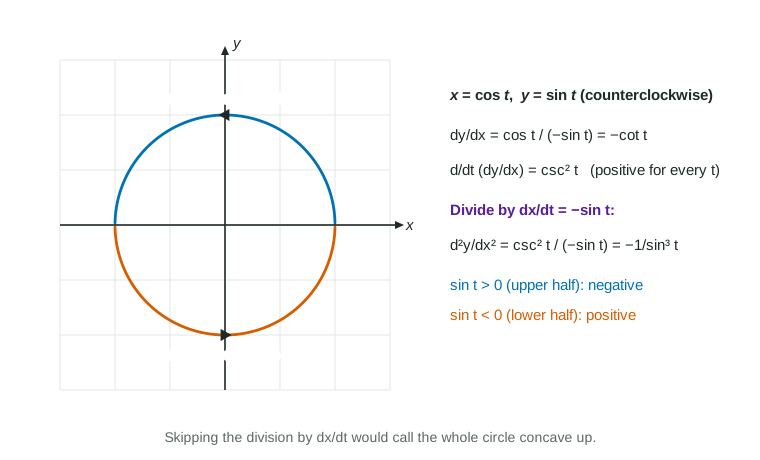
5. The circle , has . Find at .
No calculator. Type the exact value (a fraction, π, e or a root is fine).
Show the answer
at , and . So : concave down, as the top half of a circle should be.
6. For a curve , with , which expression equals ?
Show the answer
is the derivative of with respect to . Apply the slope rule to the function : its -rate divided by the -rate of .
- : Second derivatives do not divide like this; differentiate with respect to first.
- : This is a rate per unit of ; one more division by makes it per unit of .
- Correct: : Right: .
- : The numerator must be differentiated before dividing.
Part 9 · Summary
Summary
The
second derivative of a parametric curve is the derivative of
with respect to
: differentiate
with respect to
, then divide by
. Its sign gives the concavity of the curve, and with
it classifies a
horizontal tangent as a relative minimum or maximum. Never stop after differentiating, and never divide
by
.
Part 10 · Up next
What comes next
Part 11 · Connections
Connections