Parametric Equations and Their Derivatives
For a curve x = x(t) , y = y(t) , the derivatives dx/dt and dy/dt are the horizontal and vertical rates, and their signs give the direction of motion.
Part 1 · Hook
Why this matters
Part 2 · Before you start
What this builds on
Part 3 · Prerequisite check
Quick check before you start
1. If is a function of and is a function of , the chain rule says
Show the answer
The rates multiply: change in per unit of , times change in per unit of .
- Correct: :
- :
- :
- :
2. The path , passes through which point when ?
Show the answer
Put into both equations: and .
- Correct: :
- :
- :
- :
3. The line through with slope is
Show the answer
Point-slope form: with .
- Correct: :
- :
- :
- :
Part 4 · See it
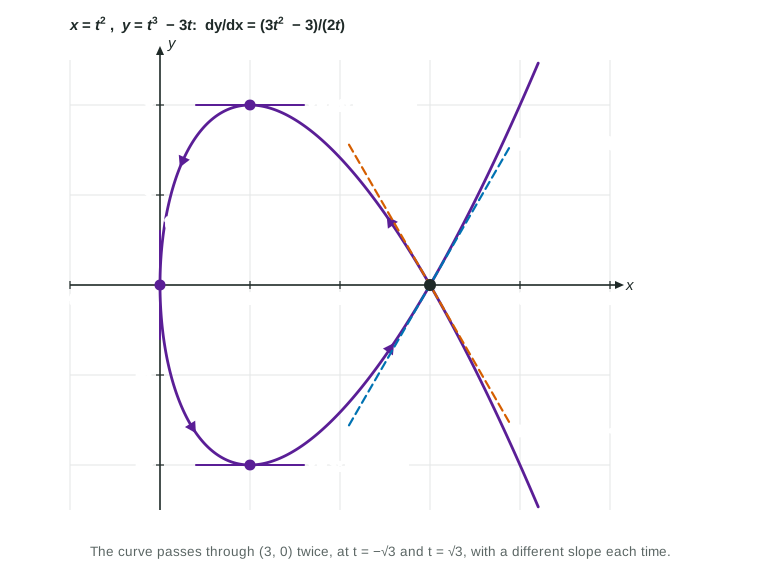
See it first
Part 5 · Step by step
How it works, step by step
- and are both functions of and are the horizontal and vertical rates of the moving point
- The chain rule gives so wherever
- while the point moves straight across for an instant: a horizontal tangent
- while the point moves straight up or down for an instant: a vertical tangent
Part 6 · Key ideas
Key ideas
- The slope of a parametric curve is , provided . It is a function of : evaluate it at the time, not at the point.
- A tangent line needs a point and a slope, both at the same :
. - Signs give direction: moves right, left; moves up, down.
- Horizontal tangent: and . Vertical tangent: and . Both zero: look closer.
Part 7 · Misconception
A common mistake
The wrong idea: At , and , so the tangent line is horizontal.
What actually happens: means no horizontal motion: the point moves straight up, so the tangent line is vertical. A horizontal tangent needs with , because is 0 only when its numerator is.
Part 8 · Check yourself
Check yourself
Exam-style questions. Anything you miss goes into your review queue.
Graph
A path with direction arrows and two marked times
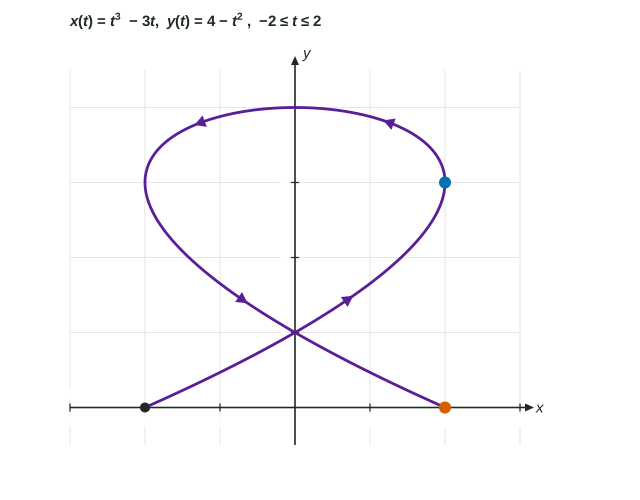
1. Find at the point where .
No calculator. Type the exact value (a fraction, π, e or a root is fine).
Show the answer
and at , so .
- Answer: ≈ -0.444
2. Write an equation of the line tangent to the path at the point where .
Type an expression for .
Show the answer
The point is
- Answer:
3. Which statement describes the tangent line at the point where ?
- It is horizontal, because there
- It has slope 2, because there
- It is vertical, because and there
- It does not exist, because is undefined there
Show the answer
At , and . The point moves straight up for an instant, so the tangent line is vertical: the path turns from moving right to moving left at .
- It is horizontal, because there: makes the horizontal motion stop, which gives a vertical tangent. A horizontal tangent needs .
- It has slope 2, because there: is a rate per unit of time, not the slope; the slope divides by , which is 0 here.
- Correct: It is vertical, because and there: Right: no horizontal motion and nonzero vertical motion give a vertical tangent line.
- It does not exist, because is undefined there: An undefined slope is the slope of a vertical line; the tangent line exists and is vertical.
4. At which point is the tangent line to the path horizontal?
- and , where and
- , where the path crosses itself
- and , where
- , where
Show the answer
Horizontal tangent: with . That is , where , at the point .
- and , where and : There and : those tangents are vertical.
- , where the path crosses itself: The crossing point has two tangent lines, one for each pass, and neither is horizontal.
- and , where : is where the path meets the -axis; the slope there is , not 0.
- Correct: , where : Right: and at .
5. A curve is given by , . Find at .
No calculator. Type the exact value (a fraction, π, e or a root is fine).
Show the answer
and , so , which is at .
- Answer: ≈ 0.736
6. A curve is given by , . Which expression gives the slope of the tangent line at a point where ?
Show the answer
By the chain rule , so : rise per unit of time over run per unit of time.
- : This is the reciprocal of the slope, run over rise.
- : This is how fast changes per unit of time, not per unit of .
- : Multiplying the rates has no meaning here; the chain rule gives a quotient.
- Correct: : Right: the chain rule, solved for .
7. The curve , passes through twice, at and at . What can be said about the slope of the curve at ?
- It is 0, because at
- There are two tangent lines, with slopes and
- There is one slope, found by putting into a formula for
- It does not exist, because the curve crosses itself there
Show the answer
. At : . At : . Each pass through the point has its own tangent line, which is why slopes are found from , not from the point.
- It is 0, because at : The height of a point says nothing about its slope; compute at each .
- Correct: There are two tangent lines, with slopes and : Right: one tangent line for each time the curve passes through the point.
- There is one slope, found by putting into a formula for : here is a formula in , and two values of give , with different slopes.
- It does not exist, because the curve crosses itself there: Each pass has a well-defined tangent line; there are simply two of them.
Part 9 · Summary
Summary
Part 10 · Up next
What comes next
Part 11 · Connections