Unit 10 · Topic 10.11
Taylor Polynomials
The n th-degree Taylor polynomial for f about x = a is ∑ for k = 0 to n of (f^((k))(a))/(k!) (x − a)^k .
Practice 1: Implementing Mathematical ProcessesPractice 2: Connecting Representations
Part 1 · Hook
Why this matters
Your calculator does not store a table of
. It computes
from a polynomial, because
polynomials need only adding and multiplying. A
Taylor polynomial is the polynomial that copies a
function's value,
slope,
concavity and more at one point, and so stays close to the function nearby.
Part 2 · Before you start
What this builds on
Part 3 · Prerequisite check
Quick check before you start
1. The tangent line to at is
Show the answer
It passes through with slope .
- Correct: :
- :
- :
- :
2. If , what is ?
Show the answer
, , .
- Correct: :
- :
- :
- :
3. What is ?
Show the answer
.
- Correct: :
- :
- :
- :
Part 5 · Step by step
How it works, step by step
- The tangent line matches and →it fits well very near but misses the bending
- Add a term →the polynomial's second derivative at is , so it bends the same way does
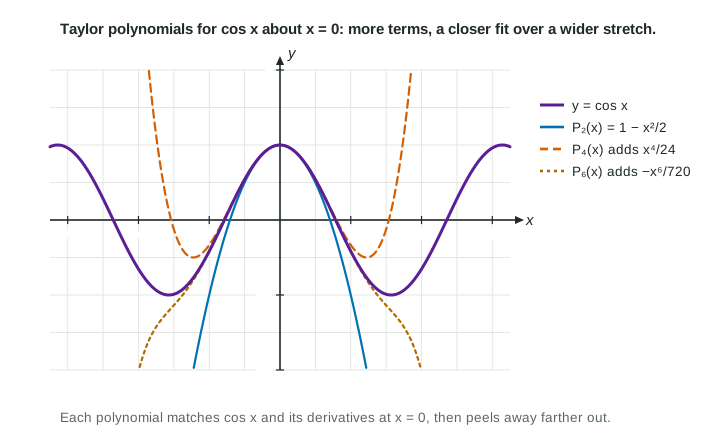
- Keep adding terms →the polynomial matches more derivatives at and usually stays close to over a wider stretch
Part 6 · Key ideas
Key ideas
- .
- The center is where the derivatives are taken: powers of , derivatives at .
- is the tangent line; each higher term matches one more derivative at the center.
- A Taylor polynomial ends at its last term: write it out with no "".
Part 7 · Misconception
A common mistake
The wrong idea: The second-degree Taylor polynomial for about is .
What actually happens: Use powers of and divide by the factorials: .
Part 8 · Check yourself
Check yourself
Exam-style questions. Anything you miss goes into your review queue.
Table
A function and its derivatives at
Values of and its first four derivatives at | | | | |
|---|
| | | | |
|---|
1. Write the second-degree Taylor polynomial for about .
Type an expression for .
Show the answer
.
- Answer:
2. Find the coefficient of in the third-degree Taylor polynomial for about .
No calculator. Type the exact value (a fraction, π, e or a root is fine).
Show the answer
The coefficient of is .
3. Use the third-degree Taylor polynomial for about to estimate .
No calculator. Type the exact value (a fraction, π, e or a root is fine).
Show the answer
, so .
4. The third-degree Taylor polynomial for about is . Find .
No calculator. Type the exact value (a fraction, π, e or a root is fine).
Show the answer
The coefficient of is , so .
5. The second-degree Taylor polynomial for about is . What does this show about at ?
- has a relative minimum at
- has a point of inflection at
- is decreasing at
- has a relative maximum at
Show the answer
The missing term means , and gives . By the second derivative test, has a relative maximum at .
- has a relative minimum at : The coefficient of is negative, so : concave down, a maximum.
- has a point of inflection at : , so the concavity is down at 3, not changing.
- is decreasing at : There is no term, so .
- Correct: has a relative maximum at : Right: and .
6. Which is written correctly as the third-degree Taylor polynomial for about ?
Show the answer
Every derivative of is , which is 1 at , so , written with no "" since a polynomial has a last term.
- : A polynomial stops: the "" turns it into an endless sum.
- : This drops and adds a fourth-degree term.
- Correct: : Right: four terms, through , and it stops there.
- : The coefficients need the factorials: and .
Part 9 · Summary
Summary
The
th-degree Taylor polynomial for
about
is
. It matches
and its first
derivatives at
, so it approximates
near
. About
it is called a Maclaurin polynomial.
Part 10 · Up next
What comes next
Part 11 · Connections
Connections