If you are struggling, you are not alone. In the US, call or text 988 (the Suicide and Crisis Lifeline), or talk to a trusted adult.
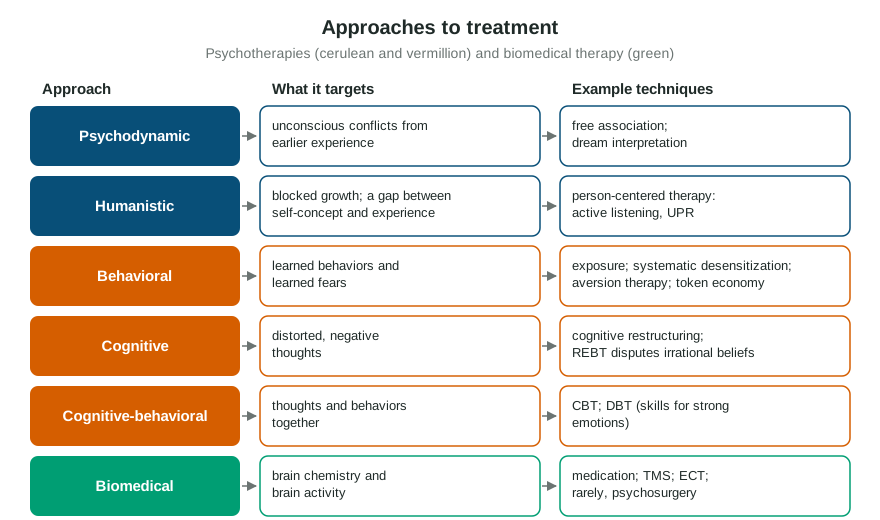
Treatments for psychological disorders fall into two broad groups. Psychotherapies work through conversation, learning and practice with a trained professional. Biomedical therapies change the brain's chemistry or activity directly. Each approach grew out of a perspective on what causes disorders, so the fastest way to learn them is to ask: what does this approach think the problem is, and how does it go after it? The second question, just as important, is what the evidence says. Treatment is very often effective, and asking for help is a sign of strength.
Psychodynamic and humanistic therapies
Psychodynamic therapy assumes symptoms grow from unconscious conflicts, often rooted in early relationships. The goal is insight. In free association the client says whatever comes to mind, and the therapist listens for patterns; in dream interpretation they look for hidden meaning in dreams. Modern psychodynamic therapy is shorter and more face-to-face than Freud's original psychoanalysis, and some forms have research support, though less than CBT for most disorders.
Humanistic therapy assumes people have a natural drive to grow, blocked when they feel accepted only under conditions. In person-centered therapy, the therapist is genuine, shows empathy through active listening (restating and clarifying the client's words and feelings) and offers unconditional positive regard. The client leads; the therapist does not diagnose or direct.
Behavioral therapies
Behavioral therapies treat problem behaviors as learned, so they can be unlearned with the same conditioning principles you met in Unit 3.
| Technique | Learning used | How it works |
|---|---|---|
| Exposure therapy | classical (extinction) | face the feared object or situation, in real life or in imagination, until the fear fades because nothing bad happens |
| Systematic desensitization | classical (counterconditioning) | learn relaxation, then pair it with a ranked list of feared scenes, from least to most frightening |
| Aversion therapy | classical | pair an unwanted behavior (drinking) with something unpleasant (nausea) so the behavior brings discomfort |
| Token economy | operant (secondary reinforcers) | earn tokens for target behaviors and trade them for rewards |
| Biofeedback | operant (feedback) | watch a live signal of a body process, such as muscle tension, and learn to change it |
Exposure-based treatments are among the best-supported treatments for phobias, panic disorder and OCD (where the person also stops doing the ritual, called exposure and response prevention). Aversion therapy's effects often fade outside the clinic, so it is used rarely and with other supports.
Cognitive and cognitive-behavioral therapies
Cognitive therapies assume that how we interpret events shapes how we feel. In depression, a common target is the cognitive triad: negative views of oneself, the world and the future. Cognitive restructuring teaches a person to catch a distorted thought, test it against evidence and replace it with a more accurate one. Rational emotive behavior therapy (REBT) does this head on, disputing irrational "must" beliefs such as "I must be liked by everyone."
Cognitive-behavioral therapy (CBT) combines changing thoughts with changing behavior, with homework between sessions. It has the broadest research support of any psychotherapy, especially for depression and anxiety disorders. Dialectical behavior therapy (DBT) is a form of CBT that balances acceptance with change and teaches mindfulness, distress tolerance, emotion regulation and relationship skills. It was developed for people with intense emotions and self-harm, including many with borderline personality disorder.
Worked example: name the therapy from the therapist's words. A therapist says, "What is the evidence for the thought that you ruin everything? What would you tell a friend who said that?"
Step 1. What is being targeted? A thought, "I ruin everything."
Step 2. What is the therapist doing to it? Testing it against evidence, not reflecting feelings (humanistic) or searching for its unconscious roots (psychodynamic).
Step 3. Name it and apply it. "This is cognitive therapy: the therapist uses cognitive restructuring, helping the client test the distorted belief that he ruins everything and replace it with a more accurate one."
Formats and the things every therapy needs
Therapy can be individual or in a group. Group therapy costs less per person, shows people they are not alone, and lets them practice new ways of relating; family therapy treats the family as a system, so patterns between members can change. Across all approaches, one of the most consistent predictors of improvement is the therapeutic alliance: trust between therapist and client, with shared goals. Cultural humility, a therapist's ongoing effort to learn about each client's culture and admit the limits of their own view, strengthens that alliance.
Good treatment is evidence-based practice: the best research (often meta-analyses that combine many studies), the clinician's expertise, and the client's culture, values and preferences, together. Ethical principles apply throughout: informed consent to treatment, confidentiality (with narrow exceptions, such as a serious risk of harm, explained at the start), avoiding harm, and competence.
History matters here too. Starting in the 1950s, deinstitutionalization moved many patients out of large state hospitals into the community, helped by new antipsychotic drugs. Community services were never fully funded, and many people were left without enough care.
Biomedical therapies
| Treatment | Used mainly for | How it works and what to know |
|---|---|---|
| Antidepressants (often SSRIs) | depression, several anxiety disorders, OCD | SSRIs are serotonin reuptake inhibitors; benefits build over several weeks |
| Anti-anxiety drugs | short-term anxiety relief | some increase the calming effect of GABA; they act fast but can cause tolerance and dependence |
| Lithium | bipolar disorder | a mood stabilizer; needs blood tests because the safe range is narrow |
| Antipsychotics | schizophrenia and psychotic symptoms | block dopamine receptors (antagonists), reducing positive symptoms; long-term use, especially of older drugs, can cause tardive dyskinesia, involuntary facial and tongue movements |
| Electroconvulsive therapy (ECT) | severe depression that has not responded to other treatment | a brief, controlled seizure under anesthesia; effective; short-term memory loss is common |
| Transcranial magnetic stimulation (TMS) | depression that has not responded to medication | magnetic pulses through the scalp while awake; no seizure |
| Psychosurgery | very rare, when nothing else works | removes or destroys small areas of brain tissue (lesioning); irreversible |
For depression, combining medication with psychotherapy tends to work better than either alone, and for depression and several anxiety disorders the gains from CBT tend to last longer after treatment ends than the gains from medication alone.
Reading a treatment study
To show that a treatment works, researchers randomly assign people with the same diagnosis to the treatment or to a control, such as a waitlist (treatment is offered after the study). The control matters because symptoms often ease somewhat over time and because expecting help can help. If the treatment group improves significantly more than the control, the treatment probably caused the extra improvement. If two treatments differ by an amount that is not statistically significant, the difference could plausibly be due to chance, so the study cannot say one is better. Ethical treatment studies describe informed consent, the right to withdraw and review by an institutional review board.