Most teens are short on sleep. Sleep experts recommend 8 to 10 hours a night for ages 13 to 18, and most US high school students get less than 8 on school nights. Sleep is not wasted time: across the night your brain runs an organized program that restores the body, stores what you learned, and sets your mood for the next day. On the exam you will name a stage from a description, read a hypnogram, match a sleep disorder to a case, and explain what a theory of sleep or dreaming predicts.
Consciousness and the body clock
Consciousness is your awareness of yourself and your surroundings. It is not on or off; it shifts from alert focus to daydreaming to drowsiness to sleep.
Those shifts follow a circadian rhythm, a body clock of about 24 hours that times alertness, body temperature and sleepiness. Light is the main thing that sets it: as daylight fades, the brain releases more melatonin and you feel sleepy. Bright screens late at night can delay that rise. Jet lag and rotating night shifts are circadian problems: the clock is set to one time and the world runs on another.
In adolescence the clock shifts later, so many teens are not sleepy until 11 p.m. or later. That is biology, not laziness, and it is one reason many school districts have moved high school start times later.
The stages of sleep
Sleep researchers identify stages by recording brain waves (EEG), eye movements and muscle activity. There are two kinds of sleep: NREM (non-rapid eye movement), with three stages, and REM.
| Stage | What it is like | Watch for |
|---|---|---|
| N1 | Light sleep for a few minutes as you drift off; easy to wake | Hypnagogic sensations: a feeling of falling, a sudden jerk, fleeting images |
| N2 | Deeper relaxation; about half the night is spent here | Brief bursts of activity on the EEG (sleep spindles) |
| N3 | Deep sleep with large, slow delta waves; hardest to wake from | Mostly in the first half of the night; sleepwalking happens here |
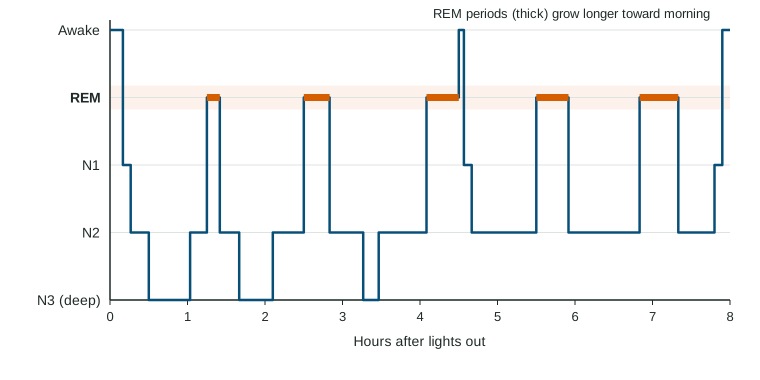
| REM | Brain nearly as active as when awake; eyes dart; major muscles almost paralyzed | Most vivid dreams; periods grow longer toward morning |
One full cycle through the stages takes about 90 minutes, so a night holds four or five cycles. Read the hypnogram from left to right: the sleeper drops quickly into N3, then rises back through N2 into the first, short REM period. Later cycles have little or no N3 and longer REM. So if you cut a night short by two hours, you lose mostly REM.
Why are the muscles limp in REM? The brainstem blocks signals to the major muscles, so you do not act out your dreams. When that block fails, the result is a sleep disorder (below).
Why we sleep
- Restoration. During sleep the body repairs tissue, and animal studies suggest the brain may clear waste products that build up while you are awake (how much this happens in people is still being studied). Growth hormone is released mainly in deep sleep.
- Storing memories. Sleep helps stabilize the day's learning so it lasts. In many studies, people who sleep after learning recall more the next day than people kept awake, even when the awake group gets a chance to nap later.
- Safety and energy. Sleeping at night kept our ancestors still and safe in the dark and saves energy.
Losing sleep has measurable costs: slower reactions, worse attention and memory, more irritability and low mood, and a higher risk of accidents. After about 18 hours awake, people perform on reaction-time tests about as poorly as people with a blood alcohol level of 0.05%.
Worked example: reading a hypnogram. A hypnogram shows REM periods of 10, 20, 25, 25 and 30 minutes in an 8-hour night. What percent of the night was REM?
Add the REM minutes:
Then interpret it: about a quarter of the night in REM is typical for a healthy young adult, and the lengthening REM periods show that the last hours of sleep are REM-rich.
Why we dream
Nearly everyone dreams several times a night, whether they remember it or not. Two theories are part of this course.
- Activation-synthesis theory. During REM the brainstem sends out bursts of random neural activity. The cortex tries to make sense of it and synthesizes a story, which is why dreams jump from scene to scene.
- Consolidation theory. Sleep, and the dreams in it, help process and store the day's experiences. Dreams often draw on recent events and worries, which fits this view.
The two are not exclusive: random activation could be shaped by the memories being processed. Neither has been proven; both are supported by some evidence.
Sleep disorders
| Disorder | What happens | A clue in a scenario |
|---|---|---|
| Insomnia | Persistent trouble falling or staying asleep, with tiredness during the day | Lies awake for an hour most nights for months |
| Narcolepsy | Sudden, uncontrollable sleep attacks during the day, often entering REM within minutes | Falls asleep mid-conversation; laughter triggers sudden weakness |
| Sleep apnea | Breathing stops again and again during sleep, briefly waking the sleeper | Loud snoring, gasping, exhausted all day |
| Somnambulism | Sleepwalking during deep N3 sleep, usually early in the night; no memory later | A child walks to the kitchen an hour after bedtime |
| REM sleep behavior disorder | The muscle paralysis of REM fails, so the sleeper acts out dreams | An older man kicks and punches and recalls a fight dream |
A quick way to separate the last two: sleepwalking comes from N3, so the person is hard to wake and recalls no dream; REM sleep behavior disorder comes from REM, so the person is acting out a dream they can often describe.
Most sleep problems can be treated, from habits (a regular schedule, a dark room, no screens in bed) and cognitive behavioral therapy for insomnia, to a breathing machine for sleep apnea and medication for narcolepsy. A doctor or sleep clinic can test for them.