Your eyes and ears only detect energy. Everything you actually experience, a friend's face, a word on a page, a car that is far away rather than tiny, is built by your brain. That building is perception: organizing and interpreting sensations so they mean something. Perception is the first topic of cognition, the mental activity of knowing, thinking and remembering.
Two directions at once
Perception runs in two directions at the same time.
- Bottom-up processing starts with the raw features (lines, edges, colors) and builds them into a whole. A baby seeing a giraffe for the first time has nothing else to go on.
- Top-down processing uses what you already know. You read a friend's messy handwriting because you know which words make sense in the sentence.
What you know is stored in schemas, mental frameworks for things like "a classroom" or "a dog". Schemas, context, recent experience and emotion create a perceptual set: a readiness to see something one way. Show people drawings of animals and then an ambiguous sketch, and many see a rat; show them faces first, and many see a man. Same sketch, different set.
Attention is a spotlight
Attention is limited, so the brain has to choose. Selective attention lets you follow one conversation at a noisy party. Ignored sounds are not fully shut out, though: if someone across the room says your name, you notice. That is the cocktail party effect.
The cost of a narrow spotlight is missing things.
- Inattentional blindness: not seeing something in plain view because attention is elsewhere. In a well-known study (Simons & Chabris, 1999), about half of the people counting basketball passes in a video missed a person in a gorilla suit walking through the middle of it.
- Change blindness: not noticing that something in a scene changed, such as an actor's scarf switching color between two shots.
Grouping: the Gestalt principles
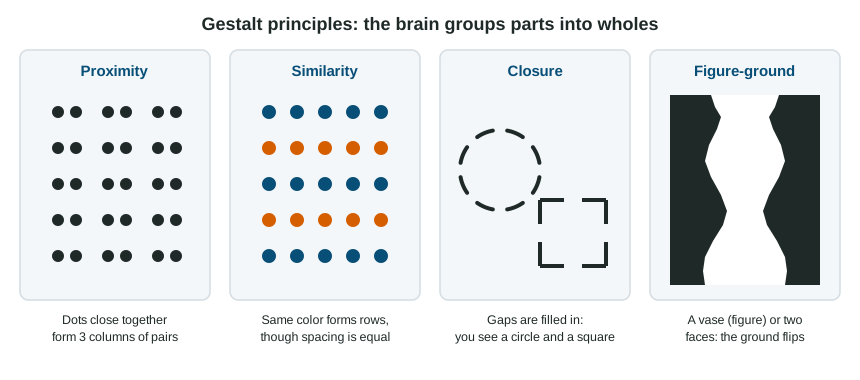
Early 20th-century Gestalt psychologists showed that the brain organizes sensations into wholes. Four principles to know:
| Principle | What the brain does | Everyday example |
|---|---|---|
| Proximity | groups things that are close together | people standing in a cluster look like one group |
| Similarity | groups things that look alike | players in the same jersey color look like a team |
| Closure | fills in gaps to make a whole | a logo made of broken lines reads as a circle |
| Figure-ground | separates an object from its background | a white vase or two black faces, but never both at once |
Seeing depth
The retina is flat, yet you see a three-dimensional world. Depth perception comes from cues.
Binocular cues need both eyes. Retinal disparity: each eye sees a slightly different image, and the bigger the difference, the closer the object. Convergence: your eyes turn inward to look at something near, and the brain reads how much they turn.
Monocular cues work with one eye, which is why a flat photo can still look deep:
- Relative size: of two things you assume are the same size, the smaller image looks farther away.
- Interposition: something that blocks part of another thing is closer.
- Linear perspective: parallel lines, like the edges of a road, seem to meet in the distance.
- Texture gradient: surface detail is coarse up close and fine and dense far away.
- Relative clarity: hazy objects look farther away than sharp ones.
Worked example: naming a depth cue. A photo shows a long fence; the posts get smaller and closer together toward the horizon, and a tree hides part of a barn.
Step 1: ask what in the picture signals distance. The posts shrinking: relative size (same posts, smaller image, farther). The posts crowding together: texture gradient. The tree covering the barn: interposition.
Step 2: check one eye or two. All three work in a flat photo, so they are monocular. A question that mentions the two eyes' views differing, or eyes turning inward, is asking about a binocular cue instead.
Keeping the world stable
Perceptual constancy lets you see objects as unchanging while the image on your retina changes. A friend walking away does not seem to shrink (size constancy); a door swinging open still looks rectangular (shape constancy); a white shirt looks white in shade or sun (color constancy). Constancy explains some illusions: in a drawing with converging lines, the brain treats the upper of two equal bars as farther away and so sees it as longer.
Finally, apparent movement (the phi phenomenon) is seeing motion in still images shown in quick succession. Every movie and every row of chasing lights on a sign relies on it.