Every day you make thousands of judgments without stopping to think: is that a bird, is this street safe, should I keep watching this movie? Your mind handles them with categories and shortcuts. Most of the time they work. The exam asks you to spot the times they do not.
Concepts, prototypes and schemas
A concept is a mental category: "bird", "fruit", "teacher". You do not check a list of rules to decide if something fits. You compare it with a prototype, the most typical example. A robin is close to the bird prototype, so you recognize it instantly; a penguin is far from it, so you hesitate.
Concepts are organized into schemas (from the perception topic). New information meets an existing schema in two ways:
- Assimilation: you fit it into the schema you already have. A toddler who knows "dog" calls a cow a dog.
- Accommodation: you change the schema, or build a new one, because the new thing does not fit. The toddler learns that cows are a different animal.
Solving problems: algorithms and heuristics
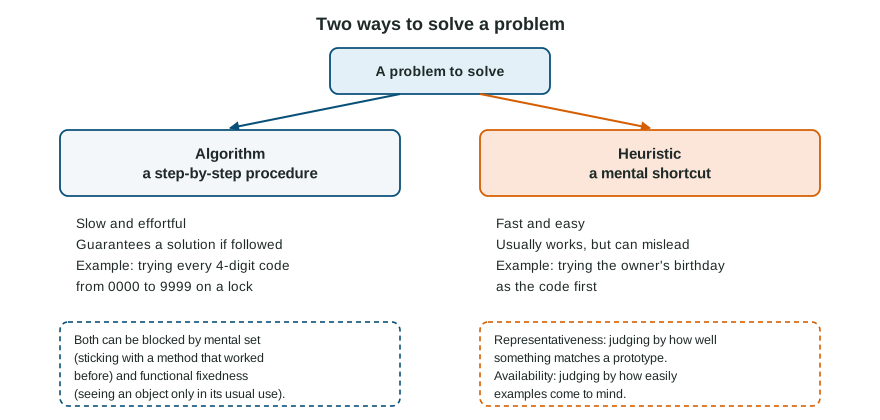
An algorithm is a step-by-step procedure that guarantees a solution if you follow it, like trying every combination on a lock. A heuristic is a mental shortcut, like trying the owner's birthday first. Heuristics save time, which is why we use them, but they can mislead.
Two blocks to problem-solving come up often:
- Mental set: sticking with an approach that worked before, even when it does not fit this problem.
- Functional fixedness: seeing an object only in its usual use. Given a box of tacks, people are slow to use the box itself as a shelf, especially when the tacks are inside it.
Biases in judgment
| Concept | What happens | Example |
|---|---|---|
| Representativeness heuristic | judging by how well something matches a prototype, ignoring how common it is | guessing that a quiet poetry lover is a professor, not one of the far more numerous truck drivers |
| Availability heuristic | judging how common or likely something is by how easily examples come to mind | fearing flying after crash news, though driving is riskier per mile |
| Framing effect | the wording of a choice changes the decision | "90% survive" sounds better than "10% die" |
| Gambler's fallacy | believing past random outcomes change the next one | betting black because red came up seven times |
| Sunk-cost fallacy | continuing because of what you already invested | sitting through a bad movie because the ticket is paid for |
| Priming | an earlier exposure makes related ideas come to mind faster | reading "ocean" makes "wave" quicker to recognize |
A note on priming and evidence: priming of words and ideas, as in the ocean and wave example, is one of the most reliable findings in the field. Some famous claims that a brief prime changes complex behavior (for example, that reading words about old age makes people walk more slowly) did not hold up when other labs tried to repeat them. Treat priming as a change in what comes to mind, not as a hidden switch for behavior.
Worked example: naming the bias. "A store marks a jacket 'was 120' and sells more than when the same jacket was simply priced at
Step 3: rule out the near misses. Availability would need examples coming to mind; sunk cost would need money already spent; representativeness would need a match to a prototype. None fits.
Executive functions and creativity
Executive functions are the mind's managers: planning, holding a goal in mind, switching between tasks and stopping an impulse. They depend heavily on the prefrontal cortex, so damage there can leave knowledge intact while making everyday planning very hard.
Creativity is producing ideas that are new and useful. It uses two kinds of thinking. Divergent thinking spreads out: list every use for a brick. Convergent thinking narrows down to the best answer, which is what most tests ask for. Good problem-solvers do both, first widening the options and then choosing.