You can ride a bike without being able to explain how, recite the capital of France without knowing when you learned it, and replay your last birthday almost like a video. All three are memory, the ability to keep information over time and use it later. But they are different kinds of memory, and the brain handles them in partly different ways.
Three steps: in, kept, out
Every memory goes through three steps.
- Encoding: getting information in, in a form the brain can keep.
- Storage: keeping it over time.
- Retrieval: getting it back out when you need it.
A failure at any step looks the same from the outside ("I don't remember"), which is why the next topics take each step in turn.
Kinds of memory
| Kind | What it holds | Example |
|---|---|---|
| Explicit: episodic | personal events, tied to a time and place | your eighth birthday party |
| Explicit: semantic | general facts and knowledge | Paris is the capital of France |
| Implicit: procedural | skills and habits, shown in doing | typing, riding a bike |
| Prospective | remembering to do something later | picking up bread on the way home |
Explicit memory (also called declarative) is memory you can consciously recall and put into words. Implicit memory (nondeclarative) shows up in behavior without conscious recall. A skilled typist can hit G without thinking but may need to picture a keyboard to say where it is.
The two can come apart. People with damage to the hippocampus may be unable to form new memories of events, yet still get better at a new skill, such as tracing a shape in a mirror, without remembering any practice. Explicit and implicit memory depend partly on different brain systems.
The multi-store model
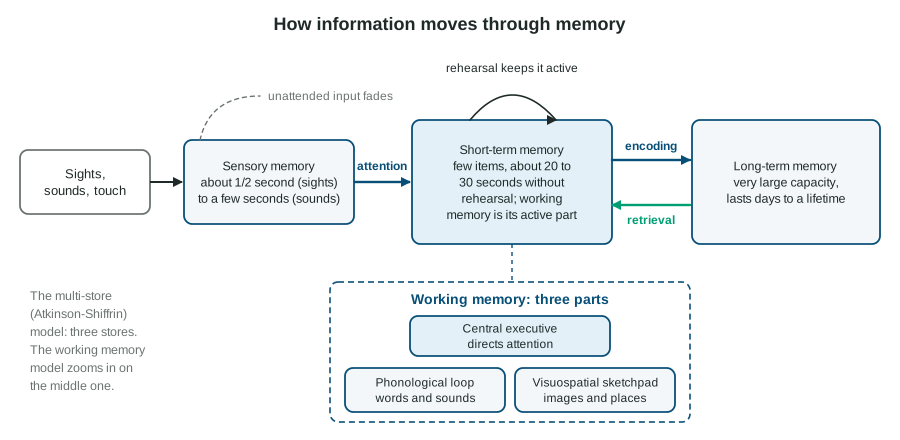
The multi-store model (the Atkinson-Shiffrin model) describes three stores.
- Sensory memory holds a nearly complete copy of what you just saw or heard, very briefly: under a second for images (iconic memory) and a few seconds for sounds (echoic memory). Whatever you do not attend to fades.
- Short-term memory holds what you are attending to: only a few items, for about 20 to 30 seconds, unless you keep repeating them.
- Long-term memory is the huge, lasting store: facts, skills and experiences that can last a lifetime.
Working memory
Working memory is a closer look at the short-term store as an active workspace, where you hold and work on information, like doing mental math. Its model has three parts:
- the central executive, which directs attention and coordinates the others;
- the phonological loop, which holds words and sounds (repeating a phone number in your head);
- the visuospatial sketchpad, which holds images and locations (picturing your route to school).
Two tasks that use the same part interfere with each other. Saying "the the the" out loud makes it hard to hold a list of spoken digits, because both use the phonological loop; tapping a visual pattern hurts much less.
Worked example: which part of working memory? "While holding a list of street names in mind, people do worse if they must also repeat a nonsense word, but not if they must also track a moving dot."
Step 1: what kind of information is being held? Street names are words, so the phonological loop.
Step 2: which second task competes for the same part? Repeating a word uses sound, so it competes. Tracking a dot uses the visuospatial sketchpad, so it competes less.
Answer: the result shows the phonological loop at work.
How deeply you process matters
Some information is encoded by automatic processing, with no effort: you know roughly how long you stayed at a party and which room was crowded. Other information needs effortful processing: attention and work, like learning vocabulary.
The levels of processing idea says that how deeply you think about information affects how well you remember it. Shallow processing attends to how a word looks or sounds; deep processing attends to what it means. In studies where people answer different questions about the same words ("Is it in capital letters?", "Does it rhyme with train?", "Does it fit this sentence?"), the meaning question leads to the best memory, even when no one expects a test.
Memory in the brain
Learning changes synapses. Long-term potentiation (LTP) is a lasting increase in how strongly a synapse responds after it has been stimulated repeatedly. It was first shown in the hippocampus of animals, and blocking it impairs learning, so it is thought to be one of the neural bases of memory: neurons that fire together come to fire together more easily.