Introduction to Memory
Memory is encoding, storage and retrieval.
Part 1 · Hook
Why this matters
Part 2 · Before you start
What this builds on
Part 3 · Prerequisite check
Quick check before you start
1. What is the hippocampus best known for?
- Helping form new long-term memories of facts and events
- Coordinating balance and movement
- Processing what the eyes see
- Controlling breathing and heart rate
Show the answer
The hippocampus, in the limbic system, is key to forming new explicit memories.
- Correct: Helping form new long-term memories of facts and events:
- Coordinating balance and movement:
- Processing what the eyes see:
- Controlling breathing and heart rate:
2. Where do two neurons communicate?
- At the synapse
- Inside the myelin sheath
- In the cell body only
- At the retina
Show the answer
Neurons release neurotransmitters across the synapse, the gap between them.
- Correct: At the synapse:
- Inside the myelin sheath:
- In the cell body only:
- At the retina:
Part 4 · See it
See it first
Part 5 · Step by step
How it works, step by step
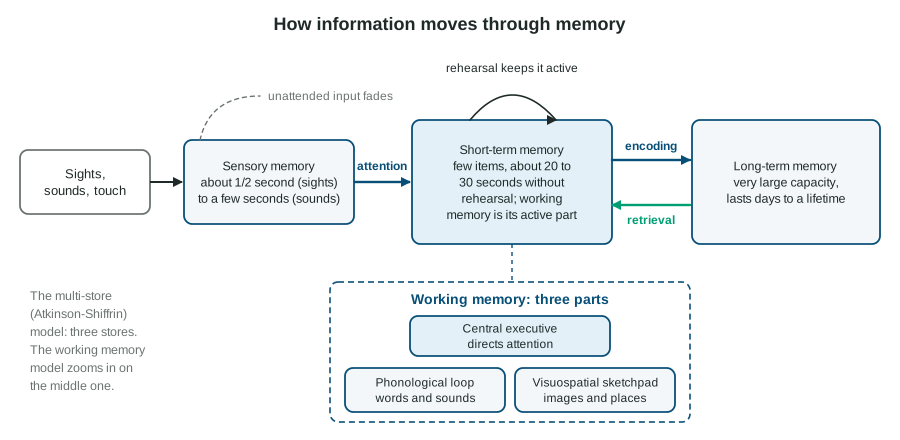
- Sensory input arrivessensory memory holds it for a moment
- Attention selects some of itit enters short-term (working) memory, where it can be worked on
- It is encoded, especially by thinking about meaningit is stored in long-term memory, supported by stronger synapses (LTP)
- A later need arisesretrieval brings it back into working memory
Part 6 · Key ideas
Key ideas
- Memory works in three steps: encoding, storage and retrieval.
- Explicit memory can be stated: episodic (events) and semantic (facts). Implicit memory shows in behavior, like procedural skills. Prospective memory is remembering to act later.
- The multi-store model: sensory memory, then short-term memory, then long-term memory. Working memory is the active short-term workspace: central executive, phonological loop, visuospatial sketchpad.
- Some information is encoded by automatic processing, some only by effortful processing. Deep processing of meaning beats shallow processing.
- Long-term potentiation strengthens synapses and is thought to underlie learning and memory.
Part 7 · Misconception
A common mistake
The wrong idea: Memory is one thing: you either have a good memory or a bad one.
What actually happens: There are several memory systems. A person can lose the ability to form new event memories yet still learn new skills, because explicit and implicit memory depend partly on different brain systems.
Part 8 · Check yourself
Check yourself
Exam-style questions. Anything you miss goes into your review queue.
Study
Thinking about meaning and remembering words
Introduction
Researchers tested whether the kind of question people answer about a word changes how well they remember it later.
Participants
90 adults (ages 18-60) recruited through a community library took part. All gave informed consent, and the consent form explained they could withdraw at any time.
Method
Each participant saw the same 40 words, one at a time, and answered one yes-or-no question about each. A computer randomly assigned each participant to one of three conditions (30 per condition). Letters condition: "Is the word in capital letters?" Rhyme condition: "Does the word rhyme with train?" Meaning condition: "Would the word fit in the sentence She put the ___ on the table?" Participants were not told there would be a memory test. Twenty minutes later they were given a surprise test: a list of 80 words (the 40 they saw and 40 new ones), and they marked each word they had seen.
Results
The letters group correctly marked 15% of the words they had seen, the rhyme group 45%, and the meaning group 78%.
Discussion
Afterward, every participant was told why the test had been a surprise and could ask to have their data removed.
Invented study for practice.
1. Which concept do the results best support?
- Levels of processing: thinking about meaning leads to better memory
- Procedural memory: practicing a skill makes it automatic
- Prospective memory: people remember planned actions better than words
- Sensory memory: words held for a moment are fully stored
Show the answer
The three questions differ in depth: letters (shallow, appearance), rhyme (sound), meaning (deep). Memory rose with depth, as the levels-of-processing idea predicts.
- Correct: Levels of processing: thinking about meaning leads to better memory: Right: The three questions differ in depth: letters (shallow, appearance), rhyme (sound), meaning (deep). Memory rose with depth, as the levels-of-processing idea predicts.
- Procedural memory: practicing a skill makes it automatic: Procedural memory is for skills and habits. Marking words seen is explicit memory for facts, not a skill.
- Prospective memory: people remember planned actions better than words: Prospective memory is remembering to do something in the future. No one had to remember to carry out an action.
- Sensory memory: words held for a moment are fully stored: Sensory memory lasts under a few seconds. The test came 20 minutes later and depended on how the words were processed.
2. How did this study operationally define memory for the words?
- The type of question a participant answered about each word
- The percent of seen words correctly marked on the 80-word list
- How deeply a participant thought about the words while reading
- The amount of time between seeing the words and the test
Show the answer
An operational definition says exactly how this study measured the variable: correctly marked words on the surprise list, reported as a percent.
- The type of question a participant answered about each word: That is the independent variable, which the researchers assigned.
- Correct: The percent of seen words correctly marked on the 80-word list: Right: An operational definition says exactly how this study measured the variable: correctly marked words on the surprise list, reported as a percent.
- How deeply a participant thought about the words while reading: Depth of thought is the idea being tested. The study measured marked words, not thought directly.
- The amount of time between seeing the words and the test: The 20-minute delay was the same for everyone. It is a controlled detail, not the measure.
Data
Two tasks at once
| During the 20 seconds | Digits recalled |
|---|---|
| Nothing | 86% |
| Repeating "the the the" | 52% |
| Tapping a visual pattern | 80% |
Forty students held a list of 7 spoken digits in mind for 20 seconds, then said them back. During the 20 seconds, every student did each of three things on different trials: nothing, repeating "the the the" out loud, or tapping a pattern on a keypad they could see. The table shows the percent of digits recalled in order.
3. Repeating "the the the" hurt digit recall much more than tapping a pattern. Which part of working memory best explains this?
- The visuospatial sketchpad, which holds images and places
- Long-term memory, which has a very large capacity
- Sensory memory, which holds sounds for a few seconds
- The phonological loop, which holds words and sounds
Show the answer
Saying words out loud uses the same sound-based store that keeps spoken digits in mind, so the two tasks compete. Tapping uses the visuospatial sketchpad, which competes much less.
- The visuospatial sketchpad, which holds images and places: If the sketchpad held the digits, tapping a visual pattern would have hurt recall most. It hurt least.
- Long-term memory, which has a very large capacity: The digits were held for only 20 seconds; the result is about what competes for space in the short-term store.
- Sensory memory, which holds sounds for a few seconds: Echoic memory fades within seconds, long before the 20-second delay ended.
- Correct: The phonological loop, which holds words and sounds: Right: Saying words out loud uses the same sound-based store that keeps spoken digits in mind, so the two tasks compete. Tapping uses the visuospatial sketchpad, which competes much less.
4. Maya remembers her eighth birthday party, the cake and who was there. Which kind of memory is this?
- Semantic memory
- Episodic memory
- Procedural memory
- Prospective memory
Show the answer
Memory of a specific personal event, tied to a time and place, is episodic memory, a kind of explicit memory.
- Semantic memory: Semantic memory holds general facts, like knowing what a birthday is, not a particular one you lived through.
- Correct: Episodic memory: Right: Memory of a specific personal event, tied to a time and place, is episodic memory, a kind of explicit memory.
- Procedural memory: Procedural memory is for skills, like riding a bike. Maya is recalling an event.
- Prospective memory: Prospective memory is remembering to do something later. Maya is remembering the past.
5. Years after learning, Lena types quickly without thinking about where the keys are, but she cannot say where the letter G is without picturing a keyboard. Which kind of memory lets her type?
- Semantic memory
- Episodic memory
- Prospective memory
- Procedural memory
Show the answer
Skills done without conscious recall are procedural memory, a kind of implicit memory. That is why she can type G but cannot easily say where it is.
- Semantic memory: Semantic memory holds facts you can state. Lena cannot easily state where G is, yet she types it.
- Episodic memory: Episodic memory is a personal event. Typing is a skill, not a remembered event.
- Prospective memory: Prospective memory is remembering to act in the future, like remembering to send a message.
- Correct: Procedural memory: Right: Skills done without conscious recall are procedural memory, a kind of implicit memory. That is why she can type G but cannot easily say where it is.
6. A patient with damage to the hippocampus cannot form new memories of events, yet over several days gets faster at tracing a star in a mirror without remembering ever practicing. What does this show?
- Memory is stored in one single brain system, so the patient's impairment is mild
- Procedural memory needs conscious awareness of each earlier practice session
- Short-term memory is unaffected, so the practice is being held in sensory memory
- Explicit and implicit memory depend partly on different brain systems
Show the answer
The patient lost the ability to form new explicit memories (events) but still learned a skill (implicit, procedural memory). The two kinds of memory can come apart.
- Memory is stored in one single brain system, so the patient's impairment is mild: If one system stored everything, the skill could not improve while event memory failed.
- Procedural memory needs conscious awareness of each earlier practice session: The patient improved without remembering practicing, so the skill did not need conscious recall.
- Short-term memory is unaffected, so the practice is being held in sensory memory: Sensory memory lasts seconds. Improvement over days shows lasting learning.
- Correct: Explicit and implicit memory depend partly on different brain systems: Right: The patient lost the ability to form new explicit memories (events) but still learned a skill (implicit, procedural memory). The two kinds of memory can come apart.
Part 9 · Summary
Summary
Part 10 · Up next
What comes next
Part 11 · Connections