Encoding Memories
Encoding improves when information is organized (mnemonics, the method of loci, chunking, hierarchies) and when study is spread out (distributed practice and the spacing effect) instead of crammed (massed practice).
Part 1 · Hook
Why this matters
Part 2 · Before you start
What this builds on
Part 3 · Prerequisite check
Quick check before you start
1. About how long does short-term memory hold information without repetition?
- About 20 to 30 seconds
- Less than one second
- About a day
- For years
Show the answer
Short-term memory fades within about 20 to 30 seconds unless the information is repeated or worked on.
- Correct: About 20 to 30 seconds:
- Less than one second:
- About a day:
- For years:
2. Which kind of processing leads to the strongest memory?
- Deep processing of meaning
- Shallow processing of how a word looks
- Shallow processing of how a word sounds
- No processing at all
Show the answer
Thinking about meaning (deep processing) produces stronger memories than attending to appearance or sound.
- Correct: Deep processing of meaning:
- Shallow processing of how a word looks:
- Shallow processing of how a word sounds:
- No processing at all:
Part 4 · See it
See it first
Part 5 · Step by step
How it works, step by step
- Information is organized into chunks, hierarchies or mnemonicsmore of it fits in short-term memory and it links to what you know
- Study is spread over several sessionseach session rebuilds the memory, so it lasts longer (the spacing effect)
- A list is learned in one passthe first items reach long-term memory (primacy) and the last stay in short-term memory (recency)
- A delay fills short-term memory with something elsethe recency effect fades but the primacy effect stays
Part 6 · Key ideas
Key ideas
- Mnemonics link new information to an easy pattern; the method of loci places items along an imagined route.
- Chunking groups items into meaningful units; hierarchies organize from general to specific. Both use what you already know.
- Distributed practice beats massed practice (cramming) for long-term memory: the spacing effect.
- The serial position effect: the first items (primacy, in long-term memory) and last items (recency, still in short-term memory) are recalled best.
Part 7 · Misconception
A common mistake
The wrong idea: Cramming works just as well as spacing, because you can do well on the next day's test.
What actually happens: Cramming can help on a test the next day, but spaced study leads to much better memory weeks later. If you need it for the final or the AP® Psychology exam, spread it out.
Part 8 · Check yourself
Check yourself
Exam-style questions. Anything you miss goes into your review queue.
Data
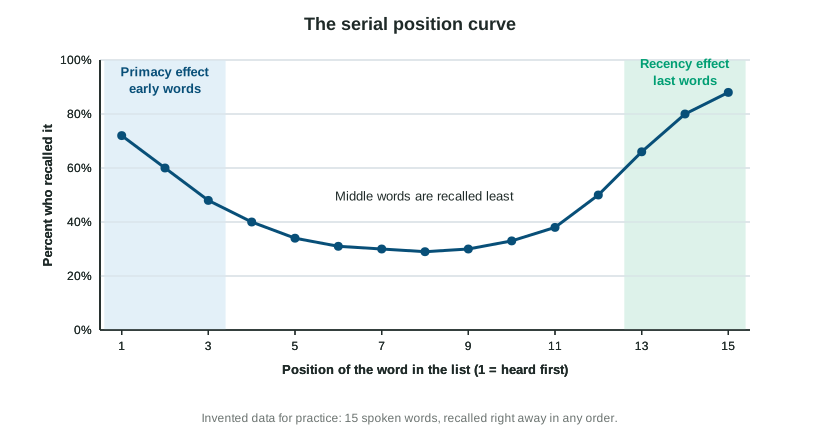
A serial position curve from a recall study
Sixty students heard a list of 15 unrelated words, one every two seconds, and then wrote down as many as they could in any order. A computer randomly assigned half the students to write the words right away. The other half first counted backward by threes for 30 seconds, which kept them from repeating the words to themselves. The graph shows the percent of students in each group who recalled the word at each position.
1. In the "recall right away" group, words 1 to 3 were recalled more often than words 6 to 10. Which concept names this part of the curve?
- The primacy effect
- The recency effect
- The spacing effect
- Chunking
Show the answer
Better recall for the first items in a list is the primacy effect. Early words get more chances to be repeated and encoded into long-term memory.
- Correct: The primacy effect: Right: Better recall for the first items in a list is the primacy effect. Early words get more chances to be repeated and encoded into long-term memory.
- The recency effect: The recency effect is better recall for the last items, at the right end of the curve.
- The spacing effect: The spacing effect is about studying in spread-out sessions. All the words here were heard in one session.
- Chunking: Chunking groups items into meaningful units. These were unrelated words heard one at a time.
2. For word 15, how many percentage points lower was recall after 30 seconds of counting than right away?
Type a number. No calculator needed: work it out by hand, as on the exam.
Show the answer
Right away, 88% recalled word 15; after counting, 32% did. percentage points.
- Answer: 56
3. The 30-second counting task almost erased the recency effect but barely changed the primacy effect. Which explanation fits best?
- Counting improved encoding of the first words, which raised the primacy effect
- Counting pushed the last words out of short-term memory; early words were already in long-term memory
- The early words were held in sensory memory, which lasts longer than short-term memory
- The students in the counting group were less motivated, so they recalled fewer words overall
Show the answer
Recently heard words sit in short-term memory, which lasts only seconds without repetition; counting backward pushed them out. The first words had been repeated more and encoded into long-term memory, so a short delay barely touched them.
- Counting improved encoding of the first words, which raised the primacy effect: Primacy barely changed (72% and 70% for word 1). Counting did not improve anything.
- Correct: Counting pushed the last words out of short-term memory; early words were already in long-term memory: Right: Recently heard words sit in short-term memory, which lasts only seconds without repetition; counting backward pushed them out. The first words had been repeated more and encoded into long-term memory, so a short delay barely touched them.
- The early words were held in sensory memory, which lasts longer than short-term memory: Sensory memory fades within seconds, faster than short-term memory, so it cannot explain early words surviving.
- The students in the counting group were less motivated, so they recalled fewer words overall: Random assignment makes the groups alike in motivation, and the drop appears only at the end of the list.
4. To remember a 10-digit phone number, Kenji remembers it as an area code, a three-digit prefix and four digits. Which strategy is he using?
- The method of loci
- Massed practice
- The primacy effect
- Chunking
Show the answer
Grouping single digits into a few meaningful units is chunking. It lets short-term memory hold more, because each chunk counts as one item.
- The method of loci: The method of loci links items to places on an imagined route. Kenji is grouping digits, not placing them.
- Massed practice: Massed practice is cramming in one long session. Kenji is organizing the number, not timing his study.
- The primacy effect: The primacy effect is better memory for the first items in a list. It is a result, not a strategy.
- Correct: Chunking: Right: Grouping single digits into a few meaningful units is chunking. It lets short-term memory hold more, because each chunk counts as one item.
5. To memorize a speech, Aisha pictures walking through her house and places each point in a different room. During the speech she "walks" through the rooms. Which mnemonic is this?
- The method of loci
- Chunking
- Hierarchical organization
- Distributed practice
Show the answer
Linking items to familiar places along an imagined route, then walking the route to recall them, is the method of loci (a memory palace).
- Correct: The method of loci: Right: Linking items to familiar places along an imagined route, then walking the route to recall them, is the method of loci (a memory palace).
- Chunking: Chunking groups items into larger units. Aisha is linking each point to a place.
- Hierarchical organization: A hierarchy organizes items from general to specific categories. Aisha is using an imagined route.
- Distributed practice: Distributed practice spreads study over time. The question is about how she encodes, not when.
6. A hiring manager interviews eight candidates in one day. At the end of the day, she remembers the last two clearly but the middle ones blur together. Which concept explains her clear memory of the last two?
- The recency effect
- The primacy effect
- The spacing effect
- Chunking
Show the answer
Better memory for the last items in a series is the recency effect; the most recent information is still active in memory.
- Correct: The recency effect: Right: Better memory for the last items in a series is the recency effect; the most recent information is still active in memory.
- The primacy effect: The primacy effect is better memory for the first items. She remembers the last ones.
- The spacing effect: The spacing effect concerns study spread over time. The interviews were all on one day.
- Chunking: Chunking groups items into units. She did not group the candidates.
Part 9 · Summary
Summary
Part 10 · Up next
What comes next
Part 11 · Connections