Storing Memories
Repeating information (maintenance rehearsal) holds it briefly; linking it to meaning (elaborative rehearsal) stores it.
Part 1 · Hook
Why this matters
Part 2 · Before you start
What this builds on
Part 3 · Prerequisite check
Quick check before you start
1. Which brain structure is most important for forming new explicit memories?
- Hippocampus
- Cerebellum
- Medulla
- Occipital lobe
Show the answer
The hippocampus is key to forming new long-term memories of facts and events.
- Correct: Hippocampus:
- Cerebellum:
- Medulla:
- Occipital lobe:
2. Which kind of processing produces the strongest memories?
- Deep processing of meaning
- Shallow processing of appearance
- Automatic processing of time
- Sensory memory
Show the answer
Thinking about meaning gives stronger memories than attending to how words look or sound.
- Correct: Deep processing of meaning:
- Shallow processing of appearance:
- Automatic processing of time:
- Sensory memory:
Part 4 · See it
See it first
Part 5 · Step by step
How it works, step by step
- Information is repeated without thinking about it (maintenance rehearsal)it stays in short-term memory for now but is often not stored
- Information is linked to meaning (elaborative rehearsal)it is encoded deeply into long-term memory
- The hippocampus and sleep consolidate the new memory over hours and daysit becomes stable
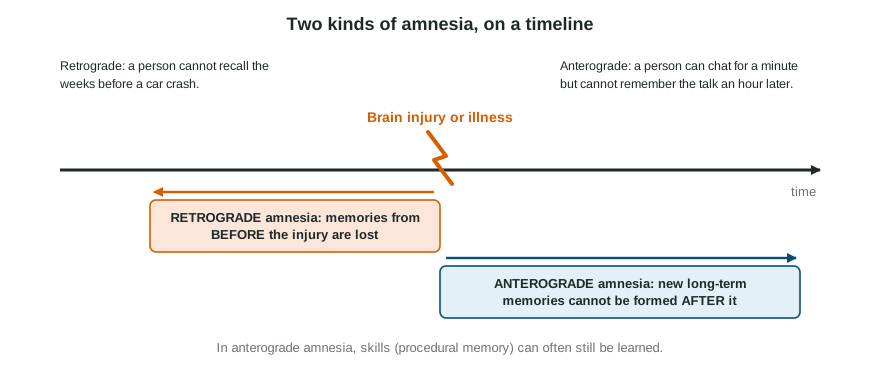
- Brain damage interrupts consolidation or the hippocampusretrograde or anterograde amnesia
Part 6 · Key ideas
Key ideas
- Maintenance rehearsal (repeating) keeps information in short-term memory; elaborative rehearsal (linking to meaning) moves it into long-term memory.
- Memory consolidation stabilizes new memories over hours to days, helped by the hippocampus and sleep.
- Retrograde amnesia loses memories from before an injury; anterograde amnesia blocks new memories after it, yet skills can still be learned.
- Alzheimer's disease is a progressive disease that often begins with trouble forming new memories. Infantile amnesia is the normal lack of memories before about age 3.
- Highly superior autobiographical memory is a very rare, extremely detailed memory for one's own life.
Part 7 · Misconception
A common mistake
The wrong idea: A person with amnesia, like in the movies, forgets who they are but can learn new things normally.
What actually happens: Most amnesia from brain damage is anterograde: people keep their identity and old memories but cannot form new explicit memories, though they can still learn skills.
Part 8 · Check yourself
Check yourself
Exam-style questions. Anything you miss goes into your review queue.
Study
A patient who cannot keep new memories
Introduction
Researchers described one patient in depth to learn which kinds of memory survive damage to the hippocampus.
Participants
One patient, called R.T. in the report to protect his identity: a 58-year-old retired electrician whose hippocampus on both sides was damaged by a brain infection. R.T. and his wife both gave written informed consent.
Method
Over 18 months the researchers interviewed R.T. and his wife, reviewed his medical records and brain scans, and gave him memory tests. On each of five days he also practiced tracing a star while seeing his hand only in a mirror, and the researchers timed each attempt.
Results
R.T. could not recall the researchers from one visit to the next or name anything that had happened since the infection. He recalled his childhood, his wedding and his years at work in detail. Memories of the two years just before the infection were patchy. His mirror-tracing time fell from 90 seconds on day 1 to 35 seconds on day 5, though each day he said he had never done the task.
Discussion
The researchers concluded that the hippocampus is needed to form new explicit memories but not to keep old ones or to learn new skills.
Invented study for practice.
1. Which research method did the researchers use?
- A case study
- An experiment
- A correlational study
- Naturalistic observation
Show the answer
An in-depth study of one person, using interviews, records and tests, is a case study.
- Correct: A case study: Right: An in-depth study of one person, using interviews, records and tests, is a case study.
- An experiment: An experiment manipulates a variable and randomly assigns participants to conditions. There was one patient and no groups.
- A correlational study: A correlational study measures two variables across many people to see how they relate. This study described one person in depth.
- Naturalistic observation: Naturalistic observation watches behavior in its usual setting without testing. The researchers gave R.T. tests and a task.
2. R.T. cannot form memories of anything that happened after the infection. Which concept names this?
- Retrograde amnesia
- Anterograde amnesia
- Infantile amnesia
- Superior autobiographical memory
Show the answer
Being unable to form new long-term memories after brain damage is anterograde amnesia.
- Retrograde amnesia: Retrograde amnesia is losing memories from before the damage. R.T.'s main problem is forming new ones.
- Correct: Anterograde amnesia: Right: Being unable to form new long-term memories after brain damage is anterograde amnesia.
- Infantile amnesia: Infantile amnesia is the normal lack of memories from the first few years of life. It is not caused by brain damage.
- Superior autobiographical memory: That is an unusually detailed memory for one's own life, the opposite of R.T.'s problem.
3. R.T.'s mirror-tracing time fell over five days though he did not remember practicing. Which conclusion does this best support?
- His anterograde amnesia went away by day 5
- Mirror tracing is stored in sensory memory
- Procedural memory can form without the hippocampus
- Old explicit memories are needed to learn a skill
Show the answer
Getting faster at a skill without conscious memory of practice shows implicit, procedural learning. It survived the hippocampal damage that blocked new explicit memories.
- His anterograde amnesia went away by day 5: He still said each day that he had never done the task, so his explicit memory did not return.
- Mirror tracing is stored in sensory memory: Sensory memory lasts seconds. Improvement across five days shows lasting learning.
- Correct: Procedural memory can form without the hippocampus: Right: Getting faster at a skill without conscious memory of practice shows implicit, procedural learning. It survived the hippocampal damage that blocked new explicit memories.
- Old explicit memories are needed to learn a skill: His improvement came from new practice, not from his old memories of work or childhood.
4. Waiting to pay, Elena repeats a new friend's phone number over and over until she types it into her phone. A week later she cannot recall it. Which kind of rehearsal did she use?
- Elaborative rehearsal
- Memory consolidation
- Maintenance rehearsal
- The method of loci
Show the answer
Repeating information to keep it in short-term memory is maintenance rehearsal. It holds the number for now but does little to store it long term.
- Elaborative rehearsal: Elaborative rehearsal links information to meaning. Elena only repeated digits.
- Memory consolidation: Consolidation stabilizes a memory over time. Elena's repetition did not lead to a lasting memory.
- Correct: Maintenance rehearsal: Right: Repeating information to keep it in short-term memory is maintenance rehearsal. It holds the number for now but does little to store it long term.
- The method of loci: The method of loci places items on an imagined route. Elena just repeated the number.
5. After a car crash, Marcus cannot remember the week before the accident, though he forms new memories normally. Which concept describes his memory loss?
- Anterograde amnesia
- Infantile amnesia
- Maintenance rehearsal
- Retrograde amnesia
Show the answer
Losing memories formed before a brain injury is retrograde amnesia. Recent memories, not yet fully consolidated, are the most likely to be lost.
- Anterograde amnesia: Anterograde amnesia is the inability to form new memories after the injury. Marcus forms new memories normally.
- Infantile amnesia: Infantile amnesia is the normal lack of memories from early childhood, not loss after an injury.
- Maintenance rehearsal: Maintenance rehearsal is a way of repeating information, not a kind of memory loss.
- Correct: Retrograde amnesia: Right: Losing memories formed before a brain injury is retrograde amnesia. Recent memories, not yet fully consolidated, are the most likely to be lost.
6. Most adults can recall almost nothing from before about age 3, though they experienced many events then. Which concept names this?
- Infantile amnesia
- Retrograde amnesia
- Anterograde amnesia
- Alzheimer's disease
Show the answer
The normal absence of memories from the first few years of life is infantile amnesia. It is linked to the immaturity of the hippocampus and to young children not yet having language and a sense of self to organize memories.
- Correct: Infantile amnesia: Right: The normal absence of memories from the first few years of life is infantile amnesia. It is linked to the immaturity of the hippocampus and to young children not yet having language and a sense of self to organize memories.
- Retrograde amnesia: Retrograde amnesia follows brain damage and wipes out memories that had been formed. Infantile amnesia is normal and has no injury.
- Anterograde amnesia: Anterograde amnesia is the inability to form new memories now. Adults form new memories normally.
- Alzheimer's disease: Alzheimer's disease is a progressive brain disease, usually in older adults. Infantile amnesia happens to almost everyone.
Part 9 · Summary
Summary
Part 10 · Up next
What comes next
Part 11 · Connections