Getting information into memory is only the start. To be useful later it has to be stored, and storage is not instant. This topic covers how rehearsal decides what is kept, how new memories become stable, and what happens when storage fails.
Two kinds of rehearsal
Maintenance rehearsal is repeating information over and over: saying a phone number to yourself until you type it in. It keeps information alive in short-term memory, but once you stop, it is usually gone. Repetition alone does little to store it.
Elaborative rehearsal links new information to meaning and to what you already know. To remember "hippocampus", you might picture a hippo on a college campus who never forgets where class is. Elaborative rehearsal is deep processing, so it builds long-term memories.
| Maintenance rehearsal | Elaborative rehearsal | |
|---|---|---|
| What you do | repeat it | connect it to meaning and to what you know |
| Keeps it in | short-term memory, for now | long-term memory |
| Example | repeating a code until you enter it | explaining a term in your own words with an example |
Worked example: reading a rehearsal study. Fifty students study the same 20 words for the same time. A coin flip assigns half to repeat each word and half to link each word to a personal memory. The next day, without warning, the repeat group recalls 22% of the words and the link group 58%.
Step 1: the difference: percentage points, in favor of linking.
Step 2: in words: 58% of 20 is about 12 words, against about 4. Same words, same time, very different memory.
Step 3: the concept: linking to memories is elaborative rehearsal, so the result supports elaborative over maintenance rehearsal.
Consolidation: memories need time to set
A new long-term memory is fragile at first. Memory consolidation is the process that stabilizes it over hours to days. The hippocampus is central: it helps bind a new memory together and, over time, its connections in the cortex become strong enough to stand on their own. Sleep helps; people who sleep after learning remember more the next day than people who stay awake for the same hours.
Because consolidation takes time, a blow to the head often wipes out the last minutes before it. A boxer who is knocked out may remember the early rounds but not the punch itself.
When storage fails: amnesia
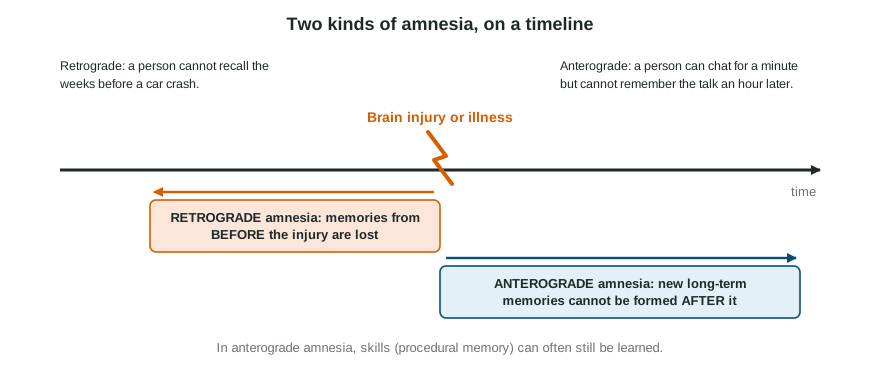
Amnesia is memory loss from brain injury, illness or disease. Which direction it points in is what the exam asks.
- Retrograde amnesia: losing memories from before the injury. Recent memories, not yet consolidated, are usually lost first; old ones from childhood usually survive.
- Anterograde amnesia: being unable to form new long-term memories after the injury, often from damage to the hippocampus. A person can hold a conversation but will not remember it an hour later.
The best-known case is a man known for decades as H.M., who in 1953 had much of the hippocampus and nearby tissue on both sides removed to stop severe seizures. He could no longer form new memories of facts or events for the rest of his life, yet his intelligence was intact and he got better at new motor skills, such as tracing a star in a mirror, while saying each time that he had never done the task. His case showed that explicit and implicit memory depend partly on different systems.
Movies often show amnesia as forgetting who you are while learning new things easily. Real amnesia is usually the reverse.
Alzheimer's disease
Alzheimer's disease is a progressive brain disease, most common after age 65. Abnormal protein deposits build up in and around neurons and the neurons die, and the hippocampus is often affected early. So the first sign is usually trouble forming new memories (forgetting a conversation from the same morning). Over years, the damage spreads, and memory for older events, language, planning and daily tasks decline too. It is a disease, not a normal part of aging.
Two ends of the range
Infantile amnesia is normal: most adults remember almost nothing from before about age 3 or 4. Likely reasons are that the hippocampus is still developing and that young children do not yet have the language and sense of self that organize memories of events.
At the other extreme, highly superior autobiographical memory (HSAM) lets a very small number of people (fewer than a hundred have been confirmed) recall what they did on almost any date for decades, without memory tricks. Interestingly, they are not better than average at memorizing lists in the lab, and their memories can still be distorted. The ability is specific to their own lives.