Much of what feels like forgetting is really a retrieval problem: the memory is stored, but you cannot find it right now. A friend says the first letter of a name and it pops out. You go back to the room where you had a thought and it returns. Retrieval depends on cues, and you can use that when you study.
Recall and recognition
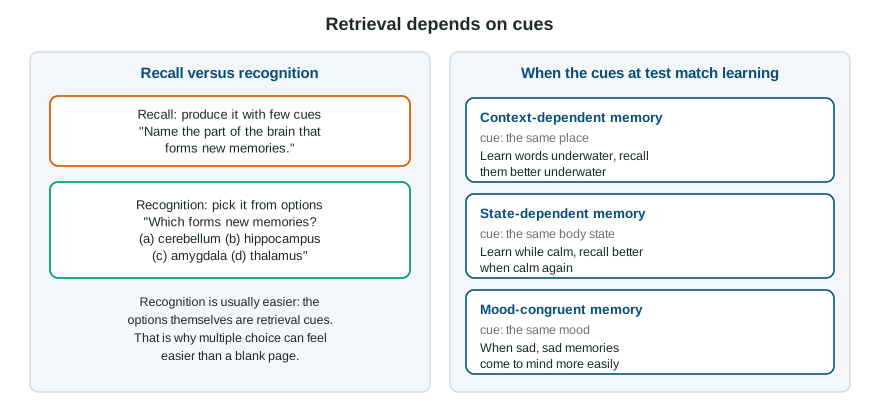
Recall means producing information with few cues, as on a fill-in-the-blank or essay question. Recognition means identifying information you have seen before among options, as on a multiple-choice question. Recognition is usually easier, because the options themselves are retrieval cues: stimuli that lead you back to the stored memory. That is why you can pick a classmate's name from a list long after you could have said it unprompted.
The free-response section of the AP® Psychology exam asks for recall. Studying only by recognizing things in your notes can leave you unready for it.
Matching cues: place, state and mood
When a memory is formed, details of the moment are stored with it. Bringing those details back at retrieval helps.
| Concept | The cue that matches | Example |
|---|---|---|
| Context-dependent memory | the external setting | divers who learned words underwater recalled them better underwater than on land (Godden & Baddeley, 1975) |
| State-dependent memory | the body's internal state | something learned after caffeine is recalled better after caffeine again |
| Mood-congruent memory | the current mood | when you feel sad, sad memories come to mind more easily |
Two cautions. These effects are real but usually modest, and they matter most when there are few other cues: for well-learned material, the room you are tested in makes little difference. And mood-congruent memory is about which memories come to mind, not about learning in a mood; it can keep a low mood going by making sad memories easier to find.
The testing effect
The most useful finding in this topic: retrieval practice, pulling information out of memory, strengthens it more than putting it in again. This is the testing effect.
In a well-known experiment (Roediger & Karpicke, 2006), 120 college students read short science passages. For one passage they studied it again; for the other they spent the same 7 minutes writing down everything they could recall, with no feedback. Five minutes later, restudying looked better (81% of the ideas recalled versus 75%). But two days later the order flipped (68% after testing versus 54% after restudying), and after a week the tested passage was still ahead (56% versus 42%). The finding has been repeated many times, in classrooms as well as labs.
Worked example: reading a testing-effect result. "After one week, students recalled 56% of the ideas from the passage they had practiced retrieving and 42% from the passage they had reread."
Step 1: which group did better? The retrieval practice condition, by percentage points.
Step 2: what does it mean? With the same time spent, practicing retrieval led to better memory a week later than rereading.
Step 3: name the concept: the testing effect. Do not just restate the numbers; say what they show.
Retrieval practice works even better when it is spaced out (from the encoding topic). Flashcards you quiz yourself on over several days, practice questions, and explaining a topic from memory to a friend all count.
Metacognition: knowing what you know
Metacognition is thinking about your own thinking, including judging how well you have learned something. Students are often poor judges. Rereading makes notes feel familiar, and familiarity feels like knowing. Retrieval practice feels harder, because it shows the gaps, so students tend to think it works less well, even when it works better. In studies, students who reread often predict higher scores than students who quizzed themselves, then score lower.
The fix is simple: test yourself with your notes closed. What you can produce is what you know.