Retrieving Memories
Retrieval depends on cues.
Part 1 · Hook
Why this matters
Part 2 · Before you start
What this builds on
Part 3 · Prerequisite check
Quick check before you start
1. What does retrieval mean?
- Getting stored information back out of memory
- Getting information into memory
- Keeping information over time
- Repeating information to hold it
Show the answer
Encoding gets it in, storage keeps it, retrieval gets it back out.
- Correct: Getting stored information back out of memory:
- Getting information into memory:
- Keeping information over time:
- Repeating information to hold it:
2. Which study plan leads to better long-term memory?
- Spreading study over several sessions
- Cramming in one long session
- Reading notes once quickly
- Studying only the first page
Show the answer
The spacing effect: distributed practice beats massed practice for long-term memory.
- Correct: Spreading study over several sessions:
- Cramming in one long session:
- Reading notes once quickly:
- Studying only the first page:
Part 4 · See it
See it first
Part 5 · Step by step
How it works, step by step
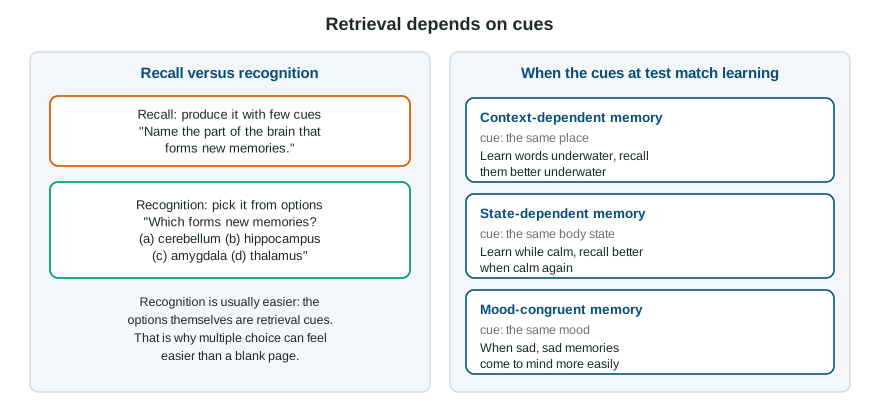
- A memory is stored with features of the setting, body state and moodthose features become retrieval cues
- The same cues are present at the testretrieval is easier (context-dependent, state-dependent and mood-congruent memory)
- Students practice pulling information out of memoryretrieval routes get stronger (the testing effect)
- Rereading makes notes feel familiarstudents overestimate what they know, a failure of metacognition
Part 6 · Key ideas
Key ideas
- Recall produces information with few cues; recognition picks it from options, which act as retrieval cues, so it is usually easier.
- Retrieval is easier when cues match learning: the place (context-dependent), the body's state (state-dependent), and the mood (mood-congruent).
- Retrieval practice (self-quizzing) beats rereading for long-term memory: the testing effect.
- Metacognition is judging your own learning. Familiarity from rereading feels like knowing but is not; testing yourself is the honest check.
Part 7 · Misconception
A common mistake
The wrong idea: Rereading notes and highlighting until they feel familiar is the best way to study.
What actually happens: Familiarity is not memory. Testing yourself, with the notes closed, builds far stronger long-term memory and shows you what you do not know yet.
Part 8 · Check yourself
Check yourself
Exam-style questions. Anything you miss goes into your review queue.
Data
Quizzing or rereading before a unit test
| Review method | Number of students | Percent correct on the unit test | Students' own prediction of their score |
|---|---|---|---|
| Reread the notes twice | 45 | 61% | 78% |
| Took two practice quizzes, no notes | 45 | 79% | 66% |
A teacher randomly assigned 90 ninth graders to review a science lesson in one of two ways for the same 20 minutes. Just before the unit test, each student predicted what percent they would score.
1. Which concept do the test scores show?
- Context-dependent memory
- Mood-congruent memory
- Infantile amnesia
- The testing effect
Show the answer
Students who practiced pulling the information out of memory (quizzes) scored higher than students who reread, after the same review time. That is the testing effect.
- Context-dependent memory: Both groups took the test in the same setting. The difference is in how they reviewed.
- Mood-congruent memory: Mood was not measured or changed.
- Infantile amnesia: Infantile amnesia is the lack of memories from early childhood, unrelated to how teenagers study.
- Correct: The testing effect: Right: Students who practiced pulling the information out of memory (quizzes) scored higher than students who reread, after the same review time. That is the testing effect.
2. By how many percentage points did the rereading group overpredict its own score?
Type a number. No calculator needed: work it out by hand, as on the exam.
Show the answer
Prediction minus actual: percentage points too high.
- Answer: 17
3. The rereading group predicted a higher score than the quiz group but actually scored lower. Which concept best explains the mistaken predictions?
- Poor metacognition: rereading feels familiar, which students mistake for knowing
- State-dependent memory: the students were in a different body state when predicting
- Mood-congruent memory: the rereaders felt more cheerful, so they predicted high
- Recognition: students recognized the notes, so their predictions were accurate
Show the answer
Metacognition is judging your own learning. Rereading makes material feel familiar, so students think they know it; quizzing exposes gaps, so it feels harder even though it works better.
- Correct: Poor metacognition: rereading feels familiar, which students mistake for knowing: Right: Metacognition is judging your own learning. Rereading makes material feel familiar, so students think they know it; quizzing exposes gaps, so it feels harder even though it works better.
- State-dependent memory: the students were in a different body state when predicting: Nothing about the students' body state differed between groups.
- Mood-congruent memory: the rereaders felt more cheerful, so they predicted high: Mood was neither changed nor measured. The rereaders misjudged how well they knew the material, which is a judgment about their own learning.
- Recognition: students recognized the notes, so their predictions were accurate: Recognizing the notes is exactly what misled the rereaders; their predictions were too high.
4. On a test, Grace cannot answer "Name the four lobes of the cerebral cortex," but on a later question she easily picks the occipital lobe from a list of options. Which concept explains the difference?
- Context-dependent memory
- Recognition is easier than recall
- Infantile amnesia
- Maintenance rehearsal
Show the answer
Recall means producing information with few cues; recognition means identifying it among options, which act as retrieval cues. Recognition usually succeeds where recall fails.
- Context-dependent memory: Both questions were on the same test in the same room, so the context did not change.
- Correct: Recognition is easier than recall: Right: Recall means producing information with few cues; recognition means identifying it among options, which act as retrieval cues. Recognition usually succeeds where recall fails.
- Infantile amnesia: Infantile amnesia is about early childhood memories, not test questions.
- Maintenance rehearsal: Maintenance rehearsal is repeating information to hold it. It does not explain why options help.
5. Walking into the kitchen, Tom forgets why he came. He goes back to the couch where he had the thought, and it comes back to him. Which concept explains this?
- State-dependent memory
- Mood-congruent memory
- Context-dependent memory
- Recognition
Show the answer
Returning to the place where the thought was formed brought back cues from that context, which helped him retrieve it.
- State-dependent memory: State-dependent memory depends on an internal state (calm, sleepy, under a drug). Tom changed his location.
- Mood-congruent memory: Mood-congruent memory is recalling memories that fit your mood. Tom's mood is not part of the story.
- Correct: Context-dependent memory: Right: Returning to the place where the thought was formed brought back cues from that context, which helped him retrieve it.
- Recognition: Recognition is picking the right answer from options. Tom produced the thought himself once the cues returned.
6. A friend shows Ben a photo of the beach where they vacationed, and a flood of details about the trip come back. In this example the photo acts as what?
- A sensory memory
- Maintenance rehearsal
- A retrieval cue
- Mood-congruent memory
Show the answer
A retrieval cue is any stimulus that helps bring a stored memory back. The photo connects to the stored memory of the trip.
- A sensory memory: Sensory memory lasts seconds. The photo brings back a memory stored years ago.
- Maintenance rehearsal: Maintenance rehearsal is repeating information to hold it. Seeing a photo is not repeating.
- Correct: A retrieval cue: Right: A retrieval cue is any stimulus that helps bring a stored memory back. The photo connects to the stored memory of the trip.
- Mood-congruent memory: Mood-congruent memory is recall that matches a mood. The photo is an external cue, not a mood.
Part 9 · Summary
Summary
Part 10 · Up next
What comes next
Part 11 · Connections