Forgetting and Other Memory Challenges
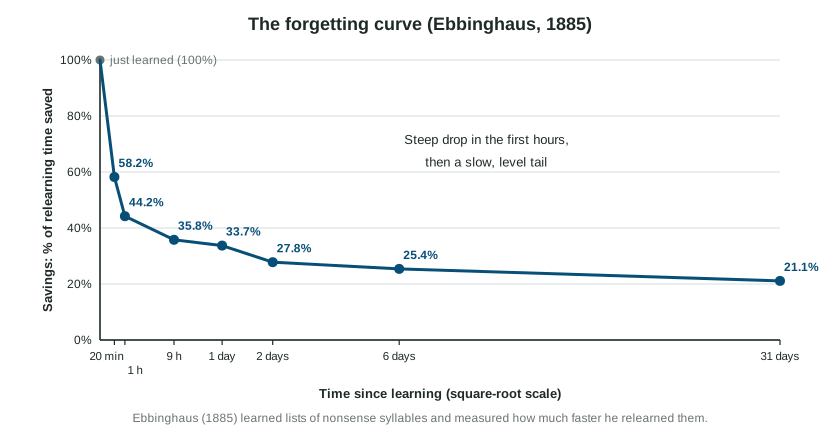
We forget quickly at first and then more slowly (the forgetting curve).
Part 1 · Hook
Why this matters
Part 2 · Before you start
What this builds on
Part 3 · Prerequisite check
Quick check before you start
1. Which strategy is most likely to reduce forgetting before a test four weeks away?
- Spaced practice over several sessions
- One long cramming session
- Rereading once the night before
- Repeating facts silently once
Show the answer
The spacing effect: distributed practice gives better long-term retention.
- Correct: Spaced practice over several sessions:
- One long cramming session:
- Rereading once the night before:
- Repeating facts silently once:
2. Why is recognition usually easier than recall?
- The options act as retrieval cues
- Recognition uses sensory memory
- Recall needs no stored memory
- Recognition never involves retrieval
Show the answer
In recognition the options themselves cue the stored memory.
- Correct: The options act as retrieval cues:
- Recognition uses sensory memory:
- Recall needs no stored memory:
- Recognition never involves retrieval:
Part 4 · See it
See it first
Part 5 · Step by step
How it works, step by step
- Information is never attended toit is never stored (encoding failure)
- Other learning competes with a memoryretrieval is blocked (proactive or retroactive interference)
- A memory is retrieved and rebuiltgaps are filled with expectations (constructive memory)
- Misleading information or repeated imagining comes in during rebuildingconfident false memories form (misinformation effect, imagination inflation)
Part 6 · Key ideas
Key ideas
- The forgetting curve: much is lost quickly, then the rest fades slowly. Spacing and retrieval practice flatten it.
- Forgetting can be encoding failure (never stored), interference (proactive: old blocks new; retroactive: new blocks old), or retrieval failure (the tip-of-the-tongue state).
- Repression is the psychodynamic account of forgetting threatening memories; the evidence for it is weak.
- Memory is constructive: the misinformation effect, source amnesia and imagination inflation can create confident false memories.
Part 7 · Misconception
A common mistake
The wrong idea: If someone remembers an event vividly and confidently, the memory must be accurate.
What actually happens: Confidence and vividness do not guarantee accuracy. Memories are rebuilt each time they are recalled, and misleading questions or repeated imagining can add details that never happened.
Part 8 · Check yourself
Check yourself
Exam-style questions. Anything you miss goes into your review queue.
Study
Eyewitness memory and a leading question
Introduction
Elizabeth Loftus and John Palmer asked whether the wording of a question about an event can change what a witness later remembers about it.
Participants
150 university students in the United States took part in groups.
Method
Every student watched the same short film of a multiple-car accident, then answered questions about it. One group of 50 was asked, "About how fast were the cars going when they smashed into each other?" A second group of 50 was asked the same question with hit instead of smashed into. A control group of 50 was not asked about speed. One week later, all students returned and answered more questions without seeing the film again, including "Did you see any broken glass?" There was no broken glass in the film.
Results
Yes, they had seen broken glass: 16 of 50 students in the smashed group, 7 of 50 in the hit group and 6 of 50 in the control group.
Discussion
The authors argued that the verb "smashed" changed students' memory of the accident itself, adding a detail that was not there.
Loftus, E. F., & Palmer, J. C. (1974). Reconstruction of automobile destruction. Journal of Verbal Learning and Verbal Behavior, 13, 585-589.
1. What was the independent variable in this study?
- The verb used in the question about speed
- Whether the student reported seeing broken glass
- The film of the accident that the students watched
- The one week between the film and the second session
Show the answer
The researchers changed the wording of the question between groups. That is the independent variable.
- Correct: The verb used in the question about speed: Right: The researchers changed the wording of the question between groups. That is the independent variable.
- Whether the student reported seeing broken glass: That was measured a week later. It is the dependent variable.
- The film of the accident that the students watched: Every student saw the same film, so it was held constant.
- The one week between the film and the second session: All groups waited the same week, so it was held constant.
2. What percent of the smashed group reported seeing broken glass?
Type a number (%). No calculator needed: work it out by hand, as on the exam.
Show the answer
.
- Answer: 32 %
3. Which concept do the results best support?
- Proactive interference
- The misinformation effect
- Encoding failure
- The tip-of-the-tongue state
Show the answer
Information given after the event (the word "smashed") was blended into the memory, so more students later remembered broken glass that was never there. That is the misinformation effect.
- Proactive interference: Proactive interference is old learning blocking new learning. The problem here is new information changing an old memory.
- Correct: The misinformation effect: Right: Information given after the event (the word "smashed") was blended into the memory, so more students later remembered broken glass that was never there. That is the misinformation effect.
- Encoding failure: Encoding failure means a detail never got into memory. Students "remembered" glass that was never in the film, which is a distortion, not a gap.
- The tip-of-the-tongue state: The tip-of-the-tongue state is being sure you know something but unable to retrieve it. Students confidently reported a false detail.
4. Ines memorized her new locker combination this year, but when she tries to open her locker she keeps entering last year's combination. Which concept explains this?
- Retroactive interference
- Proactive interference
- Source amnesia
- Encoding failure
Show the answer
Old learning (last year's code) is disrupting the recall of new learning (this year's code). Pro means forward: old interferes forward in time.
- Retroactive interference: Retroactive interference is new learning disrupting old memories. Here the old code is blocking the new one.
- Correct: Proactive interference: Right: Old learning (last year's code) is disrupting the recall of new learning (this year's code). Pro means forward: old interferes forward in time.
- Source amnesia: Source amnesia is forgetting where a memory came from. Ines knows which code is which; the old one just intrudes.
- Encoding failure: Encoding failure means the new code never got in. She did memorize it; the old one gets in the way.
5. After a year of studying French, Kai finds that the Spanish words he learned in ninth grade are harder to recall; French words keep coming to mind instead. Which concept explains this?
- Proactive interference
- Infantile amnesia
- Retroactive interference
- Imagination inflation
Show the answer
New learning (French) is disrupting the recall of older learning (Spanish). Retro means backward: new interferes back in time.
- Proactive interference: Proactive interference is older learning blocking new. Here the newer French is blocking the older Spanish.
- Infantile amnesia: Infantile amnesia concerns memories from early childhood, not ninth grade.
- Correct: Retroactive interference: Right: New learning (French) is disrupting the recall of older learning (Spanish). Retro means backward: new interferes back in time.
- Imagination inflation: Imagination inflation is imagining an event making it feel real. Kai is not imagining anything.
6. Two friends remember the same argument very differently, each sure their version is accurate. Which idea best explains how both can be confident?
- Proactive interference: an earlier argument between the same two friends blocks this one
- Encoding failure: neither friend stored any part of it
- Infantile amnesia: early memories are hard to retrieve
- Constructive memory: each rebuilt the event, filling gaps with expectations
Show the answer
Memories are reconstructed each time they are retrieved, using schemas and expectations to fill gaps. Confidence does not guarantee accuracy.
- Proactive interference: an earlier argument between the same two friends blocks this one: Interference can blur memories, but it does not explain two confident, different versions of one event.
- Encoding failure: neither friend stored any part of it: Both remember a lot; their versions differ because memory is rebuilt, not because nothing was stored.
- Infantile amnesia: early memories are hard to retrieve: The argument was recent. Infantile amnesia is about early childhood.
- Correct: Constructive memory: each rebuilt the event, filling gaps with expectations: Right: Memories are reconstructed each time they are retrieved, using schemas and expectations to fill gaps. Confidence does not guarantee accuracy.
Part 9 · Summary
Summary
Part 10 · Up next
What comes next
Part 11 · Connections