
Forgetting is not one thing. Sometimes information never got in, sometimes it is stored but blocked, and sometimes it is still there but has been quietly rewritten. Knowing which is which is what the exam asks, and it matters well beyond the exam: courts convict people on memories.
The forgetting curve
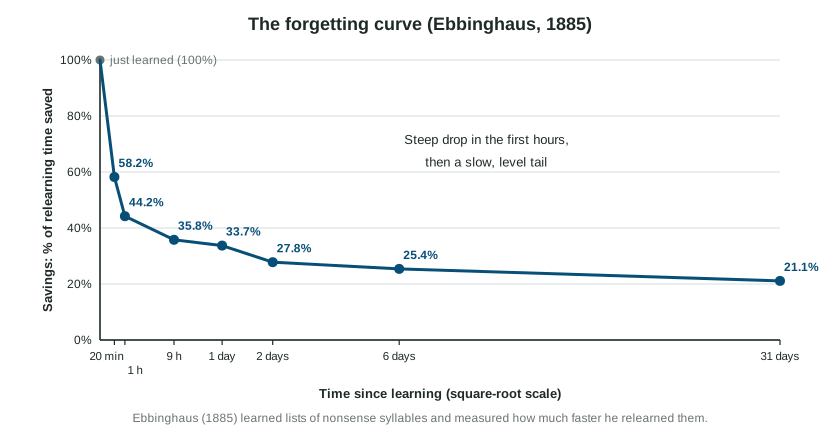
In the 1880s Hermann Ebbinghaus memorized lists of nonsense syllables (like DAX and BOK) and measured how much faster he could relearn them after different delays (Ebbinghaus, 1885). The result was the forgetting curve: he lost much of a list within the first hour, then forgot more and more slowly; after a month, something was still saved. A 2015 replication by Murre and Dros found the same shape. The curve is why the spacing effect and retrieval practice matter: each review lifts memory back up and makes the next drop slower.
Why we forget
Encoding failure. Information that was never attended to was never stored. Most people cannot draw the front of a penny accurately, though they have handled thousands, because they never encoded the details.
Interference. Other learning gets in the way of retrieval.
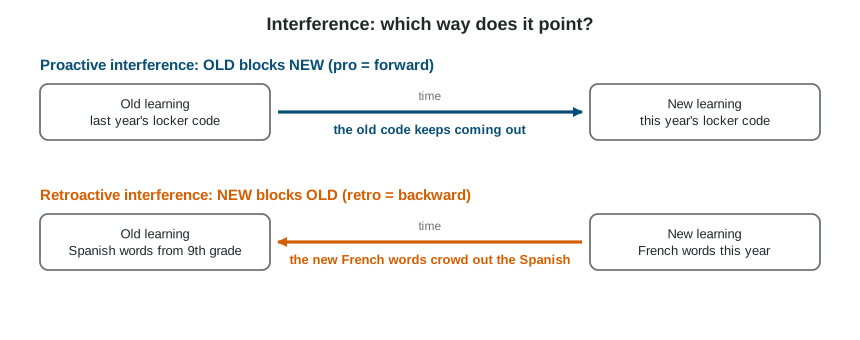
| Proactive interference | Retroactive interference | |
|---|---|---|
| What blocks what | old learning blocks new | new learning blocks old |
| Direction | forward (pro) | backward (retro) |
| Example | you keep writing last year's date in January | after learning French, your old Spanish words are harder to find |
A trick: ask which memory you are trying to get. If you want the new one and the old one intrudes, it is proactive. If you want the old one and the new one intrudes, it is retroactive.
Retrieval failure. In the tip-of-the-tongue phenomenon, you are sure you know a word, you may even recall its first letter or number of syllables, but you cannot produce it. It often pops up later, which shows it was stored all along.
Repression. The psychodynamic perspective, from Freud, says the mind protects itself by pushing anxiety-provoking memories out of awareness. Know the idea, and know its standing: most memory researchers find little good evidence for it. People who live through trauma usually remember it too well, not too little.
Memory is rebuilt, not replayed
Each time you recall an event, you rebuild it from stored pieces, filling the gaps with what you expect and what you have learned since. This is constructive memory (also called reconstructive memory). It is efficient, but it means memories can change without your noticing.
In a classic experiment (Loftus & Palmer, 1974), 150 students watched a film of a car accident. A week after being asked how fast the cars were going when they "smashed into" each other, 16 of 50 students (32%) said they had seen broken glass; after "hit", 7 of 50 (14%); with no speed question, 6 of 50 (12%). There was no broken glass. This is the misinformation effect: misleading information after an event gets blended into the memory. It has been replicated many times and is one reason police are trained to ask open, non-leading questions.
Worked example: a misinformation result, part by part. Using the Loftus and Palmer numbers above.
Method: the researchers changed the verb (manipulated a variable) and compared groups, so it is an experiment.
Measure (operational definition): whether a student answered "yes" to "Did you see any broken glass?" one week later.
Result in words: about a third of the smashed group (32%) reported glass, more than twice the hit group (14%) and the control group (12%).
What it shows: the word "smashed" added a false detail to students' memory of the crash, which supports the misinformation effect.
Two more ways memories go wrong:
- Source amnesia (source misattribution): you remember the information but not where it came from. You tell a story as if it happened to a friend, but you read it online, or you remember a "childhood memory" that is really from a family photo.
- Imagination inflation: repeatedly imagining an event makes it feel familiar, and familiarity is mistaken for memory. In studies, adults asked to imagine childhood events several times grow more confident that those events happened.
Together these can produce false memories: confident, detailed memories of things that did not happen. Researchers have led some adults to "remember" being lost in a shopping mall as a child after relatives "confirmed" it.