Psychology studies things you cannot see directly: memory, attention, mood. So the question behind every finding is the same: how do we know? This page gives you the tools to answer it. On the exam, these tools are worth points in every unit and four of the seven points in the first free-response question.
From a question to a hypothesis
The scientific method means answering questions with evidence instead of opinion. A researcher starts with a question, often from a theory: a broad explanation that organizes many findings and predicts new ones. A theory in science is not a hunch. It is tested over and over and revised when the data disagree.
From the theory comes a hypothesis, a specific prediction that data could support or refute. "Music affects reading" is too vague to test. "Students who read with lyrics playing will answer fewer comprehension questions correctly than students who read in silence" names the groups, the outcome and the direction.
Psychologists also explain the same behavior from different psychological perspectives. Take test anxiety. The biological perspective points to a racing heart and stress hormones. The cognitive perspective points to thoughts like "I always fail". The behavioral perspective points to what was learned from past consequences. The sociocultural perspective points to family and cultural pressure. The evolutionary, psychodynamic and humanistic perspectives add their own questions. Most behavior needs more than one.
Operational definitions: say how you measured it
"Aggression" or "memory" cannot be measured until you say exactly how. An operational definition does that: "aggression was the number of times a child hit or kicked the doll in 10 minutes"; "recall was the number of words written down in two minutes". Another researcher could repeat the study from that sentence alone.
Worked example: writing an operational definition the way the exam wants it.
A summary says: "Students rated their stress on a scale from 1 (not at all stressed) to 10 (extremely stressed) right before the exam."
Misses the point: "Stress is a feeling of pressure or worry." That defines the concept in general, not how this study measured it.
Misses the point: "They used a scale." Which scale, from what to what, when?
Earns the point: "Stress was each student's self-rating from 1 (not at all stressed) to 10 (extremely stressed), given right before the exam."
The experiment: the only method that shows cause
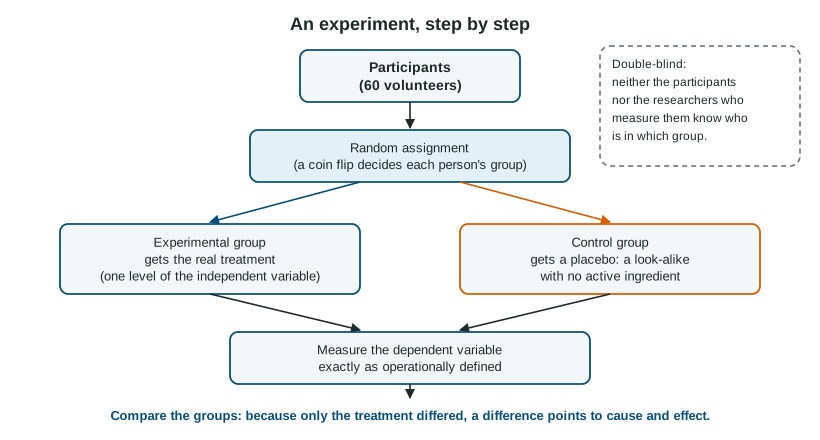
In an experiment the researcher changes one thing on purpose, the independent variable, and measures its effect on another, the dependent variable. The experimental group gets the treatment; the control group does not, and gives a baseline to compare with.
The key step is random assignment: chance, not the participant or the researcher, decides who goes in which group. Why does that matter so much? People differ in sleep, motivation, mood and a hundred other ways. Chance spreads those differences evenly, so the groups start out alike on average. If they differ at the end, the treatment is the only explanation left. That is why only an experiment supports a cause-and-effect conclusion.
Anything other than the independent variable that differs between the groups is a confounding variable. If volunteers choose their own group, motivation is confounded with the treatment. If one group studies for 30 minutes and the other for 10, time is confounded with the kind of studying.
Two more controls deal with expectations. A placebo is a look-alike treatment with no active ingredient; the placebo effect is improvement that comes from expecting to improve. Giving the control group a placebo makes expectations equal. In a single-blind study participants do not know their condition. In a double-blind study the researchers who collect the data do not know either, which also blocks experimenter bias: researchers seeing what they expect to see.
Methods that describe and predict
| Method | What the researcher does | Strength | Limit |
|---|---|---|---|
| Experiment | manipulates an independent variable, randomly assigns participants | shows cause and effect | a lab setting can be artificial |
| Correlational study | measures two or more variables as they occur | shows whether, and how strongly, variables are related; predicts | no cause: a third variable or the reverse direction may explain it |
| Case study | studies one person or a few in depth | rich detail, rare conditions, new hypotheses | one case may not be typical |
| Naturalistic observation | records behavior in its real setting, changing nothing | shows real-world behavior | no control, no cause; observers can be noticed |
| Survey | asks many people to report on themselves | fast, large samples, private topics | wording effects and self-report bias |
A correlation is a relationship between two variables. A correlational study can show that teens who sleep less report more irritability, but not which causes which. A third variable, such as stress, could cause both. The next topics in this chapter treat correlations in detail.
Surveys (also called questionnaires) often use a Likert scale: "rate from 1, strongly disagree, to 5, strongly agree". Two problems recur. A wording effect: "the unfair phone ban" draws different answers than "the phone policy". Social desirability bias: people report what makes them look good, which anonymous answers reduce. Numbers like ratings and counts are quantitative data; interview answers sorted into themes are qualitative data.
Worked example: naming the method.
"Researchers recorded how many minutes each of 200 students spent on social media and their grade averages. Students with more social media time had lower averages."
Ask two questions. Did the researchers manipulate a variable? No: they recorded what students already did. Did they randomly assign anyone? No. So the method is a correlational study, and the conclusion is "social media time and grades are negatively related", not "social media lowers grades". A student who works more hours at a job might have both less study time and more late-night scrolling.
How science checks itself
Before a study is published, other experts read it in peer review. Publication is not the end. A replication repeats a study, often with new participants, to see whether the result holds, and a meta-analysis combines many studies of the same question into one estimate. Around 2015, large replication projects found that many published psychology results were weaker than first reported or did not replicate at all (the replication crisis). Psychology responded with larger samples, plans registered before data collection and more replications. So when this course names a classic finding, it also tells you how well it has held up.