If you are struggling, you are not alone. In the US, call or text 988 (the Suicide and Crisis Lifeline), or talk to a trusted adult.
This topic tours the categories of psychological disorders the course covers, with one or a few representative disorders in each. For each, learn its core feature and any time rule. Exam questions describe a person and ask which disorder fits, so the skill is spotting the feature that separates one disorder from its neighbors. Remember that this is science, not self-diagnosis: many people have some of these experiences now and then, and only a clinician who does a full assessment can diagnose anyone.
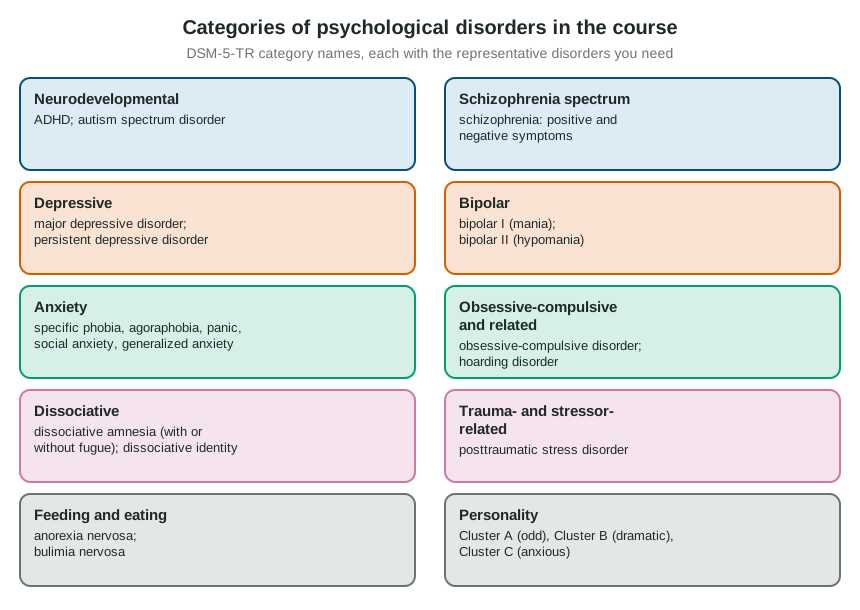
Neurodevelopmental disorders
These begin in early development. Attention-deficit/hyperactivity disorder (ADHD) is a lasting pattern of inattention, hyperactivity and impulsivity, or both, that starts in childhood and shows up in at least two settings, such as home and school. Autism spectrum disorder has two core features: differences in social communication and interaction, and restricted, repetitive behaviors or interests (such as insisting on sameness). "Spectrum" matters: some people with autism need a lot of daily support and others need very little.
Schizophrenia spectrum
Schizophrenia is a break from reality. A diagnosis needs two or more core symptoms for a significant part of a month, with signs lasting at least six months. Its symptoms come in two kinds:
| Positive symptoms | Negative symptoms | |
|---|---|---|
| Meaning | something is added to experience | something normal is reduced or missing |
| Examples | hallucinations (false perceptions, most often voices); delusions (fixed false beliefs); disorganized speech | flat facial and vocal expression; little speech; low motivation; withdrawal |
"Positive" and "negative" mean added and taken away, not good and bad. On the biological side, the dopamine hypothesis links too much dopamine activity to positive symptoms: drugs that block dopamine receptors reduce them. Twin and adoption studies show a genetic contribution, but identical twins share the diagnosis well under half the time, so environment matters too, as the diathesis-stress model predicts.
Depressive and bipolar disorders
| Disorder | Core feature | Time rule |
|---|---|---|
| Major depressive disorder | at least five symptoms, including low mood or loss of interest, plus changes in sleep, appetite, energy, focus or feelings of worth | most days, at least 2 weeks |
| Persistent depressive disorder | depressed mood that lasts, often milder | at least 2 years in adults |
| Bipolar I disorder | at least one manic episode: high or irritable mood, much less need for sleep, racing speech and ideas, risky choices | mania lasts a week or more (or needs hospital care) |
| Bipolar II disorder | at least one hypomanic episode (a milder high) and at least one major depressive episode, never full mania | hypomania lasts 4 days or more |
The trap: depression appears in both columns. What makes a disorder bipolar is a high period, mania or hypomania. Bipolar I can be diagnosed from one manic episode even with no depression, while bipolar II requires depression.
Worked example: which mood disorder? "Last year Kim had two months of deep depression. This spring she had five days of high energy and confidence, slept less, but kept working normally."
Step 1. Is there a high period? Yes, five days of high energy. So it is a bipolar disorder, not a depressive one.
Step 2. Mania or hypomania? It lasted five days and did not seriously disrupt her life, so it is hypomania, not mania.
Step 3. Apply the rule. Hypomania plus a major depressive episode is bipolar II disorder. Had she had a full manic episode, it would be bipolar I.
Anxiety disorders
All involve fear or worry that is out of proportion and gets in the way of life. Tell them apart by what the fear is about.
| Disorder | The fear is about |
|---|---|
| Specific phobia | one object or situation (heights, needles, dogs) |
| Agoraphobia | places where escape or help would be hard (crowds, buses, lines) |
| Panic disorder | unexpected panic attacks, and worry about the next one |
| Social anxiety disorder | being watched, judged or embarrassed by others |
| Generalized anxiety disorder | many everyday things, hard to control, for 6 months or more |
Culture shapes how distress looks. The DSM-5-TR calls these cultural concepts of distress (often called culture-bound syndromes). Ataque de nervios, described in many Latin American communities, is an episode of intense distress, such as shouting, crying, trembling and feeling out of control, often after a family stressor. Taijin kyofusho, described in Japan, is fear that one's body, gaze or odor will offend other people, the reverse of social anxiety's fear of embarrassing oneself.
Obsessive-compulsive and related disorders
In obsessive-compulsive disorder (OCD), obsessions are unwanted, intrusive thoughts or urges that cause anxiety (germs, harm, "did I lock the door?"), and compulsions are repeated acts or mental rituals done to reduce that anxiety (washing, checking, counting). The relief is short, which reinforces the ritual, and the cycle takes up time or causes real distress. Hoarding disorder is lasting difficulty discarding possessions, with distress at parting with them and clutter that blocks living spaces. Do not confuse OCD with obsessive-compulsive personality disorder, below: that one is about perfectionism and control, without intrusive thoughts.
Dissociative disorders
Dissociation is a break in the normal links between memory, identity and awareness. Dissociative amnesia is the loss of memory for personal information, usually about a stressful or traumatic event, that is too large to be ordinary forgetting and has no physical cause. Sometimes it comes with dissociative fugue: travel or wandering with confusion about one's identity. Dissociative identity disorder (DID) involves two or more distinct identity states and recurring gaps in memory. Researchers still debate how often DID grows out of severe early trauma and how much social and therapeutic influences shape it, so treat its causes as an open question.
Trauma- and stressor-related disorders
Posttraumatic stress disorder (PTSD) follows exposure to a traumatic event, such as violence, a disaster or a serious accident. For more than a month the person has intrusive memories (flashbacks, nightmares), avoids reminders, has negative changes in thoughts and mood, and stays on edge (jumpiness, poor sleep). Most people who face trauma do not develop PTSD, which again points to vulnerability plus stress.
Feeding and eating disorders
Anorexia nervosa is restricting food until body weight is significantly low, with intense fear of gaining weight and a distorted view of one's own body. Bulimia nervosa is repeated binge eating (a large amount in a short time with a sense of lost control) followed by compensating behaviors such as vomiting, fasting or excessive exercise; people with bulimia are often at an average weight. Both carry serious health risks and are treatable.
Personality disorders
A personality disorder is a lasting, inflexible pattern of thinking, feeling and relating that begins by adolescence or early adulthood, shows up across settings, and causes distress or dysfunction. The DSM-5-TR groups them in three clusters.
| Cluster | Theme | Disorders |
|---|---|---|
| A | odd or eccentric | paranoid (pervasive distrust), schizoid (detached from relationships), schizotypal (odd beliefs, discomfort with closeness) |
| B | dramatic, emotional or erratic | antisocial (disregard for others' rights, little remorse), histrionic (attention seeking), narcissistic (grandiosity, need for admiration), borderline (unstable emotions, self-image and relationships) |
| C | anxious or fearful | avoidant (fear of rejection), dependent (need to be cared for), obsessive-compulsive personality disorder (perfectionism and control) |
A memory aid many students use: A for "odd," B for "bold" (dramatic), C for "cautious" (anxious).