Are you shy because of the genes you inherited, or because of how you were raised? For most of the twentieth century this was argued as a contest, nature against nurture. Psychologists now ask a better question: how do the two work together? This topic covers that idea and the research designs that pull the two apart.
Nature and nurture work together
Heredity is the passing of traits and tendencies from biological parents to children. The environment is everything else: food, family, schools, friends, culture, accidents, chance. Neither acts alone. Two brothers may both inherit a tendency to be tall, but the one who grows up well fed ends up taller than the one who lives through a famine. Inheritance sets a range of possibilities; the environment decides where in that range a person lands.
The clearest example is phenylketonuria (PKU). It is inherited: the body cannot break down phenylalanine, a part of many proteins. Untreated, phenylalanine builds up and damages the developing brain. In 1953 Bickel, Gerrard and Hickmans reported that a 2-year-old girl with PKU improved on a diet very low in phenylalanine and got worse when it was added back. Later work showed that starting the diet in the first weeks of life largely prevents the damage, so newborns in many countries are now screened. An inherited condition, and the environment (diet) decides what it does.
Measuring heredity's role: twin, family and adoption studies
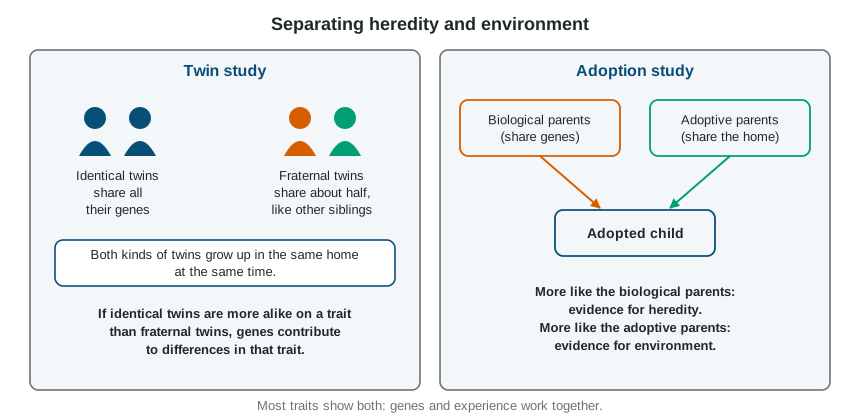
| Design | Who is compared | What points to heredity | Main limit |
|---|---|---|---|
| Family study | relatives of different closeness | a trait more common in closer relatives | families share homes as well as genes |
| Twin study | identical twins (all genes shared) and fraternal twins (about half), both raised together | identical twins more alike than fraternal twins | identical twins may be treated more alike |
| Adoption study | a child, the biological parents and the adoptive parents | the child more like the biological parents | adoptive homes tend to be similar to one another |
These designs report correlations between relatives. Nobody assigns children to families, so each design has its own possible third variables; researchers trust a conclusion most when all three point the same way.
Worked example: reading a twin table. Correlations on a reading test (invented data): identical twins raised together ; fraternal twins raised together ; adoptive siblings raised together .
Heredity: both kinds of twins share a home, but identical twins share more genes and are more alike (0.82 against 0.55). Genes contribute.
Environment: adoptive siblings share no genes but are still somewhat alike (0.25). The shared home contributes too.
Conclusion: both heredity and environment contribute to differences in reading scores in this group.
What heritability does and does not mean
Heritability is the share of the variation in a trait, within a particular group in a particular environment, that is linked to genetic differences. For intelligence test scores, twin and adoption studies usually estimate heritability at about 0.5 in adults (lower in childhood), mostly from samples in wealthier countries.
Three limits matter. First, heritability is about differences among people, not about one person: it never means "60% of your trait comes from your genes". Second, it can change with the environment: when everyone has good food and schooling, more of what remains to differ is genetic. Third, heritability within groups says nothing about the causes of differences between groups. Plant the same seeds in rich and poor soil: within each field, height differences are genetic; the difference between the fields is all soil.
The evolutionary perspective, and its misuse
Evolutionary psychology explains shared human traits by natural selection: inherited traits that helped ancestors survive and have children were passed on more often. A taste for sweet, fatty foods, once rare and full of energy, is a common example; so is a quick fear of snakes and heights. These explanations are about what humans share, and they are hard to test directly, so psychologists treat them as hypotheses to check against evidence.
Claims about heredity have been badly misused. Eugenics, a movement from the late 1800s, tried to "improve" humanity by controlling who could have children. It treated poverty and lack of schooling as inherited defects. In the United States, state laws led to the forced sterilization of tens of thousands of people, and in Nazi Germany eugenics was used to justify mass murder. Modern psychology rejects it on both scientific and ethical grounds: it ignored the environment and denied people's rights.