Your senses do not record the world like a camera. Each one detects a narrow kind of energy, turns it into neural signals, and sends a summary to the brain. That is why the smell of your own house fades, a faint star disappears when you stare at it, and soup tastes flat when your nose is blocked. On the exam you will name the concept behind a scenario like these, read a threshold or detection table, and match a hearing or vision problem to its cause.
From energy to neural signal
Sensation is detecting energy from the world. Every sense starts with transduction: receptor cells convert one form of energy into neural signals. Rods and cones transduce light; hair cells in the inner ear transduce vibration; taste and smell receptors transduce chemicals.
- The absolute threshold is the faintest stimulus a person detects half the time, such as the quietest beep a hearing test can find, or a distant light on a dark night that you see on some tries and miss on others.
- The just-noticeable difference (JND, or difference threshold) is the smallest change a person notices half the time.
- Weber's law: the JND is a constant proportion of the starting stimulus, not a fixed amount. Adding one candle to a dark room is obvious; adding one to a room lit by 100 candles is not.
Worked example: Weber's law. A person can just tell that a 50-gram weight has become 51 grams. About how much must be added to a 200-gram weight to be noticed?
The proportion is , or 2%. For 200 grams, grams.
The common slip is to answer 1 gram, the same amount. Weber's law says the change grows with the size of the stimulus.
Detecting, adapting and mixing
Signal detection theory says noticing a faint stimulus depends on the stimulus and on you: your expectations, your alertness and what it costs to be wrong. A lifeguard who fears missing a swimmer in trouble says "yes" to every splash. She gets more hits (real signals caught) but also more false alarms (saying yes when nothing is there). Someone punished for false alarms becomes cautious and misses more real signals.
Sensory adaptation is a drop in response to a stimulus that does not change: you stop feeling your watch, stop hearing the fridge hum, stop smelling your own kitchen. It lets you notice what is new.
Sensory interaction is one sense changing another. Most of what we call flavor is smell, which is why food tastes flat during a cold. Synesthesia is an unusual blending of senses in which one triggers another: some people see colors when they hear music or read numbers.
Vision
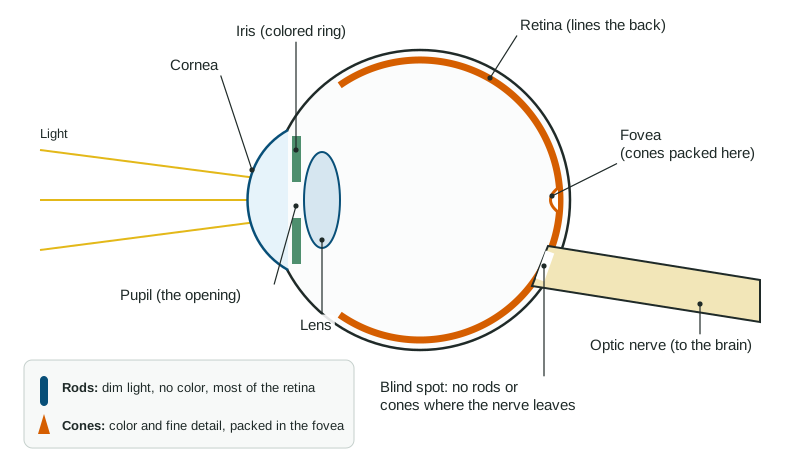
Light enters through the cornea and pupil, and the lens focuses it on the retina at the back of the eye (the figure). The retina has two kinds of receptors.
| Rods | Cones | |
|---|---|---|
| Work best in | dim light | bright light |
| Color | no (black, white, gray) | yes |
| Detail | poor | sharp |
| Where | spread across the retina outside the center | packed in the fovea, the center |
Signals leave the eye along the optic nerve. Where it exits there are no receptors at all, so each eye has a blind spot. You do not notice it because your other eye and your brain fill in the gap.
Two theories explain color, and both are right at different stages.
- Trichromatic theory: the retina has three types of cones, most sensitive to red, green or blue light. Every color is a mix of their signals. When one type is missing or faulty, the result is color vision deficiency, most often red-green, inherited and far more common in males.
- Opponent-process theory: after the cones, color is coded in opposing pairs: red-green, blue-yellow, black-white. Stare at green and that side tires; look at white and you see a red afterimage.
Some visual problems come from the brain, not the eye. In prosopagnosia (face blindness) a person sees faces clearly but cannot recognize them, even family. In blindsight, damage to the visual cortex removes conscious sight on one side, yet the person can still point to or dodge things there without knowing how.
Hearing
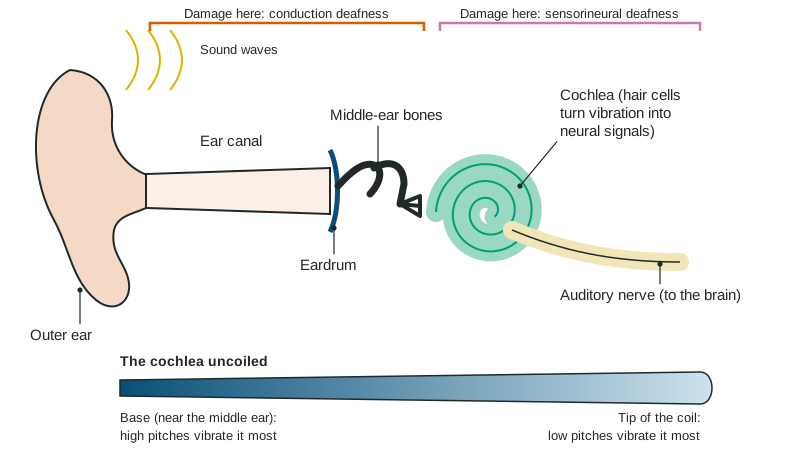
Sound waves travel down the ear canal and vibrate the eardrum. Three tiny middle-ear bones pass the vibration to the cochlea, a fluid-filled coil in the inner ear, where hair cells transduce it into signals for the auditory nerve (the figure).
How do we hear pitch? Three ideas work together.
- Place theory: different pitches vibrate different places along the cochlea, high pitches near the base. Best for high pitches.
- Frequency theory: neurons fire at the same rate as the sound wave. Best for low pitches.
- Volley principle: a single neuron cannot fire more than about 1,000 times a second, so groups take turns, letting frequency coding reach middle pitches.
Hearing loss comes in two kinds. Conduction deafness is a problem getting sound to the cochlea: a punctured eardrum, damaged middle-ear bones, fluid or wax. It can often be fixed medically. Sensorineural deafness is damage to the cochlea's hair cells or the auditory nerve, from loud noise, aging or disease; hair cells do not grow back. Earbuds turned up loud for hours can cause it, and noise usually damages the high-pitch hair cells near the base of the cochlea first.
Smell and taste
Olfaction (smell) detects airborne chemicals with receptors high in the nose. It is the one sense whose signals do not pass through the thalamus first; they go straight toward the brain's emotion and memory areas, which may be why a smell can bring back a memory so strongly.
Gustation (taste) uses taste buds on the tongue to detect sweet, salty, sour, bitter and umami, the savory taste of broth and parmesan. Researchers have proposed oleogustus, a taste for fat, as a sixth. Supertasters have many more taste buds and find bitter foods such as coffee and broccoli much stronger; in Bartoshuk's studies, women were more often supertasters than men.
Touch, pain and the body senses
Touch combines pressure, warmth, cold and pain. Pain is not just a signal from the body; the brain shapes it.
- Gate control theory: the spinal cord has a neural "gate". Large, fast fibers (from rubbing a bumped shin) and signals from the brain (distraction, calm) can partly close it, so fewer pain signals get through.
- Phantom limb sensations: many people feel pain or itching in a limb that has been amputated. The brain areas that served the limb stay active, so the brain produces the feeling.
Two senses tell you about your own body. The vestibular sense tracks balance and head movement with fluid-filled canals in the inner ear; after spinning, the fluid keeps moving and the room seems to spin. Kinesthesis senses where your body parts are from receptors in muscles, tendons and joints, which is how you can touch your nose with your eyes closed.