A car horn blares behind you. Your heart slams and your hands shake, and a moment later you feel scared. An emotion has three parts: physiological arousal (the body's reaction), expressive behavior (your face and voice) and conscious experience (the feeling and your thoughts about it). The big question is how those parts are ordered. The exam does not ask for the names of the theories. It describes what someone experiences and asks which sequence fits, so learn the sequences.
The body's part: arousal
Strong emotions such as fear and anger come with arousal from the sympathetic nervous system: the heart speeds up, breathing quickens, sweat increases and digestion slows. Afterward the parasympathetic system calms the body. The amygdala, in the limbic system, helps detect threats quickly. Some signals reach it by a fast route that bypasses the cortex, which is why you can jump back from something before you know what it is.
Three sequences
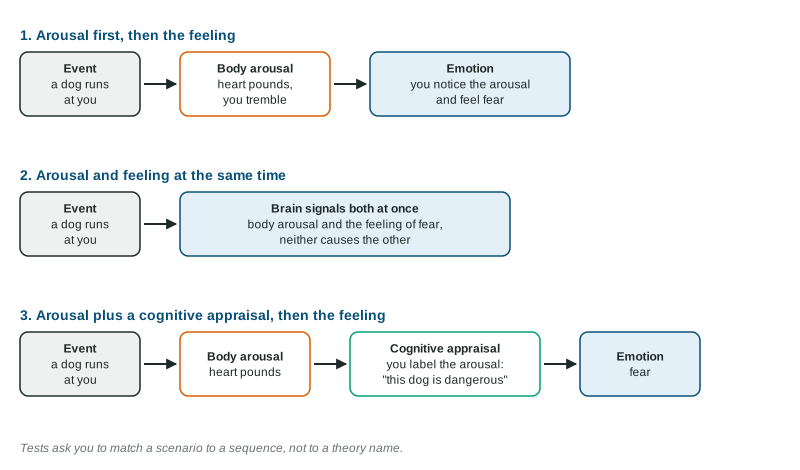
| Sequence | What happens | Sounds like |
|---|---|---|
| 1. Arousal first | the event triggers body arousal; noticing the arousal produces the feeling | "My heart was pounding, and then I realized I was scared." |
| 2. At the same time | the brain sends signals to the body and to the cortex at once; neither causes the other | "My heart raced and I felt afraid in the same instant." |
| 3. Arousal plus appraisal | body arousal is labeled by a cognitive appraisal of the situation; the label decides the emotion | "My heart was racing, and since I was on stage I decided I was excited, not scared." |
Each sequence has evidence on its side and against it. For sequence 1: different emotions do come with somewhat different patterns of body activity. Against it: many emotions share very similar arousal, and some studies of people with spinal cord injuries, which reduce body feedback, found their emotions felt weaker while others found little change. For sequence 2: brain imaging shows emotion areas and body arousal working in parallel. For sequence 3: the same arousal can be felt as different emotions depending on the situation. A classic experiment gave people an arousing injection and found that their emotion tended to match a partner's mood, though later studies had trouble replicating that result in full.
The appraisal idea also raises a debate: does thinking always come first? Some emotional reactions, like the fast fear of a swerving car, start before you have time to think. Others, such as feeling guilty after you understand you hurt a friend, clearly depend on your interpretation. Most psychologists today accept both: some emotions take a fast route, and others depend on appraisal.
Worked example: matching a scenario to a sequence. Before a big game, two players feel the same racing heart. One says, "I'm pumped!" and plays well; the other says, "I'm going to choke," and plays badly. Which sequence fits?
Step 1, is arousal present? Yes, the same racing heart for both. Step 2, is there a thinking step? Yes: each player interprets the arousal differently. Step 3, does the interpretation decide the emotion? Yes: excitement for one, dread for the other. That is sequence 3, arousal plus a cognitive appraisal. Sequence 1 cannot explain it, because the same arousal led to two different emotions.
Expressing emotion
Can your face change how you feel? The facial feedback hypothesis says it can: smiling might make you feel a bit happier. A well-known study had people hold a pen in their teeth (a forced smile) or in their lips (no smile) and reported that the smile group found cartoons funnier. When 17 labs repeated that exact study with nearly 2,000 people, they found no reliable effect. Later multi-lab work found small effects for some methods, such as copying a smiling face, and none for the pen method. So the evidence is mixed: any effect is small and depends on the method.
Are emotions universal? People in many cultures, including groups with little contact with outsiders, match photos of posed faces to emotions such as happiness, sadness, fear, anger, surprise and disgust far more often than chance. That supports some universal emotions. But recognition is better for faces from one's own culture, and posed photos are more exaggerated than everyday faces, so how universal emotions are is still debated.
Culture clearly shapes how emotions are shown. Display rules are cultural norms about when, how and how much emotion to show. Grief may be loud at a funeral in one community and quiet in another, even when people feel the same sadness. A display rule changes the expression, not necessarily the feeling.
What positive emotions do
Fear narrows attention to the threat, which helps you escape. Barbara Fredrickson's broaden-and-build theory says positive emotions work the other way. Joy, interest and contentment broaden what you notice and are willing to try. Over time, those wider moments build lasting resources: new skills, friendships and the ability to bounce back. A student who laughs with friends may be more open to joining a new club, and the friends made there are resources that last long after the good mood fades.