Is your friend "an extravert", or is she outgoing only with people she knows? Both are true, and this topic gives you the two tools to say why. Trait theories describe what is stable about a person. The social-cognitive view explains how a person's beliefs, actions and surroundings keep shaping each other.
The social-cognitive view: people and situations shape each other
Albert Bandura built the social-cognitive view on social learning: we learn by watching others and by what happens when we act. He added that our thoughts matter too. What we expect, believe and tell ourselves changes what we do.
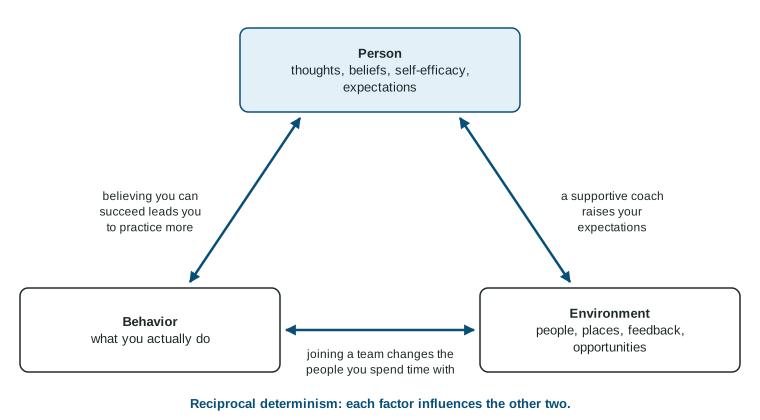
His central idea is reciprocal determinism: three factors influence one another.
- Person: thoughts, beliefs, expectations and feelings.
- Behavior: what you actually do.
- Environment: the people, places and feedback around you.
A student who believes she can learn to code (person) joins a coding club (behavior). The club's members help her (environment), which raises her confidence (person), so she starts a bigger project (behavior). No single factor is "the cause"; each one pushes on the other two. People also choose their environments: a shy student may avoid parties, so she gets less practice talking to strangers, which keeps her shy.
Three ways of seeing yourself
These three terms sound alike, and the exam loves to set them against each other.
| Term | What it is | Sounds like |
|---|---|---|
| Self-concept | all your beliefs about who you are | "I am a musician, a big sister and a night owl." |
| Self-esteem | your overall sense of your own worth | "I am a worthwhile person." |
| Self-efficacy | your belief you can succeed at a specific task | "I can make this free throw." |
The key difference is scope. Self-esteem is global; self-efficacy is about one task or area. A student can value herself highly (high self-esteem) and still doubt she can pass chemistry (low self-efficacy in chemistry). Self-efficacy matters because it predicts effort: people who expect to succeed try harder and keep going longer. It grows mostly through your own past successes, and also by watching similar people succeed and by encouragement.
Trait theories: describing what is stable
A trait is a stable tendency to think, feel or act in a certain way across many situations. Trait theories describe personality by where a person falls on a few broad dimensions. They describe more than they explain: saying someone is outgoing because she is extraverted names the pattern but does not say where it came from.
How do researchers decide which traits matter? They ask thousands of people to rate themselves on hundreds of descriptive words, then use factor analysis, a statistical method that finds clusters of items whose scores are correlated. If people who call themselves "talkative" also tend to call themselves "outgoing" and "energetic", those items form one factor. Across many studies and languages, five broad factors keep appearing: the Big Five.
| Trait | High scorers tend to be | Low scorers tend to be |
|---|---|---|
| Openness | curious, imaginative, open to new experiences | practical, prefer routine |
| Conscientiousness | organized, careful, dependable | flexible, disorganized, impulsive |
| Extraversion | sociable, energetic, talkative | reserved, quiet, prefer small groups |
| Agreeableness | warm, cooperative, trusting | competitive, critical, skeptical |
| Neuroticism | anxious, easily upset, moody | calm, emotionally stable |
Watch the direction of neuroticism. A calm person who rarely worries is low in neuroticism. Each trait is a dimension, and most people fall near the middle.
What does the evidence say? Twin and adoption studies show each Big Five trait is partly heritable. The five factors are found in many cultures, though not perfectly. Conscientiousness predicts grades and job performance, and traits predict health and relationships modestly but reliably. Traits are fairly stable in adulthood, yet they still change: on average people become more conscientious and agreeable and less neurotic from adolescence into middle age.
Measuring traits: personality inventories
Traits are measured with personality inventories: questionnaires with many clear statements, such as "I keep my things organized", answered true or false or on an agree-disagree scale and scored against norms from large samples. Big Five questionnaires and the Minnesota Multiphasic Personality Inventory (MMPI) are examples. Unlike projective tests, inventories are scored objectively, so their reliability is much higher. Their weakness is self-report: people may answer in a way that looks good (social desirability bias), and some inventories include checks for that.
Worked example: reading a trait study. Researchers give 10 seniors a conscientiousness inventory and record their GPAs. The scatterplot rises from left to right, with points close to the trend line. What can they conclude?
Step 1, direction: as conscientiousness goes up, GPA goes up, so the correlation is positive. Step 2, strength: the points hug the line, so it is strong. Step 3, the limit: nothing was manipulated, so this is a correlational study. It cannot show that conscientiousness causes higher grades. A third variable, such as more sleep or more support at home, could raise both. A fair conclusion: "In these students, higher conscientiousness was strongly associated with higher GPA."
Putting the two views together
The person-situation debate asked whether traits or situations drive behavior. The answer is both. Traits predict behavior well when you average across many situations, and less well for any single moment. Strong situations (a funeral, a job interview) push most people to act alike; weak situations (a free afternoon) let traits show. Social-cognitive theory explains how the two combine: a person's tendencies lead them to choose and shape their environments, which then shape them back.