An attitude is a learned feeling and belief about a person, group, object or idea that inclines you to respond in a certain way. Attitudes help: they let you decide quickly whom to trust and what to avoid. They also mislead, because the same quick judgments can harden into prejudice and resist evidence. This topic covers how attitudes about groups form, what keeps them in place, and what can change them.
Stereotypes, prejudice and the mind under pressure
A stereotype is a generalized belief about the members of a group ("teenagers are reckless"). Some stereotypes contain a grain of truth about averages, but they are overgeneralized and get applied to individuals who do not fit. Prejudice is an unjustified, usually negative attitude toward a group and its members. It combines a feeling (dislike, fear), a belief (the stereotype) and a readiness to act on them (discrimination).
Stereotypes act as shortcuts, and people use shortcuts most when their minds are busy. Under high cognitive load, when working memory is full because you are rushed, tired or juggling tasks, people rely more on stereotypes and are less able to correct them. That is one reason careful, structured decisions (a checklist for hiring, for example) reduce bias.
Some attitudes are not fully conscious. An implicit attitude is an automatic association, such as linking a group more quickly with "bad" than with "good" on a reaction-time task, which can differ from the attitude a person sincerely reports. These tasks show that automatic associations exist and vary across people. Be careful with what they can claim, though: a person's score changes noticeably from one testing to the next, and scores predict an individual's behavior only weakly. They are research tools, not a test that reveals whether one person is biased.
What keeps prejudice going
- The just-world phenomenon: believing that the world is fair and people get what they deserve. It is comforting, but it leads people to blame victims ("she must have done something to bring it on").
- The in-group is "us" and the out-group is "them." In-group bias is favoring your own group. Henri Tajfel's studies found it even in groups formed by trivial labels, such as which of two painters a person preferred; it is a robust finding.
- Out-group homogeneity: seeing "them" as all alike while seeing "us" as varied.
- Ethnocentrism: judging other cultures by the standards of your own and treating your own way as the normal or right one.
Worked example: tell the group concepts apart. Each statement fits one concept best.
- "People on that team are all the same." Seeing the other group as alike: out-group homogeneity.
- "Let's give the scholarship to someone from our club." Favoring your own group: in-group bias.
- "Their holidays are weird; ours make sense." Judging another culture by your own: ethnocentrism.
- "If he lost his job, he probably deserved it." Assuming outcomes are deserved: just-world phenomenon.
Why attitudes resist change
Confirmation bias is the tendency to seek, notice and remember information that supports what you already believe, and to overlook what does not. Belief perseverance is holding on to a belief even after the evidence for it is discredited. In classic studies, people kept believing a conclusion after they were told the evidence it rested on was made up; explaining why the belief could be true made it stick. Together these biases mean that simply presenting facts often fails to change a strongly held attitude.
When actions change attitudes: cognitive dissonance
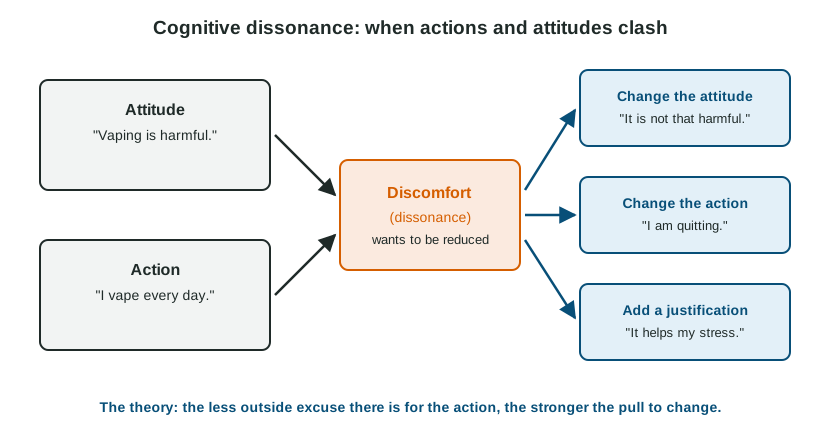
Leon Festinger proposed that people feel discomfort, cognitive dissonance, when their actions clash with their attitudes, and that they act to reduce it. Often the easiest thing to change is the attitude. In Festinger and Carlsmith's 1959 study, students did an hour of dull tasks and were then paid either $1 or $20 to tell the next participant the tasks were fun. Asked later, the $1 students rated the tasks as more enjoyable than the $20 students did. With $20, they had a good reason for the lie; with $1, they did not, so they reduced the clash by deciding the tasks were not so bad.
Dissonance is a classic idea that should be taught with its current status. Many studies find that acting against an attitude shifts the attitude. But a 2024 replication run in 39 labs with about 4,900 participants found the shift without the specific effect of choice that the theory predicts: people who were pressed to write an essay against their view changed about as much as people who felt free to choose. The effect is real; how it works is still debated.
| Concept | Does it make an attitude stick or change? | The signature |
|---|---|---|
| Confirmation bias | Stick | Seeking evidence that agrees |
| Belief perseverance | Stick | Keeping a belief after its evidence is gone |
| Cognitive dissonance | Change | Discomfort from a clash between action and attitude |