
Two people lose the same game. One blames the referee and snaps at his brother; the other admits he played badly and asks for extra practice. Personality is a person's fairly stable pattern of thinking, feeling and acting, and psychologists have several theories of where it comes from. This page covers two older views that still shape how we talk about people: the psychodynamic view, which looks below awareness, and the humanistic view, which looks at growth.
The psychodynamic view: what you do not know about yourself
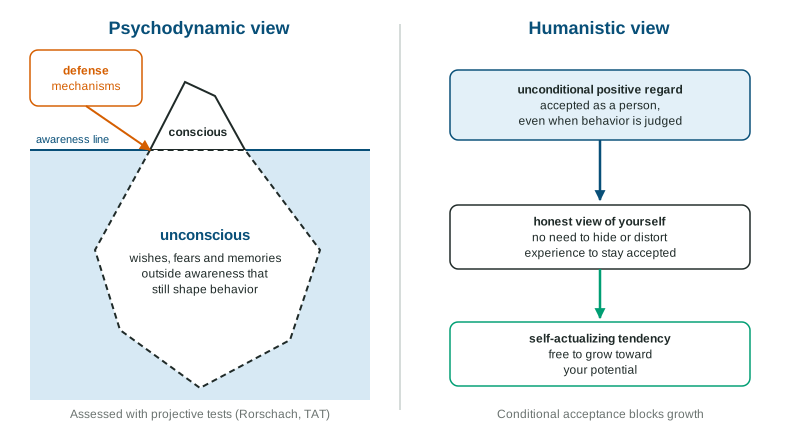
Sigmund Freud's psychoanalytic theory, and the psychodynamic theories that grew from it, start from one idea: much of mental life is unconscious. Wishes, fears and memories outside awareness still steer what we do, like the large part of an iceberg below the water. Modern psychodynamic thinkers keep that core idea and the stress on childhood relationships, but they drop most of Freud's specific claims.
If unconscious wishes clash with what is acceptable, the result is anxiety. The mind protects itself with defense mechanisms: unconscious strategies that hide or distort a threatening thought. You will not be asked to define them. You will be shown a person and asked which one fits, so learn each by what it does.
| Defense mechanism | What it does | Example |
|---|---|---|
| Repression | pushes a painful thought or memory out of awareness | a person has no memory of a frightening childhood event |
| Denial | refuses to accept a threatening reality | a man with a year-long cough insists nothing is wrong |
| Displacement | moves a feeling to a safer target | criticized by a boss, a worker yells at his brother |
| Projection | sees your own unacceptable urge in others | a student tempted to cheat accuses classmates of cheating |
| Rationalization | gives comfortable excuses for a behavior | after failing a test: "the examiner was unfair anyway" |
| Reaction formation | acts out the exaggerated opposite of a feeling | someone who resents a rival is overly sweet to her |
| Regression | retreats to behavior from an earlier stage | a 6-year-old starts thumb sucking when a baby arrives |
| Sublimation | channels an unacceptable urge into a valued activity | aggressive urges become disciplined boxing |
Two pairs cause most mistakes. Displacement moves a feeling to a new target; projection moves a trait or urge onto another person. Reaction formation shows the opposite feeling; sublimation turns the urge itself into something useful.
Repression is worth a second look. Memory research finds that people who live through a trauma usually remember it too well, not too little. Psychologists today doubt that repression explains much forgetting, and they warn that "recovering" repressed memories through suggestion can create false memories.
Worked example: naming the defense. After a breakup, Ana tells everyone she never liked her ex-boyfriend and is relieved it is over, though she cries every night. Which defense mechanism fits?
Step 1, find the hidden feeling: she still cares and is hurt. Step 2, find what she does with it: she says the opposite of the feeling, and strongly. Step 3, match: saying the exaggerated opposite of a feeling is reaction formation. It is not rationalization, because she is not making excuses for something she did, and not denial, because she accepts that the breakup happened.
Measuring the unconscious: projective tests
If the important material is unconscious, a questionnaire cannot reach it, because people cannot report what they do not know. So psychodynamic psychologists use projective tests, which show something ambiguous and let the person "project" meaning onto it. In the Rorschach inkblot test, a person says what they see in symmetrical inkblots. In the Thematic Apperception Test (TAT), a person tells a story about ambiguous pictures of people, and the clinician looks for repeated themes.
The problem is measurement. Two clinicians scoring the same responses often disagree (weak reliability), and many scores do a poor job predicting behavior (weak validity). Some scoring systems do better than others, but most researchers do not trust projective tests alone for important decisions.
Is the psychodynamic view scientific?
Its lasting ideas have support: much mental processing happens outside awareness, childhood relationships matter, and people do protect their self-image. Its weakness is testing. If a man is kind to his rival, the theory can call it real kindness or reaction formation. When every outcome can be explained after the fact, no result could ever show the theory wrong. Freud's specific claims, such as his stages of childhood development, are not part of this course.
The humanistic view: growth and acceptance
In the middle of the twentieth century, humanistic psychologists such as Carl Rogers pushed back against views that saw people as driven by hidden urges or by rewards. They stressed free choice, a person's own view of themselves, and growth.
Rogers argued that everyone has a self-actualizing tendency: a built-in drive to grow toward their potential. Whether it flourishes depends on how others treat us. Unconditional positive regard is acceptance of a person that does not depend on what they do. A parent can still disapprove of a lie ("I am disappointed you lied") while making clear the child is loved and valued.
When acceptance has conditions ("I love you when you get straight A's"), a person learns to hide or distort experiences that do not fit, such as a failed test. Their view of themselves drifts away from their real experience, and growth stalls. Rogers built his approach to therapy on this idea.
The humanistic view had a large influence on counseling, education and parenting, and on later research into what helps people thrive. Its key terms, such as "growth", are hard to measure, which is its main criticism.
Comparing the two views
| Psychodynamic | Humanistic | |
|---|---|---|
| What drives behavior | unconscious wishes, fears and conflicts | a drive to grow, and free choice |
| Key ideas | the unconscious, defense mechanisms | unconditional positive regard, self-actualizing tendency |
| How it is assessed | projective tests (Rorschach, TAT) | a person's own description of themselves, interviews |
| Main criticism | hard to test; explains any outcome after the fact | vague terms; too optimistic about human nature |