Finals week: you sleep less, your shoulders ache, and by the last exam you have a cold. Your friend, facing the same exams, says she feels fired up. Health psychology studies how psychological, behavioral and social factors affect physical health. Stress is its central topic: what it is, how the body responds, and how people cope.
What stress is
A stressor is an event or condition that triggers stress. Stress is the whole process of appraising that stressor and responding to it. The word "appraising" matters. Two students can face the same final: one sees a threat she cannot handle, the other a challenge she can prepare for. The second feels less distress, because stress depends on how we interpret an event and how well we think we can deal with it.
- Eustress is positive stress, felt as a motivating challenge: the nervous excitement of a first day at a new job.
- Distress is negative stress, felt as overwhelming or harmful. Intense or long-lasting distress is the kind linked to poorer health.
Stressors come in several sizes. Catastrophes such as earthquakes and wars affect whole communities. Major life changes, such as moving or losing a family member, affect individuals. Daily hassles, such as traffic, lost keys and a noisy roommate, are small, but they add up, and people who report more of them tend to report more health problems. Adverse childhood experiences, such as abuse, neglect or growing up with family violence, are linked to higher rates of heart disease, depression and other problems decades later. These are correlations: many people with such experiences stay healthy, and factors such as income and support also play a part.
The body's fast response
When a threat appears, the sympathetic nervous system and stress hormones such as adrenaline prepare the body for action. Heart rate and breathing rise, energy is released into the blood, and digestion slows. This is the fight-flight-freeze response: the body readies to fight, to run, or to go still, as a deer does in headlights.
Shelley Taylor and her colleagues pointed out a second pattern, first described in women: tend-and-befriend. Under stress, people often protect those who depend on them (tend) and seek support from others (befriend). It is linked to oxytocin, and it helps explain why people gather together after a disaster.
When stress keeps going: the general adaptation syndrome
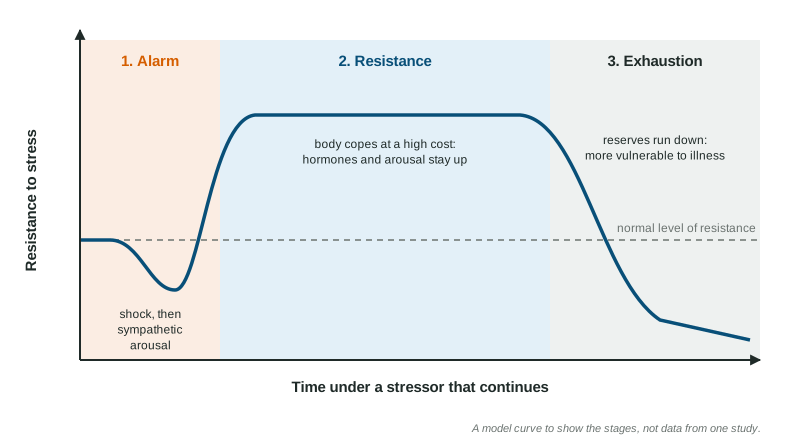
Hans Selye exposed rats to many different stressors, from cold to injury, and found the body responded in the same general way. He called it the general adaptation syndrome, with three stages:
- Alarm. At the shock of the stressor, resistance briefly drops, and then the sympathetic system mobilizes the body.
- Resistance. The body copes. Arousal and stress hormones stay high and resistance is above normal, but this costs resources.
- Exhaustion. If the stressor goes on long enough, reserves run down. Resistance falls below normal and the person becomes more vulnerable to illness.
Research on people supports the broad pattern. Long-lasting stress, such as caring for a family member with a serious illness, is linked to weaker immune responses and slower healing of wounds. People differ a great deal, though: appraisal, coping and support all change how strongly stress affects the body.
Worked example: reading a stress graph. A line graph shows nursing students' immune index (100 = normal) over a 12-week placement: 86 in week 1, about 118 to 120 in weeks 3 to 7, and 76 by week 12. Students reported the most cold symptoms at the end.
Step 1, match the stages: the early dip is alarm, the long stretch above 100 is resistance, and the fall below 100 is exhaustion. Step 2, compute if asked: the mean of weeks 3 to 7 (118, 120, 119, 120, 117) is . Step 3, link to the claim: more colds at the end fits exhaustion, when reserves are low. Step 4, the limit: one group followed over time, with no comparison group, cannot rule out other causes, such as flu season starting.
Coping
Coping means the ways we try to reduce stress. There are two broad kinds.
| Problem-focused coping | Emotion-focused coping | |
|---|---|---|
| Aim | change the stressor itself | manage the emotional reaction |
| Examples | making a study plan, asking the teacher for help, fixing a schedule conflict | talking to friends, exercise, journaling, relaxation, reframing the situation |
| Best when | you can change the situation | you cannot change it, such as after a loss |
Neither kind is always better. People cope best when they are flexible: they act on the parts of a problem they can control and manage their feelings about the rest. Some emotion-focused strategies, such as avoiding the problem entirely or numbing feelings with alcohol, tend to make things worse over time. Support from other people helps with both kinds, which is one reason social connection predicts better health.