Introduction to Health Psychology
Health psychology studies how stress and behavior affect physical health.
Part 1 · Hook
Why this matters
Part 2 · Before you start
What this builds on
Part 3 · Prerequisite check
Quick check before you start
1. Which part of the nervous system arouses the body for action in an emergency?
- Sympathetic nervous system
- Parasympathetic nervous system
- Somatic nervous system
- Cerebellum
Show the answer
The sympathetic division raises heart rate and breathing; the parasympathetic calms the body.
- Correct: Sympathetic nervous system:
- Parasympathetic nervous system:
- Somatic nervous system:
- Cerebellum:
2. Which hormone, linked to bonding, is released during social contact and caregiving?
- Oxytocin
- Melatonin
- Ghrelin
- Leptin
Show the answer
Oxytocin is linked to bonding and social behavior.
- Correct: Oxytocin:
- Melatonin:
- Ghrelin:
- Leptin:
Part 4 · See it
See it first
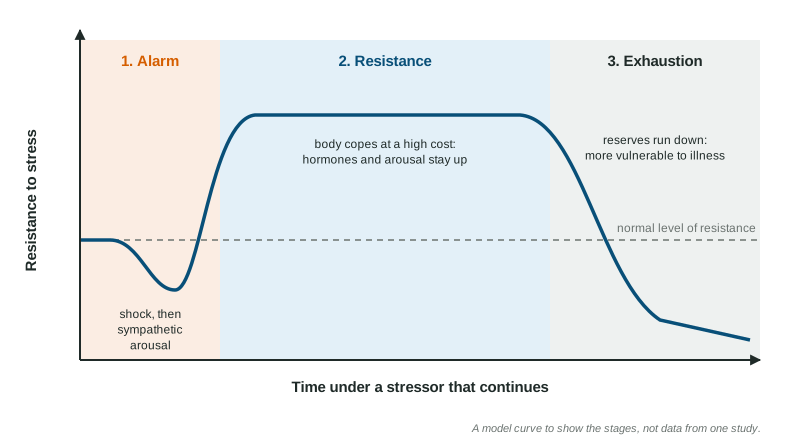
Part 5 · Step by step
How it works, step by step
- A stressor appears and is appraised as a threatthe sympathetic nervous system triggers fight-flight-freeze, or people tend and befriend
- The stressor continuesthe body moves from alarm to resistance, keeping arousal and stress hormones high
- The stressor lasts for a long timereserves run down (exhaustion) and the person becomes more vulnerable to illness
- The person copes: problem-focused for what they can change, emotion-focused for what they cannotthe stress response is smaller and shorter
Part 6 · Key ideas
Key ideas
- Health psychology studies how psychological and social factors affect physical health. Stress is how we appraise and respond to stressors; eustress feels like a challenge, distress like harm.
- Stressors include catastrophes, major life changes, daily hassles and adverse childhood experiences, which are linked to poorer later health (a correlation).
- The general adaptation syndrome: alarm, resistance, exhaustion. Fast responses: fight-flight-freeze (sympathetic) and tend-and-befriend (protect and seek support).
- Problem-focused coping changes the stressor; emotion-focused coping manages feelings. Match the strategy to how controllable the stressor is.
Part 7 · Misconception
A common mistake
The wrong idea: All stress is bad for you.
What actually happens: Short-term stress mobilizes the body and can sharpen performance, and eustress feels like a motivating challenge. The health risk comes mainly from stress that is intense, uncontrollable or long-lasting.
Part 8 · Check yourself
Check yourself
Exam-style questions. Anything you miss goes into your review queue.
1. Ines is nervous but excited about starting her dream job. The challenge pushes her to learn quickly and she feels energized. Which concept describes this kind of stress?
- Distress
- Eustress
- A daily hassle
- The exhaustion stage
Show the answer
Eustress is stress felt as a motivating challenge; distress is stress felt as harmful.
- Distress: Distress is harmful, overwhelming stress; Ines feels energized and challenged.
- Correct: Eustress: Right: positive stress that motivates and feels like a challenge.
- A daily hassle: Daily hassles are small, everyday annoyances, not a major positive life change.
- The exhaustion stage: Exhaustion follows long, unrelenting stress; she is just starting and energized.
2. Lena is stressed about a chemistry test next week. She makes a study schedule, forms a study group and asks the teacher for practice problems. Which coping strategy is she using?
- Emotion-focused coping
- Problem-focused coping
- Displacement
- The exhaustion stage
Show the answer
Problem-focused coping tackles the stressor itself.
- Emotion-focused coping: Emotion-focused coping manages the feelings rather than changing the stressor.
- Correct: Problem-focused coping: Right: she takes direct action on the cause of her stress.
- Displacement: Displacement is a defense mechanism that moves feelings to a safer target.
- The exhaustion stage: Exhaustion is a stage of long-term stress, not a coping strategy.
3. Marco's grandmother has died. He cannot change what happened, so he talks with friends, journals about his feelings and goes for long walks. Which coping strategy fits best?
- Emotion-focused coping
- Problem-focused coping
- Fight-flight-freeze
- Sensation seeking
Show the answer
Emotion-focused coping regulates feelings; it suits stressors we cannot control.
- Correct: Emotion-focused coping: Right: when a stressor cannot be changed, managing the emotional response is often the better fit.
- Problem-focused coping: There is no problem he can act on to change the loss.
- Fight-flight-freeze: That is an automatic response to sudden threat, not a chosen coping strategy.
- Sensation seeking: Sensation seeking is a trait of seeking intense experiences.
Data
A long stressor and the body's resistance
Researchers followed 30 nursing students through a demanding 12-week hospital placement. Each week they measured an index of immune activity from a saliva sample, scored so that 100 is each student's own normal level. Students also reported how many days each week they had cold symptoms.
4. Which stage of the general adaptation syndrome do weeks 3 to 7 best represent?
- Alarm reaction
- Resistance
- Exhaustion
- Recovery after the stressor ends
Show the answer
In resistance the body's defenses stay raised while the stressor continues.
- Alarm reaction: The alarm reaction is the brief dip at the start, around week 1.
- Correct: Resistance: Right: the index stays well above normal as the body copes with the continuing stressor.
- Exhaustion: Exhaustion is when the index falls below normal, around weeks 10 to 12.
- Recovery after the stressor ends: The placement is still going on in weeks 3 to 7.
5. Students reported the most days with cold symptoms in weeks 10 to 12. How does the general adaptation syndrome explain this?
- The alarm reaction makes people sick at the start of stress
- Eustress protects people from illness, so the students got sick from boredom
- Resistance is highest at the end of a long stressor
- Long stress drained reserves, so the body reached exhaustion
Show the answer
Exhaustion: reserves run down after prolonged stress, and vulnerability to illness rises.
- The alarm reaction makes people sick at the start of stress: Weeks 10 to 12 are at the end of the placement, not the start.
- Eustress protects people from illness, so the students got sick from boredom: Long, demanding stress here is distress, and eustress is no guarantee of health.
- Resistance is highest at the end of a long stressor: The graph shows the index falling below normal at the end.
- Correct: Long stress drained reserves, so the body reached exhaustion: Right: the index fell below 100, matching the exhaustion stage and more illness.
6. What is the mean immune index for weeks 3, 4, 5, 6 and 7 (values 118, 120, 119, 120 and 117)?
Type a number. No calculator needed: work it out by hand, as on the exam.
Show the answer
- Answer: 118.8
7. A reader concludes from this graph that the placement caused the drop in immune activity. Why should that claim be made with caution?
- With no comparison group, something else, like flu season, could explain it
- Immune activity is hard to measure from saliva, so the numbers are made up
- The sample of 30 students is far too large to be meaningful
- A line graph is the wrong way to show weekly change
Show the answer
Following one group over time without a comparison group cannot rule out other causes.
- Correct: With no comparison group, something else, like flu season, could explain it: Right: without a control group, a third variable that changed over time could explain the pattern.
- Immune activity is hard to measure from saliva, so the numbers are made up: Saliva can be used for some immune measures; the issue is the design.
- The sample of 30 students is far too large to be meaningful: Thirty is a small sample, and size is not the main problem.
- A line graph is the wrong way to show weekly change: Line graphs are the standard way to show change over time.
Part 9 · Summary
Summary
Part 10 · Up next
What comes next
Part 11 · Connections