How do babies come to love the people who care for them? Why do some parents set firm rules and others almost none, and does it matter? What are teens really doing when they agonize over who they are? This topic follows relationships and the sense of self from the crib to old age. On the exam, expect a short scenario and a question about which attachment pattern, parenting style, stage or teen idea it shows.
Layers of influence
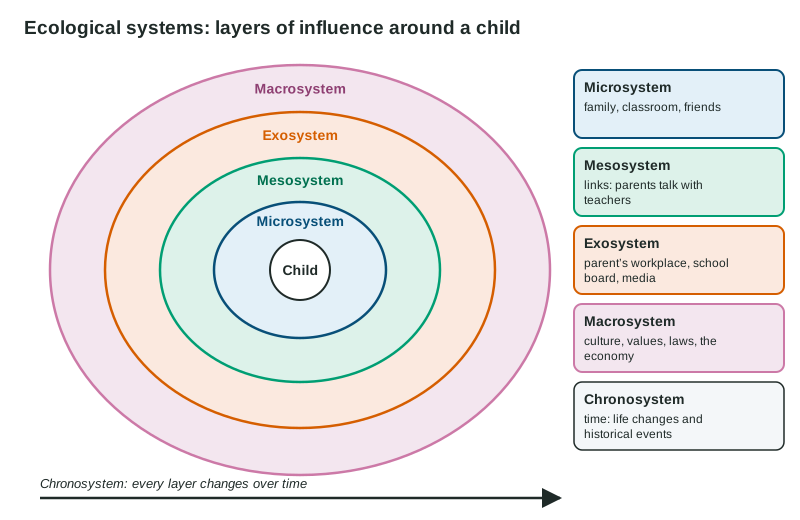
Urie Bronfenbrenner's ecological systems theory pictures a child at the center of nested layers. The microsystem holds the settings a child is in directly: family, classroom, friends. The mesosystem is the links between those settings, such as parents and teachers working together. The exosystem holds settings the child is not in that still matter, such as a parent's workplace: a move to the night shift changes bedtime at home. The macrosystem is the wider culture, its values, laws and economy, such as a national paid-leave law. The chronosystem adds time: a recession or a family move changes every other layer.
Attachment: where the bond comes from
Attachment is the deep emotional bond between a child and a caregiver. In the 1950s many psychologists thought babies bond with whoever feeds them. Harlow (1958) tested this with infant rhesus monkeys raised with two artificial mothers, one of bare wire and one covered in soft cloth. Even when only the wire mother held milk, the infants spent most of the day clinging to the cloth mother, and ran to it when frightened. Contact comfort, not food alone, drove the bond. Monkeys raised with no real mother later had lasting problems with social behavior and with raising their own young.
The studies also show why research ethics changed. The infants were separated from their mothers and suffered lasting harm; today's animal-care rules, which require minimizing pain and distress, would not allow this work. And because they were monkeys, the results suggest, but cannot by themselves prove, the same for people. Human research later supported the central idea: responsive, comforting care builds attachment.
Around 8 months, many babies show separation anxiety: they cry when a caregiver leaves, a sign that a specific bond has formed. It usually peaks in the second year and fades.
Measuring attachment: the strange situation
Mary Ainsworth's strange situation observes a 1-year-old in an unfamiliar playroom through short separations from and reunions with a caregiver, with a friendly stranger present for part of the time. The reunion matters most.
| Pattern | When the caregiver leaves | When the caregiver returns |
|---|---|---|
| Secure | may be upset; explored freely before | seeks comfort, calms quickly, goes back to play |
| Avoidant | little distress | ignores or turns away from the caregiver |
| Anxious (ambivalent) | very upset; explored little before | clings and resists at once; hard to soothe |
| Disorganized | varies | confused or contradictory: freezes, approaches while looking away |
A securely attached child uses the caregiver as a secure base, exploring and returning for comfort. In US middle-class samples, about 60 to 65% of infants are classified as secure; the rates of the other patterns vary across cultures. Secure attachment in infancy predicts somewhat better relationships later, but the links are modest, and attachment can change when a family's circumstances change.
Worked example: reading attachment data. In an invented study of 50 one-year-olds, 30 were secure, 10 avoidant, 6 anxious and 4 disorganized.
Percent secure: . Percent not secure: .
What it shows: most infants were secure. Before generalizing, check who the infants were: if all came from middle-class families in one city, the percentages may not hold for other cultures or circumstances.
Temperament and parenting styles
From birth, babies differ in temperament, their inborn style of reacting: some are easygoing, some fussy and intense, some slow to warm up. Temperament is partly heritable, fairly stable, and it shapes how parents respond.
Diana Baumrind described three parenting styles by how warm parents are and how many rules they set.
| Style | Warmth | Rules and demands | Sounds like |
|---|---|---|---|
| Authoritarian | low | high, not explained | "Because I said so." |
| Authoritative | high | high, explained and open to discussion | "Curfew is 10, because you have school. Let's talk if something comes up." |
| Permissive | high | low | "Do what feels right." |
In many US studies, children of authoritative parents tend to have higher self-reliance, social skills and grades. These are correlations. Children influence parents too (an easygoing child makes reasoned, warm parenting easier), and the pattern differs across cultures: in some communities, strict parenting combined with warmth is common and linked with good outcomes. The names are easy to mix up: authoritative is the warm, firm one.
Play
Play grows more social and more imaginative. Around age 2, children often engage in parallel play, playing side by side with similar toys but little interaction. In the preschool years, pretend play blossoms: a block becomes a phone, and a sandbox becomes a bakery where children take turns selling cakes. Pretend play lets children practice roles, rules and taking other points of view.
Erikson's eight stages
Erik Erikson proposed eight psychosocial stages, each with a social challenge. Meeting it builds a strength; struggling with it leaves a vulnerability that can still be worked on later.
| Typical age | Stage | Example |
|---|---|---|
| Infancy | trust versus mistrust | A baby whose cries are answered learns the world is reliable. |
| Toddler | autonomy versus shame and doubt | "Me do it!" when dressing. |
| Preschool | initiative versus guilt | Planning a game and inviting others to play. |
| School age | industry versus inferiority | Feeling competent at reading, sports or art. |
| Adolescence | identity versus role confusion | Working out values, goals and who one is. |
| Young adulthood | intimacy versus isolation | Forming close, committed relationships. |
| Middle adulthood | generativity versus stagnation | Coaching, mentoring, raising children. |
| Late adulthood | integrity versus despair | Looking back on a meaningful life, or with regret. |
Erikson's stages are a useful framework more than a tested timetable; people often revisit challenges at different ages.
Adolescence: identity and the teenage mind
James Marcia described four identity statuses using two questions: has the teen explored options, and have they committed?
| Committed | Not committed | |
|---|---|---|
| Explored | Achievement: tried internships, chose nursing | Moratorium: still trying options |
| Not explored | Foreclosure: a dentist "because my family are dentists" | Diffusion: drifting, not looking |
Teens also imagine possible selves, the people they hope or fear to become, and these images can steer choices, like volunteering at an animal shelter to become a vet. Two kinds of teenage thinking echo Piaget's egocentrism. The imaginary audience is the sense that everyone is watching: one pimple and "everyone will stare." The personal fable is the sense of being unique ("nobody has ever felt this way") and sometimes invulnerable ("it won't happen to me").
Adulthood
In many wealthy countries, the years from about 18 to the mid-20s have become emerging adulthood: no longer adolescents, many young people are still in school, changing jobs, living with parents and not yet feeling fully adult. It is tied to longer schooling and later marriage, so it is far less common where people take on adult roles early. Adults also measure themselves against the social clock, a culture's expected timing for leaving home, marrying, having children and retiring. Social clocks differ across cultures and have loosened over generations.
Adverse childhood experiences
Adverse childhood experiences (ACEs) are stressful events in childhood, such as abuse, neglect, or a household member's substance use, mental illness or incarceration. In the first large report from a study that eventually surveyed more than 17,000 adults (Felitti and colleagues, 1998), the more ACEs people reported, the higher their average rates of heart disease, depression and other health problems. This is a correlation across a population, built on adults' memories. An ACE score does not decide any one person's future: many people with high scores do well, and a stable, caring relationship with even one adult is one of the strongest protective factors.
If you are struggling, you are not alone. In the US, call or text 988 (the Suicide and Crisis Lifeline), or talk to a trusted adult.