Classical and operant conditioning describe learning that happens to you: a pairing, a consequence. But a great deal of learning happens in your head and through other people. You learn how to act at a new job by watching coworkers, you know a shortcut through your neighborhood you never practiced, and sometimes the answer to a problem arrives all at once. This topic covers the social, cognitive and neurological sides of learning.
Learning by watching
Social learning theory, also called observational learning, holds that people learn by watching others, called models, and imitating them (modeling). Albert Bandura, who developed the idea, described what has to happen:
- Attention. The observer notices the model. Models who are similar, warm, admired or successful get more attention.
- Retention. The observer remembers what the model did.
- Reproduction. The observer is able to do it. Watching a gymnast does not let you do a back handspring.
- Motivation. The observer has a reason to do it.
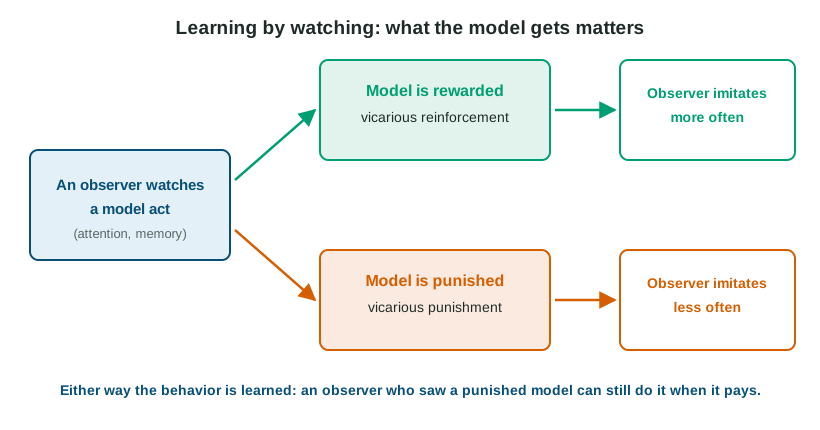
Motivation is where consequences come in. In vicarious conditioning, the observer learns from what happens to the model. Vicarious reinforcement (the model is rewarded) makes imitation more likely; vicarious punishment (the model is punished) makes it less likely.
Worked example: which kind of learning? Decide whose consequence changed the behavior.
- Nora gets a sticker each time she shares, and she shares more. Her own behavior was rewarded: positive reinforcement (operant conditioning).
- Nora sees her friend get a sticker for sharing, and Nora starts sharing. The model was rewarded: vicarious reinforcement (observational learning).
- Nora sees a friend sent to the corner for grabbing, and she stops grabbing. The model was punished: vicarious punishment.
The Bobo doll studies, read honestly
In Bandura's 1961 study, preschoolers who watched an adult hit and kick an inflatable "Bobo" doll were more likely to copy those exact acts when left alone with it than children who saw a calm adult. In a 1965 follow-up, children who saw the model punished copied fewer acts, but when they were then offered treats for showing what the model did, they copied as many as the other children. The behavior had been learned; the punishment had only held back its performance. The studies are a clear demonstration of imitation. Their limits are also real: the children hit a toy built to be hit, in a short session, so the studies say little about real aggression toward people over time.
Learning in the mind: latent learning, cognitive maps and insight
In 1930, Edward Tolman and Charles Honzik let three groups of rats run a maze. One group found food at the end every day; one never did; one found food only from day 11. The third group's errors dropped almost at once to the level of the always-fed rats. They had been learning the maze all along without showing it. This is latent learning: learning without reinforcement that appears once there is a reason to use it. Tolman argued the rats had formed a cognitive map, a mental layout of the maze, which challenged the strict behaviorist idea that learning is only stimulus and response.
Wolfgang Köhler watched chimpanzees facing food out of reach. After a pause, some suddenly stacked boxes or joined sticks to get it, and repeated the solution easily afterward. This is insight learning: a sudden grasp of the whole solution, unlike the gradual improvement of trial and error.
| Concept | What shows it | Example |
|---|---|---|
| Modeling | Copying a person's behavior | A teen picks up an older sibling's habits |
| Vicarious reinforcement | Copying more because the model was rewarded | Trying a dance after it gets a friend likes |
| Latent learning | Hidden learning appears when there is a reason | Finding your way after years as a passenger |
| Insight learning | A sudden, whole solution after a pause | "Aha! Turn the key the other way." |
The brain's part
Learning also has a neurological side. The brain's reward circuits, which use dopamine, respond strongly when a reward is better than expected and less when it is fully predicted. That surprise signal helps strengthen the behavior that came just before. It also helps explain why unpredictable rewards, like a variable-ratio schedule, are so gripping.
Does watching aggression lead to aggression?
This is the real-world question behind the Bobo doll, and the evidence is more mixed than many textbooks suggest. Laboratory experiments often find short-term increases in aggressive thoughts and mild aggressive acts (such as giving a stranger a blast of noise) after violent media. Large reviews find a small average link between violent video games and later aggression, and researchers still disagree about how large it is once publication bias is accounted for. In 2020 the American Psychological Association said the link to aggression is small but reliable and that there is not enough evidence to link violent games to criminal violence. Most of the long-term evidence is correlational, so third variables, such as home environment or a child's temperament, can contribute. On the exam, use the concept (modeling, vicarious reinforcement) and say plainly what each study can and cannot show.