When a baby is born, people usually ask one question: boy or girl? Psychology splits that into four separate questions about a person. Keeping them apart is the key to this topic, and to the exam items that ask which one a situation describes.
Four different questions
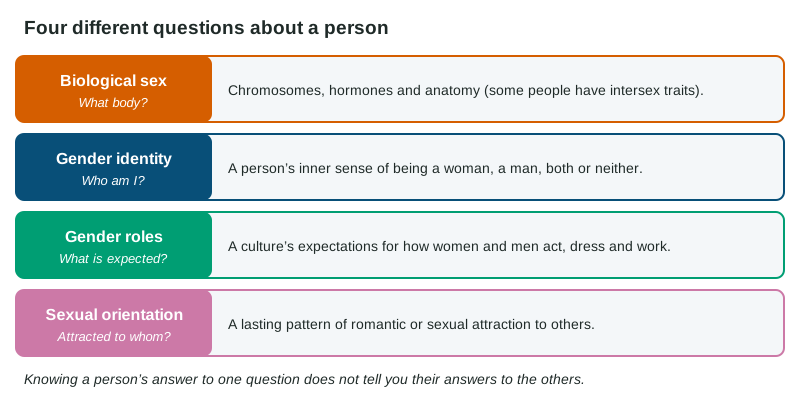
| Concept | The question it answers | Example |
|---|---|---|
| Biological sex | What body? | A newborn has XY chromosomes and testes. |
| Gender identity | Who am I? | Alex has always known she is a girl. |
| Gender roles | What does my culture expect? | In one town, men are expected to cook for guests. |
| Sexual orientation | Whom am I attracted to? | Ryan, a man, is attracted to men. |
Biological sex refers to the body: chromosomes (usually XX or XY), hormones and reproductive anatomy. Most bodies fit a female or male pattern, and some people are born with intersex traits that do not fit either pattern neatly. Gender is broader: the meanings, roles and identities a culture links with being a woman or a man.
Gender identity
Gender identity is a person's inner sense of being a woman, a man, both or neither. Most children can label their own gender by about age 2 or 3. For most people, gender identity matches the sex they were assigned at birth (cisgender). For a transgender person it differs: Alex was assigned male at birth and is a woman. A nonbinary person does not identify only as a woman or only as a man. Major psychological organizations treat these identities as part of normal human variation, not as a mental illness. When transgender people experience distress, research links much of it to stigma, rejection and the mismatch between body and identity, and support from family is linked to better mental health.
Gender roles and gender typing
Gender roles are a culture's expectations for how women and men should act, dress and work. They vary across cultures and change over time: in the United States, a doctor was usually assumed to be a man in 1960, and today more than half of new medical students are women. Because the same task can be "men's work" in one place and "women's work" in another, roles come largely from culture rather than biology.
Gender typing is how children learn and adopt their culture's traditional gender roles. Several forces work together:
- The people around them. Parents and others often give different toys and praise different traits ("sweet" for girls, "tough" for boys), and children watch and copy the adults and older children of their own gender.
- Their own mental frameworks. Once children know their own gender, they build schemas for what is "for girls" and "for boys" and use them to choose what is "for me." Preschoolers often apply these rules rigidly ("only girls wear dresses") and become more flexible in middle childhood.
- Biology. Prenatal hormones play some part. Girls exposed to high levels of male hormones before birth, because of a genetic condition, tend to show more interest in toys usually chosen by boys.
Worked example: reading a labeling study. In an invented experiment, 80 preschoolers were randomly assigned to hear that a new toy was "for girls" or "for boys." Children played with it for a mean of 13 minutes when the label matched their gender and 6 minutes when it did not.
Method: an experiment, because the label was manipulated and children were randomly assigned. Result: more minutes with an own-gender label, about twice as long.
What it shows: a single label changed play, so gender typing guides children's choices. Because the label was assigned at random, the label itself caused the difference.
How different are girls and boys?
Less than many people think. A large review that pulled together 46 earlier meta-analyses (Hyde, 2005) found that most average differences between males and females in mental abilities, communication and personality are small or close to zero. That means the groups overlap heavily: many girls outscore many boys on any given measure, and the reverse. A few differences are larger, such as physical aggression (higher on average in males) and some motor skills like throwing distance. An average difference never tells you about one person.
Sexual orientation
Sexual orientation is a lasting pattern of romantic or sexual attraction: to people of the other sex (heterosexual), the same sex (gay or lesbian), more than one sex (bisexual), or little or no sexual attraction to anyone (asexual). It is separate from gender identity: a transgender woman may be attracted to men, women, both or neither.
What shapes orientation? The evidence points to many interacting factors, none of them choice or parenting:
- Twin studies find that identical twins are more alike in orientation than fraternal twins, so genes contribute. A very large genetic study of nearly half a million people (Ganna and colleagues, 2019), which looked at same-sex sexual behavior, found many genes, each with a tiny effect, and no single "gay gene."
- Prenatal factors matter: a man's chance of being gay rises a little with each older biological brother his mother had before him, a finding replicated many times.
- No way of raising a child has been found to cause a child's orientation, and efforts to change a person's orientation do not work and can cause harm.