Gender and Sexual Orientation
Sex refers to biology; gender to identity and to the roles a culture expects.
Part 1 · Hook
Why this matters
Part 2 · Prerequisite check
Quick check before you start
1. What does a twin study compare?
- How similar identical twins are with how similar fraternal twins are
- Twins with only children
- A twin before and after an experiment
- Two random strangers
Show the answer
Identical twins share nearly all genes and fraternal twins about half, so comparing them shows a genetic contribution.
- Correct: How similar identical twins are with how similar fraternal twins are:
- Twins with only children:
- A twin before and after an experiment:
- Two random strangers:
2. What is a schema?
- A mental framework that organizes and interprets information
- A reflex present at birth
- A kind of research design
- A hormone
Show the answer
Schemas are mental frameworks; they guide what we notice and expect.
- Correct: A mental framework that organizes and interprets information:
- A reflex present at birth:
- A kind of research design:
- A hormone:
Part 3 · See it
See it first
Part 4 · Step by step
How it works, step by step
- Biology sets sex (chromosomes, hormones, anatomy)most bodies fit male or female patterns, and some people have intersex traits
- A culture expects different things of women and menchildren learn those gender roles, a process called gender typing
- Children build mental frameworks for what is "for girls" and "for boys"they use labels to choose toys and activities for themselves
- Gender identity and sexual orientation develop from many interacting factorsno single cause explains them, and how a child is raised has not been found to set orientation
Part 5 · Key ideas
Key ideas
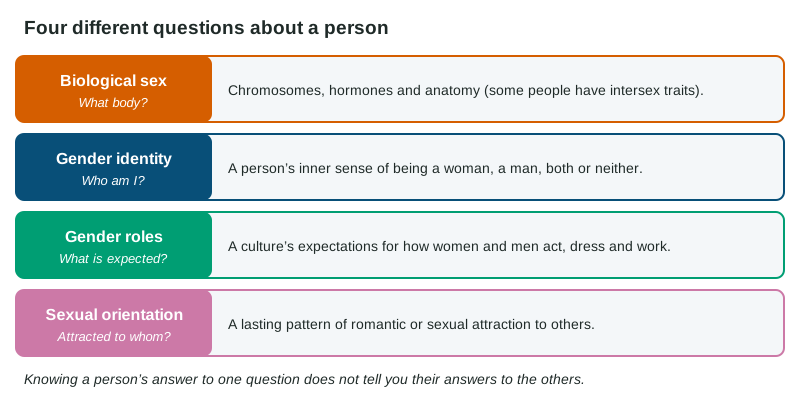
- Biological sex is about the body; gender is the set of meanings a culture attaches to being female or male, plus a person’s own sense of self.
- Gender identity is a person’s inner sense of being a woman, a man, both or neither. A transgender person’s identity differs from the sex they were assigned at birth.
- Gender roles are a culture’s expectations for women and men; gender typing is how children learn and adopt them, through adults, peers and their own mental frameworks.
- Sexual orientation is a lasting pattern of attraction. Genes and prenatal factors play a part, it is not chosen, and no way of raising a child has been found to cause it.
Part 6 · Misconception
A common mistake
The wrong idea: Sex, gender identity and sexual orientation all come as one package, so knowing one tells you the others.
What actually happens: They are separate: a person’s body, sense of self, cultural role and attractions can combine in many ways.
Part 7 · Check yourself
Check yourself
Exam-style questions. Anything you miss goes into your review queue.
Figure
Four questions about a person
1. Alex was assigned male at birth, has always known she is a girl, and lives as a woman. Which row of the figure describes "has always known she is a girl"?
- Gender identity
- Biological sex
- Gender roles
- Sexual orientation
Show the answer
Gender identity is the answer to "Who am I?" in the figure. Alex is a transgender woman.
- Correct: Gender identity: Right: a person’s inner sense of their own gender is gender identity.
- Biological sex: Biological sex is about the body (chromosomes, hormones, anatomy), not the inner sense of self.
- Gender roles: Gender roles are a culture’s expectations, not a person’s sense of who they are.
- Sexual orientation: Sexual orientation is about whom a person is attracted to, which the scenario does not mention.
2. Ryan, a man, is attracted to men. In which row of the figure does that fact belong?
- Gender identity as a man
- Gender roles
- Biological sex
- Sexual orientation
Show the answer
Sexual orientation answers "Attracted to whom?", separate from identity and sex.
- Gender identity as a man: Ryan’s sense of being a man is his gender identity; whom he is attracted to is a separate question.
- Gender roles: Gender roles describe expected behavior, not attraction.
- Biological sex: Biological sex describes the body, not attraction.
- Correct: Sexual orientation: Right: a lasting pattern of attraction to others is sexual orientation; Ryan is gay.
3. In one country, men are expected to cook for guests; in another, cooking is seen as women’s work. Which row best explains this difference?
- Sexual orientation, which sets household chores
- Gender identity, which a person picks to suit chores
- Gender roles, which a culture sets
- Biological sex, which differs between countries
Show the answer
When the same behavior is expected of different genders in different places, culture, not biology, is setting the role.
- Sexual orientation, which sets household chores: Attraction does not decide who cooks.
- Gender identity, which a person picks to suit chores: Gender identity is a deep sense of self, not a choice made to fit tasks.
- Correct: Gender roles, which a culture sets: Right: expectations for how men and women act differ across cultures and times.
- Biological sex, which differs between countries: Bodies do not differ between these countries in a way that explains cooking.
Study
Toy labels and preschoolers’ play
Introduction
Researchers asked whether telling children that a new toy is "for girls" or "for boys" changes how long they play with it.
Participants
80 children aged 4 and 5 (40 girls, 40 boys) at four preschools in one city. Parents gave informed consent, each child agreed to play, and any child could stop at any time.
Method
Each child was randomly assigned to one of two conditions. A researcher showed the child an unfamiliar toy (a set of colored gears) and said either "This is a toy for girls" or "This is a toy for boys." The child then had 20 minutes of free play in a room with the gears and other toys. A coder who did not know the condition recorded how many minutes the child played with the gears.
Results
When the gears were labeled for their own gender, children played with them for a mean of 13 minutes; when labeled for the other gender, a mean of 6 minutes. The difference was statistically significant and was similar for girls and boys.
Discussion
A single label changed play, suggesting that children use gender labels to decide what is "for me."
Invented study for practice.
4. Which research method did this study use?
- An experiment: children were randomly assigned to a label
- A correlational study, because it compared the play of girls and boys
- Naturalistic observation of play at home
- A longitudinal study of preschool play
Show the answer
Manipulation plus random assignment makes an experiment, which allows a causal claim.
- Correct: An experiment: children were randomly assigned to a label: Right: the researchers manipulated the label and randomly assigned children to it.
- A correlational study, because it compared the play of girls and boys: Girls and boys were not the conditions; the manipulated label was.
- Naturalistic observation of play at home: The play was in a set-up room after a label the researcher chose.
- A longitudinal study of preschool play: Each child was tested in one session.
5. Which concept best explains why a "for girls" label made boys play less with the gears?
- Sexual orientation, attraction to others
- Biological sex differences in skill with mechanical toys
- Puberty, the hormone changes of adolescence
- Gender typing: learning which activities suit one’s gender
Show the answer
Gender typing is acquiring a traditional gender role, including "what is for me."
- Sexual orientation, attraction to others: The study is about toy choice, not attraction.
- Biological sex differences in skill with mechanical toys: The same toy got more play when labeled for the child’s own gender, so skill did not decide it.
- Puberty, the hormone changes of adolescence: The children were 4 and 5.
- Correct: Gender typing: learning which activities suit one’s gender: Right: children had already learned to sort activities by gender and acted on the label.
6. Jordan’s parents learn their son is gay and wonder whether their parenting caused it. What does research suggest?
- Orientation is a choice made in the teen years
- Orientation is set by one gene passed down from a parent
- No way of raising a child has been found to cause it
- A distant father causes a son to be gay
Show the answer
Twin and genetic studies show genes contribute, but no single cause explains orientation, and how a child is raised has not been found to cause it.
- Orientation is a choice made in the teen years: People do not report choosing their orientation, and attempts to change it do not work.
- Orientation is set by one gene passed down from a parent: Many genes each have tiny effects, and no single gene decides orientation.
- Correct: No way of raising a child has been found to cause it: Right: studies find no link between how a child is raised and orientation; genes and prenatal factors play some role.
- A distant father causes a son to be gay: This old idea is not supported by research.
Part 8 · Summary
Summary
Part 9 · Up next
What comes next
Part 10 · Connections