Cognitive Development Across the Lifespan
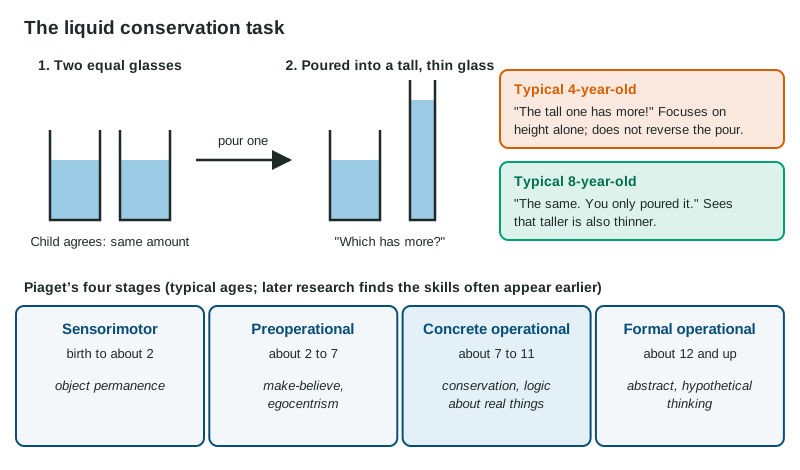
Piaget described four stages of thinking, from object permanence in infancy, through the egocentrism and failed conservation of the preschool years, to logical and then abstract thought; research supports his order more than his ages.
Part 1 · Hook
Why this matters
Part 2 · Before you start
What this builds on
Part 3 · Prerequisite check
Quick check before you start
1. A toddler calls a cat a "doggy" because it has four legs and fur. What is she doing?
- Assimilation: fitting something new into an existing schema
- Accommodation: changing a schema
- Using a heuristic
- Showing a reflex
Show the answer
She fits the cat into her existing "doggy" schema.
- Correct: Assimilation: fitting something new into an existing schema:
- Accommodation: changing a schema:
- Using a heuristic:
- Showing a reflex:
2. What does an intelligence test measure in a person compared with others of the same age?
- Mental ability relative to peers
- Personality traits
- Reaction time only
- Memories from early childhood
Show the answer
Intelligence tests compare a person’s performance with others of the same age.
- Correct: Mental ability relative to peers:
- Personality traits:
- Reaction time only:
- Memories from early childhood:
3. Which design compares different age groups at one time?
- Cross-sectional
- Longitudinal
- Case study
- Experiment
Show the answer
Cross-sectional studies test different ages at once.
- Correct: Cross-sectional:
- Longitudinal:
- Case study:
- Experiment:
Part 4 · See it
See it first
Part 5 · Step by step
How it works, step by step
- Children act on the world and meet things their schemas do not fitthey assimilate what fits and accommodate their schemas when it does not
- Infants learn through senses and actionsthey develop object permanence by about their first birthday
- Preschoolers think with symbols but focus on one feature at a timethey play make-believe, but are egocentric and fail conservation
- School-age children reason logically about concrete thingsthey conserve; by adolescence many reason about abstract and hypothetical ideas
- Support from a more skilled person targets tasks in the zone of proximal developmentchildren learn more than they could alone (Vygotsky)
Part 6 · Key ideas
Key ideas
- Piaget: children build understanding by assimilating new experiences and accommodating their schemas, moving through four stages.
- Sensorimotor (birth to about 2): object permanence. Preoperational (about 2 to 7): make-believe play, egocentrism, no conservation. Concrete operational (7 to 11): logic about real things. Formal operational (12+): abstract thought.
- Theory of mind, understanding that others have their own beliefs, usually appears around age 4 to 5.
- Vygotsky: learning happens in the zone of proximal development with scaffolding from others. In adulthood, crystallized intelligence holds or grows while fluid intelligence declines; dementia is disease, not normal aging.
Part 7 · Misconception
A common mistake
The wrong idea: A 4-year-old who says the tall glass has more juice is not paying attention.
What actually happens: She is attending closely, to the height. Preoperational thinkers focus on one feature and do not yet mentally reverse the pour, so they do not conserve.
Part 8 · Check yourself
Check yourself
Exam-style questions. Anything you miss goes into your review queue.
Study
Conservation of liquid at ages 4, 6 and 8
Introduction
Researchers asked at what age children understand that pouring water into a differently shaped glass does not change how much water there is.
Participants
90 children from three public elementary schools in one city: 30 aged 4, 30 aged 6 and 30 aged 8 (about half girls). Parents gave informed consent, each child agreed to play "a water game," and children could stop at any time. Results were reported only as group totals.
Method
Each child saw two identical short glasses with the same amount of water and agreed they held the same amount. While the child watched, the researcher poured one glass into a tall, thin glass and asked, "Is there more water in this glass, more in that glass, or the same in both?" A child passed the task by saying "the same" and giving a reason, such as "You only poured it." Each child was tested once.
Results
The percentage of children who passed rose with age: 10% at age 4, 40% at 6 and 87% at 8. Most children who failed said the tall glass had more water.
Discussion
Understanding of conservation grew sharply between 4 and 8, but there was wide variation within each age group.
Invented study for practice.
1. Which research design did this study use?
- A cross-sectional study comparing age groups at one time
- A longitudinal study, following the same children from 4 to 8
- An experiment, randomly assigning children to ages 4, 6 and 8
- A case study of one child’s thinking
Show the answer
Different people of different ages, tested at the same time, is a cross-sectional design.
- Correct: A cross-sectional study comparing age groups at one time: Right: three groups of different ages were each tested once.
- A longitudinal study, following the same children from 4 to 8: Each child was tested once; the age groups were different children.
- An experiment, randomly assigning children to ages 4, 6 and 8: Age cannot be randomly assigned.
- A case study of one child’s thinking: The study tested 90 children on the same task.
2. Most 4-year-olds said the tall glass held more water. In Piaget’s terms, why?
- They lack object permanence and forget the poured water exists
- They are formal operational and reason about hypotheses
- They have no theory of mind about the researcher
- They are preoperational: they focus on height alone
Show the answer
Conservation, the idea that amount stays the same when shape changes, marks the move from preoperational to concrete operational thought.
- They lack object permanence and forget the poured water exists: They watched the water and talked about it, so they know it exists.
- They are formal operational and reason about hypotheses: Formal operational thinking comes around adolescence and would conserve easily.
- They have no theory of mind about the researcher: The task asks about amounts of water, not about what another person thinks.
- Correct: They are preoperational: they focus on height alone: Right: preoperational children center on one feature and do not yet conserve.
3. There were 30 children in the age-6 group. How many of them passed the task?
Type a number. No calculator needed: work it out by hand, as on the exam.
Show the answer
40% of 30 is children.
- Answer: 12
4. What do the results in the graph show?
- The biggest jump came between ages 4 and 6
- Passing rose with age, most between 6 and 8
- Most 8-year-olds failed the task
- The share of children who passed fell as age went up
Show the answer
Compare the differences between bars: 30 points, then 47.
- The biggest jump came between ages 4 and 6: That rise is 30 points; the rise from 6 to 8 is 47 points.
- Correct: Passing rose with age, most between 6 and 8: Right: 10% to 40% is a 30-point rise; 40% to 87% is a 47-point rise.
- Most 8-year-olds failed the task: 87% of 8-year-olds passed, so most succeeded.
- The share of children who passed fell as age went up: The bars rise from 10% to 87%.
5. Maria can do long division only when her tutor breaks each problem into steps and gives hints; without help she gets stuck. In Vygotsky’s terms, what are long-division problems for Maria right now?
- In her zone of proximal development, with scaffolding
- Beyond her ability, so she is not ready to learn them
- A sign she is still in the sensorimotor stage
- Something she has mastered on her own
Show the answer
Vygotsky stressed that learning moves forward through guided help from more skilled people.
- Correct: In her zone of proximal development, with scaffolding: Right: tasks she can do with help but not alone are in her ZPD, and support that is later removed is scaffolding.
- Beyond her ability, so she is not ready to learn them: She can do them with help, which is exactly where Vygotsky said learning happens.
- A sign she is still in the sensorimotor stage: Long division is far beyond infancy; this is about social support, not Piaget’s stages.
- Something she has mastered on her own: She cannot yet do them without help.
6. A puppet named Sally puts a ball in a basket and leaves. Anne moves it to a box. A child is asked where Sally will look for the ball. Most 3-year-olds say "the box"; most 5-year-olds say "the basket." What has the older child developed?
- Object permanence: knowing the ball still exists
- Conservation: knowing amounts stay the same
- Crystallized intelligence: stored knowledge
- Theory of mind: others can hold false beliefs
Show the answer
Passing a false-belief task is a classic sign of theory of mind, typically around age 4 to 5.
- Object permanence: knowing the ball still exists: Both ages know the ball exists; the difference is understanding Sally’s belief.
- Conservation: knowing amounts stay the same: Nothing changed shape or amount.
- Crystallized intelligence: stored knowledge: This is a skill of reading minds, not stored facts.
- Correct: Theory of mind: others can hold false beliefs: Right: the 5-year-old knows Sally did not see the move and so believes something untrue.
7. Ruth, 80, forgets where she put her glasses and needs longer to learn a new phone. Her neighbor, 78, gets lost on his daily walk and no longer recognizes his son. Which comparison is most accurate?
- Both show normal aging, which includes not recognizing family
- Ruth shows dementia because she is older than her neighbor
- Ruth: normal aging; her neighbor: likely dementia
- Both show dementia, which is a normal part of aging
Show the answer
Dementia is a decline in memory and thinking severe enough to disrupt daily life, most often from Alzheimer’s disease.
- Both show normal aging, which includes not recognizing family: Failing to recognize close family is not normal aging.
- Ruth shows dementia because she is older than her neighbor: Age alone does not make a diagnosis; the kind of change matters.
- Correct: Ruth: normal aging; her neighbor: likely dementia: Right: mild slowing is normal; losing the way home and failing to recognize family point to disease.
- Both show dementia, which is a normal part of aging: Dementia is caused by disease and is not a normal part of aging.
Part 9 · Summary
Summary
Part 10 · Up next
What comes next
Part 11 · Connections