Communication and Language Development
Language has layers, from phonemes to morphemes to words, organized by grammar: semantics for meaning and syntax for order.
Part 1 · Hook
Why this matters
Part 2 · Prerequisite check
Quick check before you start
1. What is a sensitive period?
- A window when learning is easiest, though still possible later
- A window that must not be missed
- A substance that harms development before birth
- A reflex present at birth
Show the answer
Learning is easiest during a sensitive period but still possible later.
- Correct: A window when learning is easiest, though still possible later:
- A window that must not be missed:
- A substance that harms development before birth:
- A reflex present at birth:
2. A toddler fits a new animal into her "doggy" category. What is this?
- Assimilation
- Accommodation
- Conservation
- Object permanence
Show the answer
Fitting the new into an existing schema is assimilation.
- Correct: Assimilation:
- Accommodation:
- Conservation:
- Object permanence:
Part 3 · See it
See it first
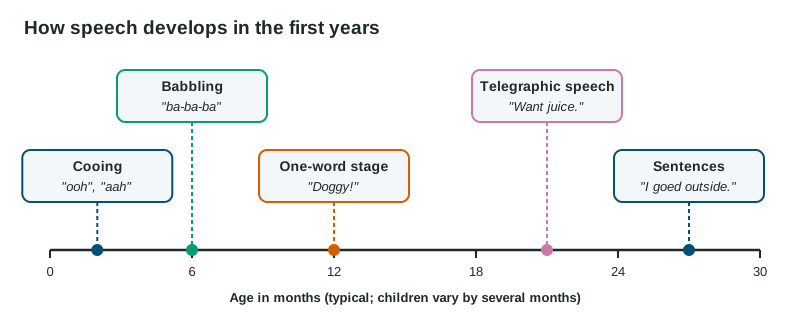
Part 4 · Step by step
How it works, step by step
- Babies hear the speech around themby about their first birthday they tune in to the phonemes of their own language
- Cooing gives way to babbling around 6 monthsbabbling comes to sound like the home language
- Around 12 months, single words carry whole ideasby about 2, children combine key words in telegraphic speech
- Children work out grammar rules from what they hearthey overgeneralize rules ("goed") and generate sentences they never heard
Part 5 · Key ideas
Key ideas
- Language is built in layers: phonemes (sounds) form morphemes (units of meaning), which form words; grammar includes semantics (meaning) and syntax (word order).
- Language is generative: a limited set of rules can produce an unlimited number of new sentences.
- The sequence: cooing (about 2 months), babbling (about 6 months), the one-word stage (about 12 months), telegraphic speech (about 18 to 24 months), then full sentences.
- Overgeneralization ("goed," "mouses") shows a child has learned a rule and applies it too widely.
Part 6 · Misconception
A common mistake
The wrong idea: Children learn to talk by copying the exact sentences they hear.
What actually happens: Children work out rules. That is why they say things adults never say, such as "goed" and "mouses," and why they can create new sentences.
Part 7 · Check yourself
Check yourself
Exam-style questions. Anything you miss goes into your review queue.
Figure
Milestones of early speech
1. A 6-month-old says "ba-ba-ba, da-da-da" while playing alone. Which milestone in the figure is this?
- Babbling
- Cooing
- The one-word stage
- Telegraphic speech
Show the answer
Babbling begins around 6 months and gradually takes on the sounds of the home language.
- Correct: Babbling: Right: repeated consonant-vowel syllables, made in play, are babbling.
- Cooing: Cooing is vowel-like sounds such as "ooh," which come earlier, around 2 months.
- The one-word stage: Repeating syllables in play is not using a word to mean something.
- Telegraphic speech: Telegraphic speech combines two or more words.
2. A 13-month-old points at the door and says "Out!" meaning "I want to go outside." Which stage does this show?
- Telegraphic speech
- Babbling
- Overgeneralization
- The one-word stage
Show the answer
Around the first birthday, children use single words that carry a sentence of meaning.
- Telegraphic speech: Telegraphic speech uses two or more words, such as "Go out."
- Babbling: Babbling is syllables made in play, without meaning.
- Overgeneralization: Overgeneralization is applying a grammar rule where it does not fit.
- Correct: The one-word stage: Right: a single word stands for a whole idea.
3. A 2-year-old says "Daddy go car." Which stage is this, and what does it show?
- Babbling: sounds without meaning
- Cooing: vowel-like sounds
- Telegraphic speech: key words in order
- The one-word stage: one word stands for a whole idea
Show the answer
Telegraphic speech follows the word order (syntax) of the language even though it leaves out small words.
- Babbling: sounds without meaning: Each word has a clear meaning.
- Cooing: vowel-like sounds: Cooing comes in the first months and has no words.
- Correct: Telegraphic speech: key words in order: Right: like a telegram, it keeps content words in order and drops "is," "in" and "the."
- The one-word stage: one word stands for a whole idea: The child uses three words.
4. Near the end of the timeline, a child says "I goed outside" and "I saw two mouses." What do these errors show?
- Babbling: sounds without meaning
- Overgeneralization of grammar rules
- That the child is copying adults’ words exactly
- Telegraphic speech: leaving out small words
Show the answer
These errors are a good sign: the child has learned a rule and is using it.
- Babbling: sounds without meaning: The words have clear meanings.
- Correct: Overgeneralization of grammar rules: Right: the child applies the "-ed" and "-s" rules to irregular words.
- That the child is copying adults’ words exactly: Adults do not say "goed," so the child is using a rule, not copying.
- Telegraphic speech: leaving out small words: Nothing is left out; a rule is applied too widely.
5. "The dog bit the man" and "The man bit the dog" use the same words but mean different things. Which part of grammar explains this?
- Cooing, an early infant sound
- Syntax, the rules for word order
- Phonemes, the smallest sound units
- Morphemes, the smallest units of meaning
Show the answer
Grammar includes semantics (meaning) and syntax (order); here the order carries the meaning.
- Cooing, an early infant sound: Cooing is a stage of infancy.
- Correct: Syntax, the rules for word order: Right: changing the order changed who did what.
- Phonemes, the smallest sound units: The sounds are the same; the order differs.
- Morphemes, the smallest units of meaning: Both sentences have the same morphemes.
6. A 4-year-old says, "The zorp is snoozling on the blicket," a sentence nobody has ever said to her. What does this show about language?
- Generativity: rules create new sentences
- Telegraphic speech: leaving out small words
- That she is copying a sentence she heard on TV
- The one-word stage
Show the answer
Generativity is the ability to produce and understand an unlimited number of new sentences.
- Correct: Generativity: rules create new sentences: Right: she combined words with grammar rules to make a sentence she never heard.
- Telegraphic speech: leaving out small words: Her sentence includes "is," "on" and "the."
- That she is copying a sentence she heard on TV: No one has said it to her.
- The one-word stage: She used a full sentence.
Part 8 · Summary
Summary
Part 9 · Up next
What comes next
Part 10 · Connections