Social-Emotional Development Across the Lifespan
Social and emotional development happens inside nested systems, from family to culture.
Part 1 · Hook
Why this matters
Part 2 · Before you start
What this builds on
Part 3 · Prerequisite check
Quick check before you start
1. Which design follows the same people over time?
- Longitudinal
- Cross-sectional
- Case study
- Experiment
Show the answer
A longitudinal study retests the same people.
- Correct: Longitudinal:
- Cross-sectional:
- Case study:
- Experiment:
2. What is egocentrism in Piaget’s theory?
- Difficulty taking another person’s point of view
- Selfishness
- Knowing objects still exist when hidden
- Reasoning about hypothetical ideas
Show the answer
It means seeing the world only from one’s own perspective.
- Correct: Difficulty taking another person’s point of view:
- Selfishness:
- Knowing objects still exist when hidden:
- Reasoning about hypothetical ideas:
3. What is imprinting?
- A young animal’s bond with the first moving object it sees, in a critical period
- A reflex present at birth
- A teratogen
- A sensitive period for accents
Show the answer
Imprinting forms in a narrow early window.
- Correct: A young animal’s bond with the first moving object it sees, in a critical period:
- A reflex present at birth:
- A teratogen:
- A sensitive period for accents:
Part 4 · See it
See it first
Part 5 · Step by step
How it works, step by step
- Warm, responsive care and comforting touch meet an infant’s needsa secure attachment forms, and the child uses the caregiver as a base to explore
- A child’s temperament and the parents’ style shape each otherwarm, firm (authoritative) parenting is linked with better outcomes, though not as a simple cause
- Each life stage brings a new social task (Erikson)meeting it builds strengths such as trust, identity and intimacy
- Teens explore and commit to values and goalsthey move through identity statuses, with the imaginary audience and personal fable along the way
- Adverse childhood experiences pile upaverage health risks rise, while supportive relationships help many children do well
Part 6 · Key ideas
Key ideas
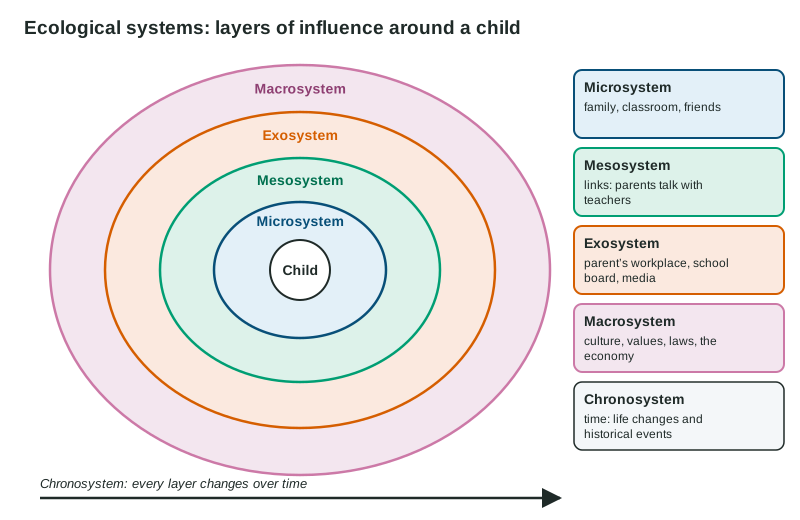
- Ecological systems theory: a child develops inside nested layers (micro, meso, exo, macro), all changing over time (chrono).
- Attachment grows from contact comfort and responsive care. In the strange situation, babies are secure, avoidant, anxious or disorganized; separation anxiety appears around 8 months.
- Parenting styles: authoritative (warm and firm), authoritarian (strict, cold), permissive (warm, few limits). The links to outcomes are correlational and vary by culture; temperament shapes parenting too.
- Erikson’s eight psychosocial stages run from trust versus mistrust to integrity versus despair. Teens explore identity status and possible selves; adults face the social clock and, in many countries, emerging adulthood.
Part 7 · Misconception
A common mistake
The wrong idea: Babies love their parents mainly because their parents feed them.
What actually happens: Harlow’s monkeys clung to a soft cloth mother that gave no milk. Comfort and responsive care, not food alone, build attachment.
Part 8 · Check yourself
Check yourself
Exam-style questions. Anything you miss goes into your review queue.
Study
Cloth and wire mothers
Introduction
In the 1950s, many psychologists believed infants bond with their mothers mainly because mothers feed them. Harry Harlow tested this idea with infant rhesus monkeys.
Participants
Infant rhesus monkeys separated from their mothers shortly after birth and raised in a laboratory.
Method
Each infant’s cage held two artificial "mothers": one made of bare wire and one covered in soft terry cloth. For some infants, only the wire mother held a milk bottle; for others, only the cloth mother did. Researchers recorded how much time each infant spent on each mother and where it ran when frightened by a noisy mechanical toy.
Results
Infants spent most of each day clinging to the cloth mother, even when only the wire mother gave milk; they went to the wire mother only to feed. When frightened, they ran to the cloth mother and, after clinging to it, began to explore.
Discussion
Comfort from soft touch, not feeding alone, drove the bond. Monkeys raised with no real mother later showed lasting problems with social behavior and parenting. These studies caused serious, lasting harm to the animals and are widely criticized today; current animal-care rules would not allow them.
1. The infant monkeys clung to the cloth mother even when the wire mother held the milk. Which concept does this result support?
- Contact comfort as a basis of attachment
- Imprinting on the first moving object
- Feeding as the main source of the infant’s bond
- Egocentrism in infant monkeys
Show the answer
Harlow’s results challenged the idea that infants bond because they are fed.
- Correct: Contact comfort as a basis of attachment: Right: soft touch, not food, drew the infants to the cloth mother.
- Imprinting on the first moving object: Neither artificial mother moved; the infants chose comfort.
- Feeding as the main source of the infant’s bond: The infants left the wire mother as soon as they had fed, so food was not what bonded them.
- Egocentrism in infant monkeys: Egocentrism is about taking another’s point of view.
2. Frightened infants ran to the cloth mother, clung to it and then began to explore. In human attachment research, what does the cloth mother act as?
- A source of separation anxiety for the infant
- An example of permissive parenting
- An example of parallel play
- A secure base from which to explore
Show the answer
Secure attachment lets a child explore because comfort is available when needed.
- A source of separation anxiety for the infant: Separation anxiety is distress when the caregiver leaves, not comfort when present.
- An example of permissive parenting: Parenting styles describe how parents set rules and show warmth, not a cloth figure.
- An example of parallel play: Parallel play is children playing side by side.
- Correct: A secure base from which to explore: Right: a securely attached child uses the caregiver as a base, returning for comfort and then venturing out.
Data
Attachment classifications in a strange situation study
Researchers observed 50 one-year-olds in the strange situation, a series of short separations from and reunions with a parent in an unfamiliar playroom, and classified each child’s attachment.
3. In the study, one baby barely reacts when her mother leaves and looks away when she returns. Which bar does she belong to?
- Secure
- Anxious
- Disorganized
- Avoidant
Show the answer
The reunion is the key moment for classifying attachment.
- Secure: A secure baby may be upset when the parent leaves and seeks comfort at reunion, then calms.
- Anxious: An anxious baby is very upset at separation and both clings and resists at reunion.
- Disorganized: A disorganized baby shows confused or contradictory behavior, such as freezing or approaching while looking away.
- Correct: Avoidant: Right: little distress at separation and turning away at reunion mark avoidant attachment.
4. Another baby screams when his father leaves. When the father returns, the baby reaches to be held, then kicks and pushes away, and is hard to calm. Which classification fits?
- Avoidant attachment
- Separation anxiety alone, with no attachment
- Anxious attachment
- Secure attachment
Show the answer
Anxious babies want comfort but cannot easily be soothed by it.
- Avoidant attachment: An avoidant baby shows little distress and ignores the parent at reunion.
- Separation anxiety alone, with no attachment: Distress at separation shows an attachment exists; the reunion shows what kind.
- Correct: Anxious attachment: Right: intense distress and a mix of clinging and resisting at reunion mark anxious (ambivalent) attachment.
- Secure attachment: A secure baby is comforted by the parent’s return and goes back to playing.
5. Owen’s parents tell him, "Because I said so," when he asks why he has a 7 p.m. curfew. They give harsh penalties for breaking rules and seldom show affection. Which style is this?
- Authoritative
- Permissive
- Avoidant
- Authoritarian
Show the answer
The names are close: authoritarian is the strict, cold style; authoritative is the warm, firm one.
- Authoritative: Authoritative parents explain their rules and are warm.
- Permissive: Permissive parents set few rules.
- Avoidant: Avoidant is an attachment classification of a child, not a parenting style.
- Correct: Authoritarian: Right: strict rules, no explanations and little warmth.
6. Studies in the United States link authoritative parenting with higher grades and more social skill. Which conclusion is best supported?
- Parenting style has no relationship with grades
- Children with high grades cause their parents to be strict
- A correlation; child traits and culture may also explain it
- Authoritative parenting causes higher grades across cultures
Show the answer
Correlation is not causation, and influence runs both ways between parents and children.
- Parenting style has no relationship with grades: A relationship was found.
- Children with high grades cause their parents to be strict: Children can influence parents, but this reverses the finding.
- Correct: A correlation; child traits and culture may also explain it: Right: these are correlational findings; easygoing children may draw out warm, reasoned parenting, and effects differ across cultures.
- Authoritative parenting causes higher grades across cultures: The studies are correlational, and the pattern varies across cultures.
7. Zoe, 14, will not go to school because of a small pimple, sure that everyone will stare at it all day. Which concept explains her worry?
- The imaginary audience
- The personal fable
- Identity foreclosure
- The social clock
Show the answer
The imaginary audience and personal fable describe a kind of teenage egocentrism.
- Correct: The imaginary audience: Right: teens often feel that others are watching and judging them far more than they are.
- The personal fable: The personal fable is believing one is unique or invulnerable, not that others are watching.
- Identity foreclosure: This is about commitment to a path without exploring.
- The social clock: The social clock is about when life events are expected to happen.
Part 9 · Summary
Summary
If you are struggling, you are not alone. In the US, call or text 988 (the Suicide and Crisis Lifeline), or talk to a trusted adult.
Part 10 · Up next
What comes next
Part 11 · Connections