
Your body changes more in your first two years than in any two years after, and it keeps changing until the end of life. The exam asks you to match a situation to the right idea: a substance harming a baby before birth, a newborn's reflex, a window when an experience matters most, or a change of puberty or later adulthood.
Before birth: teratogens
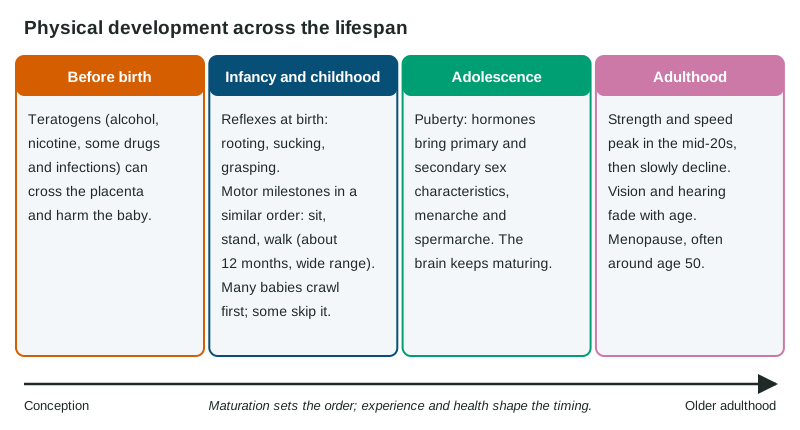
During prenatal development, the baby gets oxygen and nutrients from the mother's blood through the placenta. Some harmful substances get through too. A teratogen is anything that can harm development before birth: alcohol, nicotine, some medicines and illegal drugs, and infections such as rubella or Zika. The harm depends on the dose and on timing, since organs form at different times.
Alcohol is the best-known example. Heavy drinking in pregnancy can cause fetal alcohol spectrum disorders, with a smaller head, distinctive facial features, and lasting problems with learning and attention. Health agencies say no amount of alcohol in pregnancy is known to be safe. Smoking is linked to lower birth weight and early birth.
Newborns: reflexes and the visual cliff
Newborns arrive with reflexes, automatic responses that help them survive. Stroke a newborn's cheek and she turns toward the touch and opens her mouth: the rooting reflex, which helps her find the breast or bottle. She also sucks whatever touches her lips and grips a finger placed in her palm. Most of these reflexes fade over the first months as the brain matures.
Can babies see depth? Gibson and Walk (1960) built a visual cliff: a glass table with a checkered pattern right under the glass on one side and far below it on the other. Of 27 crawling babies (6 to 14 months old) who moved off the center board, only 3 crept onto the deep side, even when their mothers called. Most crawling babies perceive depth. The study cannot say depth perception is present at birth, though, because the babies had to be old enough to crawl. Later studies found that babies with more crawling experience are more wary of the drop, so experience matters along with maturation.
Motor development: order and timing
Maturation is growth that unfolds on a largely genetic timetable. It is why motor development follows a similar order in most babies: roll over, sit, stand with support, then walk. Many babies crawl before walking; some skip crawling. The order is more predictable than the age. Healthy babies take their first steps anywhere from about 9 to 17 months, and walking age in that range does not predict later intelligence. Practice cannot make a baby walk before the nervous system and muscles are ready, but culture and experience can shift timing a little.
Worked example: a typical walker. Five babies first walked at 9, 11, 11, 12 and 17 months (invented data).
Mean:
What it shows: the late walker at 17 months pulls the mean up, so the median, 11 months, describes the typical baby better.
Critical and sensitive periods
Timing matters. A critical period is a window when a specific experience is needed for normal development. Newly hatched goslings follow the first moving thing they see and bond with it, a process called imprinting. If they see nothing moving in the first days, the bond does not form later. In people, a child born with a cataract that blocks one eye's view can have lasting vision loss in that eye if it is not treated early, because the brain's visual pathways need input in the first years.
A sensitive period is softer: a window when learning is easiest, though still possible later. Children who learn a second language young usually speak it without an accent; adults who learn it later can become fluent but often keep an accent.
| Critical period | Sensitive period | |
|---|---|---|
| If the window is missed | the ability may not develop normally | learning is harder but still possible |
| Example | imprinting in geese; early input for vision | an accent-free second language |
Adolescence and puberty
Adolescence runs from the start of puberty to adult independence. During puberty, rising sex hormones bring two kinds of change. Primary sex characteristics are the reproductive organs (ovaries, uterus, testes, penis), which mature so that reproduction becomes possible. Secondary sex characteristics are other sex-related traits: breasts and wider hips, a deeper voice, and body and facial hair. Two milestones mark puberty: menarche, the first menstrual period (around 12 in the United States), and spermarche, the first ejaculation (around 13 to 14). Timing varies by several years between healthy teens.
The brain is still changing. Unused connections are pruned and pathways become faster. Areas tied to emotion and reward respond strongly in the teen years, while the prefrontal cortex, which helps with planning and self-control, keeps maturing into the early to mid 20s. That gap helps explain why a teen who knows the risks may still take them, especially with friends watching.
Adulthood and aging
Strength, speed and stamina peak in the 20s and decline slowly after. With age, the lens of the eye stiffens and clouds, so reading needs more light; hearing for high pitches fades; and reaction time slows. Menopause, when menstruation stops for good, usually comes around 50. Men's fertility declines more gradually. These are normal changes, not illness, and exercise, health and practice slow many of them. Well-practiced skills and knowledge stay strong, and the brain stays able to rewire itself throughout life.